
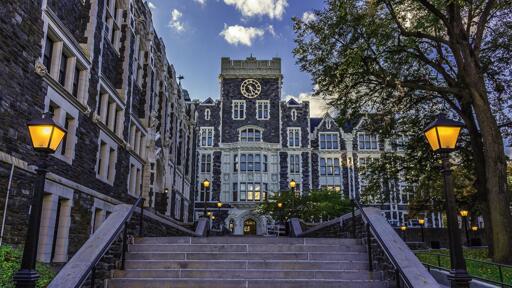
Last spring, a budget hearing for the City University of New York (CUNY) system in New York City revealed that an estimated 8,000 students were homeless in the last year. With approximately 20 percent of students reporting some kind of housing insecurity, ranging from difficulty paying rent to the more extreme danger of being unhoused, it is clear that students need serious material assistance. This is particularly startling in New York, where the CUNY system lauds itself as an institution accessible to the working class.
These dynamics are reflected nationwide. In 2020, more than 1.5 million students experienced homelessness across the country, with around 42 percent living at or below the federal poverty line. Like most material hazards, more marginalized demographics, like people of color and women, experience these difficulties more acutely.
This phenomenon should also be understood as part of a broader affordability crisis, where the average cost of tuition, including at public universities, has skyrocketed by over 175 percent in the last 20 years. The cost of rent, on average, has doubled, while inflation-adjusted wages have grown at 10 to 20 percent less than worker productivity. Students are also expected to weather these hardships while U.S. taxpayer dollars are spent on imperialist war against Iran, recruitment for ICE, and insulating an ever more detached and opulent bourgeoisie.

The hazards of pursuing higher education for working-class people show that equal opportunity is a class-based myth. While it is true that anyone can theoretically pursue whatever kind of education and corresponding career that they choose (even though the One Big Beautiful Bill restricted the availability of loans for certain programs), the material ability to complete these degrees is uncertain for low-income and working-class students.
This is one of the ways the bourgeoisie enshrines and reproduces itself, creating a symbiotic relationship between the ruling class and academia. Universities legitimize the wealthy, insulating successive generations of bourgeois leadership with prestige. These leaders, in turn, fund the universities and link them to sectors of the bourgeoisie. In the past, it was understood that higher learning bore with it a deterministic social character, that it was the privilege of the wealthy and the powerful, but modern liberal republics promote a mythology of equal opportunity, and access to higher learning as a ladder of upward social mobility was a pillar of the Post-War Order.
When thousands of working-class students experience homelessness while pursuing secondary education, it is disgustingly disingenuous to say that any equality of opportunity exists. While CUNY still ranks relatively high in terms of social mobility, this is still part of a downward trend overall, especially given that tuition used to be free and higher levels of certification are increasingly necessary for advancement.
“The experiment is to be tried, whether the children of the people — the children of the whole people — can be educated; and whether an institution of learning of the highest grade can be successfully controlled by the popular will, not the privileged few but by the privileged many.” These words from Horace Webster, president of the Free Academy, which preceded the CUNY system, speak to an idea that everyone involved with CUNY is familiar with, but which doesn’t represent the material reality. If CUNY truly wants to educate “the children of the whole people,” then why is it patting itself on the back for being half the cost of the national university average when half the nation’s students live in poverty?
This “affordable” tuition, while far more accessible than other colleges, is not affordable enough to someone making minimum wage. Initiatives like the New York State Tuition Assistance Program, which provides non-repayable tuition grants to low-income students, have income thresholds lower than a full-time minimum wage income. This demonstrates a common frustration working-class students experience: being too poor to fund their studies, but evidently not poor enough to qualify for what assistance does exist.
The descent from the lofty liberal platitudes that sparkled on the newborn CUNY only highlights the sharp contradictions of today. Late-nineteenth- and early-twentieth-century planners excitedly proclaimed that quality education, made available to the whole population for free, would provide a way for the poor to ascend to an expanding middle class. Now that promise is systematically out of reach.
Higher education is not considered a right in the United States, but rather a commodity to be sold for profit. The barrier created by tuition alone is often enough to deter working-class, poor, and otherwise marginalized young people from pursuing education, but even if they can manage that, education can exacerbate their precarity. Forced to reduce their working hours, forego workplace advancement, or take less secure work in general, the basics of food, health, and shelter often fall by the wayside in pursuit of something that is understood to be a personal and social good. Add to that areas of study that require labs or field work, which tend to be the more lucrative career tracks that are emphasized, or the dilemma of having a handful of classes left to take that happen to only be scheduled when a student has to work.
Young people are taught that a secondary education is basically an essential component of social upward mobility in contemporary America, and yet society seems engineered to deter the working class from attaining it. Those who can weather the material hazards might find that a bachelor’s degree increasingly does not guarantee the security that it used to.
Various progressive slogans surround higher learning, ranging from canceling student debt to making state schools and technical programs free, but these slogans are not enough. With thousands of CUNY students living without secure housing, we should go beyond trying to convince rich people and reactionaries of progressive reforms, and instead raise demands for a revolutionary program for the university.
We can and must fight to preserve and expand the democratic rights we have, but we have to do so with a transitional strategy. Free tuition and student debt relief? Students should be paid to attend school, freeing them to focus on learning, engaging, and bringing forth the next great waves of thought. Disclosure and divestment from imperialism? The decisions and budgets of universities should be made democratically by students and workers, in direct defiance of the capitalist state.
The university should be the laboratory of a new society, where students and faculty reject the social arrangements of capitalism and reorganize based on meeting human needs, like housing for all. More urgently, the academy provides a battleground to raise the democratic demand for full rights for immigrants, where a collaborative environment of education can protect the students and faculty that make it vibrant. We must not be shackled by bureaucratic conservatism and compromise. Instead, we should tie the needs of the most vulnerable to our demands for a university under student and worker control, and treat this as part of a direct challenge to capitalism.
The post Dangling from the Ivory Tower at CUNY: Higher Education Under Capitalism appeared first on Left Voice.
From Left Voice via This RSS Feed.
Higher education is not considered a right in the United States, but rather a commodity to be sold for profit. The barrier created by tuition alone is often enough to deter working-class, poor, and otherwise marginalized young people from pursuing education, but even if they can manage that, education can exacerbate their precarity. Forced to reduce their working hours, forego workplace advancement, or take less secure work in general, the basics of food, health, and shelter often fall by the wayside in pursuit of something that is understood to be a personal and social good. Add to that areas of study that require labs or field work, which tend to be the more lucrative career tracks that are emphasized, or the dilemma of having a handful of classes left to take that happen to only be scheduled when a student has to work.
Young people are taught that a secondary education is basically an essential component of social upward mobility in contemporary America, and yet society seems engineered to deter the working class from attaining it. Those who can weather the material hazards might find that a bachelor’s degree increasingly does not guarantee the security that it used to.