When almost 200 countries endorsed the Paris Agreement in 2015, they agreed to a massive transfer of money between the world’s largest carbon emitters and the poor countries on the front lines of climate change. The accord promised that developed countries would begin “mobilizing climate finance” in “a progression beyond previous efforts,” with a focus on “public and grant-based resources” as opposed to loans that poor countries would have to pay back. This money would help develop clean energy projects like solar and wind farms as well as sea walls, water wells, and other projects that could help the Global South adapt to extreme weather. For countries already facing down climate disasters, it would pay to help them recover from the “loss and damage” caused by these events.
The reality has been a lot uglier. These promises were always voluntary, or at least impossible to enforce, and rich countries have failed to meet most of their obligations. They have provided most clean energy finance through loans, which have strained the budgets of many poor countries. They have failed to cut their own emissions fast enough to slow down global warming, which has increased the cost of adapting to a warmer world. They have failed to provide money for that adaptation, which has increased the scale of “loss and damage.” And they have failed to provide money for loss and damage, which has forced developing countries to spend their own money on recovery from extreme weather.
In recent years this financial failure has all but derailed the United Nations climate process, in which countries try to achieve global decisions based on universal consensus. Developing countries say they can’t ditch fossil fuels without much more money, while rich countries say they can’t go beyond their current commitment to provide $300 billion a year in climate finance by 2035.
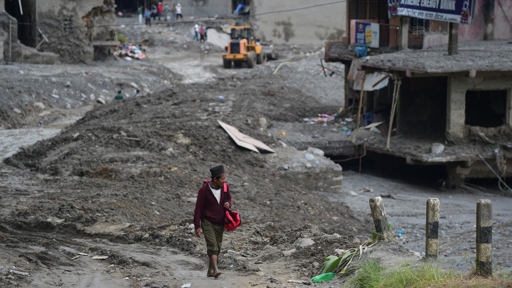
It was against this backdrop that leaders from Nepal arrived at COP31, this year’s U.N. climate meeting or “conference of the parties” in Antalya, Turkey. Just three months ago, a glacial collapse in the Himalayas caused massive flooding in Nepal’s Bhotekoshi region, leaving more than 1,400 dead and another 5,000 missing. Initial scientific studies have concluded that global warming likely contributed to the weakening of the glacier and the melting of permafrost that triggered the catastrophic avalanche. The estimated cost of rebuilding exceeds $4.8 billion, or around 10 percent of the country’s gross domestic product, but the world has pledged only a few hundred million in aid. Nepal hoped that other countries would provide more relief money at COP31.
Two weeks later, Nepal left Antalya no better off than when it arrived. Not only did rich countries fail to provide any additional assistance to the ravaged country, they declined to deliver almost any new disaster aid. One European negotiator said even before the conference began that such an idea was “dead in the water.” Nepali negotiators also hoped to win global support for less expensive interventions, like glacial melt detection systems and a dedicated forum to research mountain climate risks. Yet these items also failed to secure consensus amid a collapse in talks at the summit, which was only the second in 20 years to conclude without a final overarching agreement.
Leaders and experts from Nepal and other mountain countries said the failure to deliver for Nepal reflects fundamental problems with the U.N. process.
“We left with empty hands,” said Dharam Uprety, a Nepali climate scientist who serves as the head of the country’s disaster response agency. “In the past, I used to be very optimistic, but I’m very pessimistic about the COPs. Without any adequate outcomes, it’s just a waste of money.”
The U.N. has a vehicle for dealing with catastrophes like the one in Nepal — the “Fund for Responding to Loss and Damage,” which rich nations agreed to establish in 2022 after years of pressure from developing countries to fulfill the promise of the Paris Agreement. This commitment to climate reparations was hailed as a breakthrough at the time, but it has taken years for the fund to establish bylaws and procedures for disbursing money. When the Nepal floods hit in August, the fund had just finished taking applications for its first-ever grants, and it was months away from actually sending out any checks.
The catastrophe in Nepal was an early test of the fund’s relevance. Even as the fund’s board considered this first round of applications, Nepal submitted an emergency request for recovery money, saying that it couldn’t wait for ordinary bureaucracy to take its course; a number of leaders from other developing countries endorsed this request. The board met for an “extraordinary meeting” in October and allocated Nepal $20 million plus administrative costs, less than half a percent of the cost of rebuilding. Even this emergency funding will take months to arrive — before it can get money, Nepal still has to submit an application saying what it plans to spend the money on. It’s unclear if it will be able to get any more money from the fund down the road.
“If we can’t respond to the urgency, then [the process] is obviously not healthy,” said Manjeet Dhakal, a Nepali climate negotiator who advises the chair of the Least Developed Countries, a bloc of developing nations. “The scale of the resources — and also the way of doing business, if a country has to wait for two months to get resources — is not fit for purpose.”
Dhakal said that while emergency donations from Nepal’s neighboring countries helped with immediate rescues and debris clearance, the money from the U.N. fund will support reconstruction of destroyed buildings — although it will cover only a tiny fraction of the more than 7,000 ruined structures. Nepal’s own finances are so thin that it has turned to crowdfunding to help close the gap.
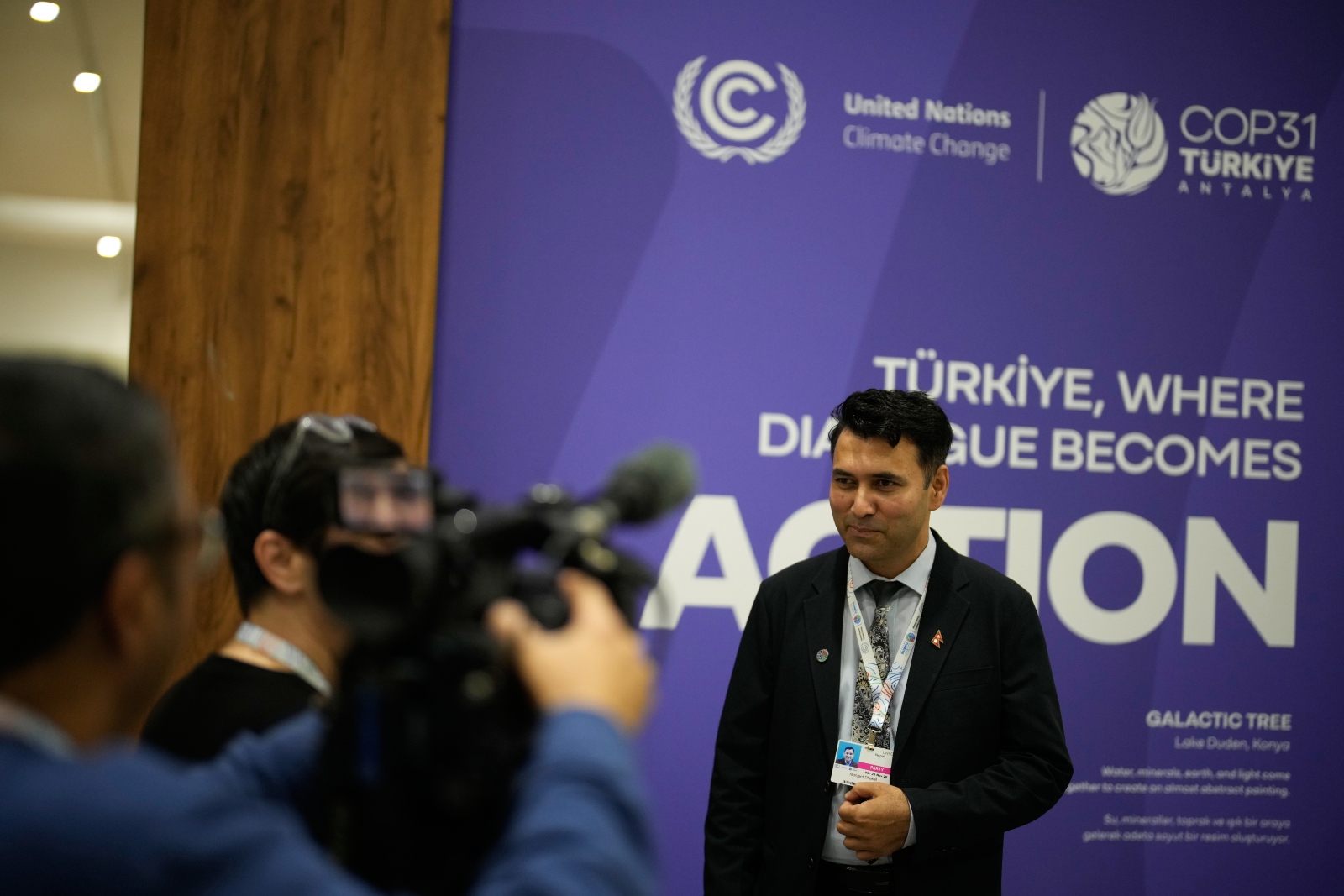
Manjeet Dhakal, a Nepali climate negotiator who advises the Least Developed Countries bloc, speaks to members of the media at COP31. Nepal’s delegation sought aid money from rich nations to recover from a glacial collapse earlier this year. AP Photo / Khalil Hamra
A bigger problem than the sluggish response time is that the fund is small and seems unlikely to grow. It has received only $800 million in donations, almost all of them coming in when it first launched. It competes for dollars with other U.N. climate accounts like the Green Climate Fund, an all-purpose decarbonization program; that fund has received dozens of times more money than the Loss and Damage Fund, but it’s underfunded as well. The countries that have historically contributed the most climate aid, like the United States and the United Kingdom, are either absent from the U.N. or dealing with fiscal constraints of their own. Even though the Loss and Damage Fund only started taking applications this year, it is already oversubscribed — 119 countries asked for $2.8 billion in funding, more than triple how much the fund has ever received.
“It reflects the wider inconsistencies of the Paris Agreement,” said Imane Saidi, a senior researcher at the Imal Initiative for Climate and Development, a Morocco-based think tank, and a negotiator on climate finance issues. “We create funds and we leave them empty.”
The horror of the Nepal tragedy did not produce any new promises at COP31, and neither did the looming threat of a super El Niño. The pace has been so slow that the Solomon Islands, one of the smallest and most climate-vulnerable countries in the world, made a $400,000 pledge to the Green Climate Fund, a pointed gesture to shame the rest of the international community for its inaction. “The Pacific did not create this crisis, but we will not stand by and wait for others to act,” said the country’s prime minister in a statement.
By far the largest contribution to Nepal’s relief came outside the U.N. climate process, from India, a country that has long resisted efforts to classify it as a donor country for climate aid. The day after COP31 concluded, India promised $1.6 billion to support the recovery efforts, several times more than the total pledged to U.N. funds at COP31.
The Nepal floods revealed the shortcomings of “early warning systems,” one of the few areas where all the world’s countries tend to agree. U.N. nations have vowed for years that they would deploy disaster detection technology across the entire world by 2027, ensuring that every country has sensors and weather instruments that can detect flooded rivers and oncoming drought. The world still falls well short of that more attainable goal, and outgoing U.N. secretary António Guterres used his final COP address to urge more action.
Even the existing systems are not keeping pace with the scale of climate disaster. Nepal has maintained a flood warning gauge system for years, but it proved inadequate during the August glacial collapse, according to Dhakal. One river sensor registered normal water levels early in the morning of the collapse; 10 minutes later, the next time it sent a measurement, floodwaters had already swept over it and knocked out the system. Dhakal says that the country will need to consider investing in satellite monitoring systems that can track glacial lake levels, but those systems are beyond the country’s budget.
With no money for flood recovery and no guarantee of better flood detection, Nepal tried to settle for a lower priority — a dedicated forum to negotiate and discuss how climate change impacts mountain countries. A group of mountainous nations led by Kyrgyzstan has been trying for years to secure this commitment, arguing that traditional adaptation measures like sea walls and desert water wells don’t help with the specific dangers caused by melting glaciers. This effort also ran aground early on in COP31, so Nepal shifted its focus to winning an even smaller concession — an acknowledgment of the risks faced by mountains in a global “cover decision” that would summarize the state of climate action.
This acknowledgement did appear in the text negotiated by diplomats, which “recognized the vulnerability of mountain regions” and would have devoted money to study their risks. But more than 130 countries rejected that text in the waning hours of the conference over its friendly language about fossil fuels. Nepal and its fellow glacier-dependent countries left without even a promise to further discuss the existential risks they face.
While many developing nations and civil society organizations blasted the lack of a global agreement at COP31, calling the conference a “shameful failure,” Dhakal said he does not believe that Nepalis can give up on U.N. negotiations. Even if the resources provided are inadequate, the conferences still remind the world about the needs of nations like Nepal — at least in years when talks don’t break down altogether.
“I think for countries like ours, there are no alternatives to the multilateral process,” he said.
This story was originally published by Grist with the headline Nepal hoped for flood aid at COP31. It got nothing. on Nov 24, 2026.
From Grist via This RSS Feed.
You must log in or register to comment.