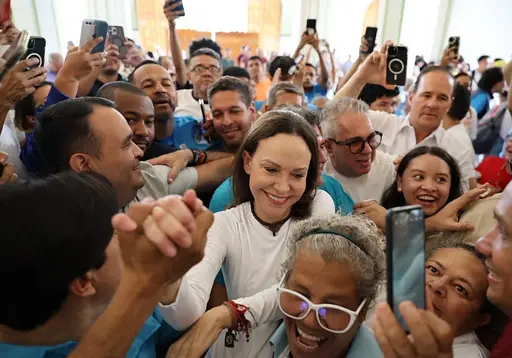
Caracas (OrinocoTribune.com)—Far-right politician María Corina Machado returned to Venezuela on Sunday, October 25, appearing at a religious gathering at the Divina Pastora sanctuary in Barquisimeto, Lara state. Footage published by The Assembly Media showed a small turnout at the event. Machado, upon arrival, wrote on social media, “I am here, with you.”
Edmundo González Urrutia also announced her arrival. González, the far-right opposition candidate whose camp claims he won Venezuela’s controversial 2024 presidential election, has lived in Spain since September 2024. He added, “Very soon, I will be with you and with her, so that our country can truly move toward freedom.”
January 3 US bombing undercuts far right’s claimThe opposition’s claim of victory in the 2024 election did not translate into authority after the US bombing of Venezuela and the abduction of President Nicolás Maduro on January 3. Hours later, Trump said Machado lacked “the support or the respect within the country” to lead, as Orinoco Tribune reported. Trump announced that Washington intended to run Venezuela until a transition could take place, dismissing Machado’s ability to lead.
The episode exposed the hierarchy behind the far-right’s victory claim: Washington asserted the authority to decide who could lead Venezuela after the military attack and abduction of President Maduro. Machado’s camp claimed an electoral mandate, but Trump’s announcement made clear that the US government was pursuing its own transition strategy.
A return after nearly a year abroadMachado left Venezuela by boat to Curaçao in December 2025, intending to travel to Oslo for the Nobel Peace Prize ceremony.
Her team described at least seven alleged unsuccessful attempts to return, according to local outlets. The first two came in June, after earthquakes struck Venezuela, with routes planned via the United States and Panama. Two more plans were not made public. The last three allegedly took place in September, around the New York meeting between Acting President Delcy Rodríguez and Trump. Her team said a boat trip from Panama suffered an alleged mechanical failure; it also said Bonaire, Aruba, and Curaçao denied landing permits for a private aircraft.
Machado’s entourage accused Venezuelan authorities of obstructing her return, while officials denied responsibility. Diosdado Cabello dismissed the earlier attempts as a media spectacle and challenged her to return. In its October 23 report, Orinoco Tribune attributed to Cabello the argument that the obstruction claims were an excuse to avoid exposing Machado’s limited political weight.
Taken together, Cabello’s criticism and Washington’s public description of a phased timetable support the Chavista interpretation: the failed-return campaign may have kept Machado’s political profile high while delaying her return, giving other far-right operators willing to work within Washington’s gradual strategy to displace Chavismo an opening to sideline her.
Spain’s ABC reported that a diplomatic operation involving several countries enabled Machado’s return with Washington’s knowledge, describing US approval as decisive. That account, together with Rubio’s later statement, places the United States at the center of the process surrounding her return, despite its veiled calls to keep Machado’s disruptive and divisive nature at bay.
Washington claims a role in the talks and Machado’s returnThe third round of talks between Venezuelan officials and a delegation of former deputies from the now-defunct 2015 National Assembly concluded on October 21.
An Orinoco Tribune report attributed to an unnamed US official the claim that Vente Venezuela had been invited to the talks. The same official said Washington was not setting fixed election dates and publicly discussed the pace and conditions of Venezuela’s political process, countering Machado’s far-right “elections now” strategy.
On Sunday, Secretary of State Marco Rubio presented Machado’s return as a direct result of US-backed reconciliation talks. “The conditions allowing for the safe return of Ms. Machado to Venezuela is the direct result of the US supported reconciliation talks which has already seen hundreds of political prisoners freed and hundreds of political opposition figures return from exile, he wrote in a social media post.
Rubio added that “we expect all political actors to support these talks which represent the best chance Venezuela has had in thirty years to peacefully achieve not just a free and fair election but an enduring democracy.” His statement cast Washington’s talks as the route to political participation and pressed Machado to support a process the US government backs and seeks to shape without shortcuts and turmoil.
Trump, meanwhile, said on Sunday, “I don’t know anything about it”, when reporters asked about Machado’s whereabouts. He then praised her while centering the Nobel medal she gave him: “She’s a very nice woman. She gave me her Nobel Prize, so how can I say anything else? I hope she’s safe. She’s a very nice woman. But we’re doing really well in Venezuela.” His remarks offered no indication that Washington would hand political authority to Machado or change its “transition” strategy after her return.
Negotiating tableOn Monday, opposition negotiator and former deputy Juan Miguel Matheus was asked directly whether Machado would join the negotiating team. He did not confirm that she would. Instead, he said the delegation represented all sectors of the opposition and that he expected Machado to heed Rubio’s call to support the talks. Matheus also credited the talks with producing her return and described it, alongside political-prisoner releases, as part of an atmosphere of “optimism and hope,” Union Radio reported.
“There isn’t a single Venezuelan there who isn’t represented by us, in the sense that we are seeking what’s best for Venezuela. We are aiming for the completion of all three phases, and María Corina is part of that. I have no doubt that María Corina will heed the call made by US Secretary of State Marco Rubio when he asks all actors to support the negotiating table, to see it as a historic opportunity to inaugurate a democracy that can endure. It is a historic task, and I am sure that we will all take it on,” Matheus said.
Matheus’ answer asserted the delegation’s authority to speak for all opposition sectors while invoking Rubio’s appeal and the three-phase US regime change strategy. His statement did not resolve whether Machado or Vente Venezuela would join the negotiating table.
Vente Venezuela‘s national coordinator Henry Alviarez said Machado returned to secure a national unity agreement and pressure authorities to set an electoral timetable. “She comes to achieve a great national agreement, to meet with all sectors that are clamoring for solutions, to prepare for a transitional phase, to exert enough pressure to set the electoral timetable,” he said. The claim has been heavily questioned by the Charvista leadership and by the US “slow pace” strategy.
Alviarez also claimed that he learned of Machado’s return only minutes before it happened and did not know her route.
Their statements expose a strategic dispute within the far-right opposition: Matheus urged Machado to heed Rubio’s call and treated the talks as the path forward, while Alviarez credited her team’s work and placed political guarantees in street mobilization. The disagreement also concerns Washington’s role and whether the far-right should enter a phased process shaped by US interests or press for a faster electoral timetable.
Turnout and the return’s immediate testOn Thursday, October 22, Vente Venezuela called demonstrations demanding an electoral timetable. Orinoco Tribune reported small opposition crowds in Caracas and Maracaibo, alongside a much larger PSUV women’s march for health and peace.
Vente had called supporters to a Caracas gathering scheduled for Sunday afternoon to welcome Machado. After intense media campaigns, a video shared on social media around 8:30 p.m. showed a limited crowd at the reception.
Local media reported that, as of 11:35 p.m. on Sunday, she had not addressed the media or the crowd, nor had she given a formal speech.
Dialogue as a path to political coexistenceOn Sunday, National Assembly Deputy Jorge Arreaza said that the dialogue process seeks to restore institutional channels and create conditions for political activity without excessive confrontation.
“The ongoing dialogue process does not seek to neutralize or eliminate the other side; it seeks to create the conditions for political activity to take place without excessive confrontation, while remaining united in support of the Constitution,” Arreaza wrote.
Special for Orinoco Tribune by staff
OT/JRE/SF
From Orinoco Tribune via This RSS Feed.
I’m very sorry for Venezuela.