

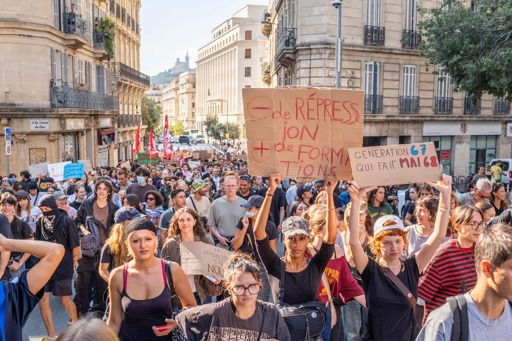
A wave of youth rebellion is sweeping across Europe. In France, hundreds of thousands have taken to the streets in a movement that began in high schools in working-class suburbs and spread to universities throughout the country. In the Spanish State, the eviction and subsequent death of an 87-year-old woman sparked a rebellion against housing speculation, leading to occupied public squares and calls for a general strike. In Germany, students have mobilized against the possibility of compulsory military service. Protests have also spread to Belgium, while students in Italy are calling for similar actions.
Different countries and different demands, but they share a common reality: in each case, a generation has grown up amid economic crises, austerity, precarious employment, unaffordable housing, accelerating rearmament, a genocide unfolding in real time, and imperialist wars. Young people are beginning to rebel against a system that offers them an increasingly uncertain future.
The images from France have led to comparisons with May 1968, when a student rebellion helped unleash the largest general strike in French history and opened a period of revolutionary struggles internationally.
The implications extend beyond Europe. In the United States, the movement for Palestine and resistance to ICE in Minneapolis have already demonstrated that a new generation is entering political struggle.
From France to Spain and Germany: A European Autumn of Struggle
France is at the forefront of this emerging movement. What began in September in high schools in the working-class suburbs of Paris developed into a nationwide rebellion comprising school blockades, university occupations, mass demonstrations, and confrontations with police, who have brutally repressed student demonstrators.
On October 6, as many as 450,000 people, according to organizers, demonstrated across the country. Hundreds of high schools and dozens of universities joined the protests.
The rebellion erupted in schools where decades of austerity have produced deteriorating buildings, overcrowded classrooms, staff shortages, and an education system that reproduces social inequalities. In working-class neighborhoods, particularly those with large immigrant populations, these conditions reveal the poor state and inequitable resources of the French public education system.
Students are demanding increased funding, more teachers, better school buildings and learning conditions, shorter school days, an end to discrimination in university admissions, and, more broadly, a better future. These demands come as Macron’s government, led by Prime Minister Sébastien Lecornu, pursues fiscal austerity while expanding military spending.
Behind these demands lies something deeper: the feeling that society refuses to listen to the youth, but also the discovery that, together, they can make their voices heard. In a conversation with Anasse Kazib, a railway worker and spokesperson for Révolution Permanente who joined a high school blockade, students expressed their frustration and determination: “We don’t want to live like this anymore.” “We want change. Big changes!”
One student described the conditions they face: “There are no resources, and they treat us like animals, like people who don’t belong, when in reality we’re all equal and have the same rights.” Another explained that teachers support their blockade: “They told us they believed in what we were doing, that they were fighting for the same cause.” As the student pointed out, teachers “work under the same conditions in which we study, and every day they see that things aren’t going well.”
These voices reveal a generation that is beginning to move beyond frustration toward collective action, discovering solidarity with teachers and workers who face many of the same conditions. They also evoke the rebellious spirit of May 1968, when slogans such as “Be realistic, demand the impossible” and “Under the paving stones, the beach” expressed a generation’s refusal to accept the limits imposed by the existing order. Today, the demand for something as basic as a decent education and a future worth living is once again raising questions that go far beyond the classroom.
The images from France are striking — massive demonstrations, school and university blockades, confrontations with police. But equally important is the emergence of spaces for self-organization, where students are democratically discussing and deciding how to carry their struggle forward. Mass general assemblies have reportedly taken place at universities across the country, including gatherings of around 2,000 students in Nantes, 600 in Grenoble, and 500 in Créteil.
Macron’s government has responded with fierce repression. More than 6,500 people have reportedly been arrested since the movement began, most of them high school students. Hundreds have been injured, including students who have suffered devastating injuries from police weapons, such as the loss of an eye or a hand. The interior minister has blamed protesters and the Left for the violence, even targeting our comrades in Révolution Permanente and Le Poing Levé.
But repression has not extinguished the movement. Instead, it has generated broader solidarity among teachers, parents, university students, and workers. As one teacher put it, young people are questioning not only the education system but also the future that society offers them.
In several cities, railway workers and trade unionists have joined demonstrations and formed human chains to protect students from police violence. Many public sector workers, who are also facing austerity and poor conditions, find common ground in their demands with those of the students. These remain initial expressions of solidarity, but they raise a fundamental question: Could the rebellion catalyze a broader working-class struggle?
The movement is part of a larger cycle of struggles in France. The Yellow Vest rebellion of 2018–19 and the enormous mobilizations against Macron’s pension reform in 2023 revealed deep opposition to neoliberal policies, as well as the difficulties of defeating the government’s offensive.
Today’s rebellion is also the product of a generation shaped by more than a decade of class struggle. Many high school students grew up watching their communities take part in the Yellow Vest movement, the protests against pension reform, mobilizations against police violence after the killing of Nahel Merzouk in 2023, and the movement against the genocide in Gaza. These experiences have left their mark on a generation often portrayed as individualistic or politically passive. The methods of struggle, distrust of state institutions, and willingness to confront repression did not come out of nowhere; they reflect a political consciousness developing through successive waves of resistance.
Across the Pyrenees, a different struggle has erupted in the Spanish State.
The eviction of Maricarmen Abascal, an 87-year-old woman, became a symbol of the brutality of housing speculation. Her eviction in September sparked protests and an encampment in Madrid’s Puerta del Sol, inspiring mobilizations in other cities. Her subsequent death intensified the anger that echoed the Indignados movement of 2011.
The housing crisis has particularly devastating consequences for young people. Soaring rents absorb enormous portions of wages, making independent living increasingly inaccessible and forcing many to remain with their families or endure precarious conditions. Young people have occupied Madrid’s iconic Puerta del Sol in solidarity with Abascal and to continue the struggle against housing speculation.
Under pressure from the movement, the major union confederations, CCOO and UGT, joined the call for a general strike on November 11. The planned day of action, however, remains limited, scheduled weeks after the initial mobilizations and close to the elections. The struggle against evictions, initially organized through neighborhood networks and tenants’ unions, is beginning to raise the possibility of involving the broader working class through strikes and workplace mobilizations.
It also exposes the limitations of Pedro Sánchez’s supposedly progressive government, which has failed to resolve the housing crisis or confront the power of landlords, banks, and investment funds. The challenge is whether the general strike can strengthen grassroots organization rather than allowing discontent to be redirected into electoral politics.
Germany presents another dimension of the emerging radicalization.
In September, more than 45,000 students, according to organizers, mobilized across about 100 cities against the government’s military service plans and the possible return of conscription. Unlike France and the Spanish State, where education and housing are central demands, German students are directly challenging the militarization of European society.
Meanwhile, the French rebellion has inspired protests in neighboring Belgium, while school occupations in Italy point toward the possibility of further developments.
These movements are neither identical nor part of a unified movement, but their simultaneous emergence is significant. From struggles over basic living conditions to opposition to rearmament, young people are beginning to challenge different aspects of the same social and political order in decay.
A Generation Caught between Genocide, Austerity, and War
One of the central contradictions connecting these struggles is the deterioration of living conditions alongside Europe’s growing militarization.
Across the continent, governments insist that public services must be cut, budgets must be restrained, and workers must make sacrifices. Yet enormous resources are being devoted to military expenditures and preparations for new conflicts.
In France, public debt is approaching 120 percent of GDP while the government debates austerity measures and expands its military commitments. In the Spanish State, the housing crisis deepens under a supposedly progressive government participating in Europe’s drive toward rearmament. In Germany, the government seeks to expand the armed forces and prepare a new generation for military service while political polarization deepens.
These developments reflect a broader crisis of European capitalism and its increasingly aggressive response to economic and geopolitical instability, especially as the wars in Ukraine, Gaza, and Iran shape the political experience of a generation that has already lived through austerity and economic crises.
The Palestinian struggle has played a particularly important role. Millions of young people have watched the destruction of Gaza unfold in real time, while Western governments, proclaiming their commitment to democracy and human rights, have supported Israel or refused to stop its attacks. The contradiction is increasingly difficult to ignore: governments claim they cannot afford adequate education, housing, health care, or pensions, yet billions are available for weapons and war.
This creates the potential for struggles that currently appear separate to converge. The fight for public education in France, housing in the Spanish State, and opposition to military service in Germany express different dimensions of a common rejection of a future defined by austerity and militarism.
From Youth Rebellion to Working-Class Struggle
The importance of these movements cannot be measured only by their size or militancy. The decisive question is whether they can develop organizations capable of sustaining the struggles and connecting them with broader sectors of the working class.
France offers initial examples of solidarity between students, railway workers, and teachers. The Spanish State provides another example, with the housing movement raising the possibility of a general strike.
These developments point toward a fundamental lesson of May 1968: youth rebellion becomes qualitatively more powerful when it converges with the working class.
As Juan Chingo explains, one of the central contradictions of these movements is that their radicalization and expansion can develop much faster than their forms of democratic organization. Digital networks can help coordinate demonstrations and spread the rebellion, but they cannot substitute for assemblies, elected delegates, and organizations capable of debating and deciding on a common strategy.
You may be interested in: In France, the High School Student Revolt Gains Ground and Shakes the End of Macron’s Reign
The challenge is to transform spontaneous mobilization into lasting democratic structures, with representatives elected by participants and subject to recall. This means rejecting attempts by reformist organizations to impose decisions from above, with the idea that any form of coordination necessarily undermines the movement’s spontaneity. Such forms of self-organization are essential not only for sustaining the struggle but also for allowing a new generation to develop its own political experience, evaluate competing strategies, and build organizations independent of the institutions it is confronting.
This convergence between youth and workers cannot depend on the top-down decisions of major union leaders but must be organized from below. Previous struggles have demonstrated how union bureaucracies and reformist parties often seek to limit mobilizations or redirect them toward electoral solutions.
The experiences following the 2008 crisis offer a warning. The Indignados in the Spanish State and the mass struggles against austerity in Greece contributed to the rise of Podemos and Syriza, but their attempts to transform society through capitalist institutions failed to deliver the changes millions demanded. Today, La France Insoumise in France and Die Linke in Germany seek to channel discontent into electoral politics without breaking with the institutions of the capitalist state.
Avoiding those limits requires strengthening democratic assemblies, student organizations, strike committees, and coordination between schools, universities, workplaces, and neighborhoods. It also means developing political organizations that openly defend a revolutionary socialist perspective, helping a new generation transform its experiences of struggle into lasting forms of political organization.
From Europe to Minneapolis: What Does This Mean for the United States?
The emerging rebellion in Europe should also be understood in relation to developments in the United States, where economic insecurity, unaffordable housing, and the concentration of wealth coexist with growing resistance to Trump’s authoritarian offensive.
The Black Lives Matter rebellion of 2020 and the movement for Palestine demonstrated the potential for mass mobilization, as have protests against ICE in Los Angeles and Chicago. But the struggle against ICE in the Twin Cities offers a particularly important example of grassroots self-organization and working-class intervention.
Faced with federal immigration raids and the killings of Renée Good and Alex Pretti, residents developed networks to monitor ICE activity, protect schools, and organize neighborhood resistance. These initiatives built on previous experiences, including the George Floyd rebellion and the teachers’ strike of 2022.
As Vincent Rissier and Enzo Tresso explain, one of the movement’s greatest strengths was the creation of grassroots networks connecting workers, students, immigrant families, and entire neighborhoods. Education workers played a particularly important role, using their relationships with students, families, and communities to help organize resistance.
You may be interested in: From Minneapolis to French High Schools: How Self-Organization Can Beat Repression
The January 23 mobilization under the slogan “No Work, No School, No Shopping” represented a turning point. Around 50,000 people marched, nearly 700 workplaces shut down, and teachers, education workers, and other sectors of the working class joined the struggle. This collective action helped change the balance of power and contributed to the partial withdrawal of ICE forces from Minneapolis.
The experience offers important parallels with France. In both cases, repression generated broader solidarity, while education workers helped connect students, families, and working-class neighborhoods together in struggle. In France, the emergence of student assemblies and solidarity from railway workers and teachers points toward similar possibilities for organizing the struggle from below. The lesson is that struggles against austerity, militarization, and repression can develop broader social power through self-organization and alliances with the working class.
For the United States, this raises a strategic question. The mobilizations against ICE, racism, and imperialist wars reveal significant political radicalization, but transforming these struggles into a lasting political force requires overcoming fragmentation and developing an alternative independent of the Democratic Party. This also means building democratic spaces for self-organization in our schools, universities, workplaces, and communities to coordinate struggles from below.
Just as the French May, the movement against the Vietnam War, and the Black struggle formed part of an international cycle of radicalization in 1968, today’s struggles could also begin to reinforce one another across borders.
These movements are not yet comparable in scale or development to those of the late 1960s, but they suggest that a new generation is discovering its collective strength and questioning the foundations of the existing social order.
The question is not simply whether another May 1968 is coming; the question is whether this generation can transform its experiences of rebellion into lasting organizations, forge alliances with the working class, and build a revolutionary socialist alternative capable of confronting 21st-century capitalism.
The post Generation 6-7 Does May ’68: A New Generation of Rebellion in Europe appeared first on Left Voice.
From Left Voice via This RSS Feed.
No meme headlines. Bad news outlet.

