Author bio: Nandita Lal is a writer on militarism, critical minerals, and climate change. She has written for CODEPINK, Tribune, Red Pepper, The New Arab, Socialist Worker, Counterfire, The Canary, and The Centre for Financial Accountability.
Lula almost stopped USA Rare Earths from buying Brazil’s Serra Verde, and if he wins, he might negate the deal
In the last two months, two divergent trends have taken shape in South American critical minerals policy. The US-backed governments of Chile, Argentina, Bolivia, and Peru signed a deal in late August that is being framed as a step toward what one analyst calls “investor-grade rules.” The agreement, signed in Santiago on August 28, was a joint declaration aimed at strengthening regional cooperation on strategic minerals, with a focus on copper and lithium.
Two of these countries, Chile and Argentina, are part of Pax Silica as formal members. The Trump administration launched Pax Silica in December 2025 as an initiative on AI and supply-chain security.
Simply, according to Mondoweiss, Pax Silica is a gathering of warmongering states like Israel, the UK, and the UAE, extending Gaza as a laboratory that fuses Big Tech, finance, and critical minerals into one authoritarian order.
Brazil is not in Pax Silica or in the quadrilateral deal signed recently by South American countries.
Instead, under Lula, Brazil passed its own critical minerals law on September 16, just shy of being able to stop USA Rare Earth’s takeover of Serra Verde.
The law has now led to an interministerial council with the power to approve and prioritize projects, giving Lula leverage over future deals if he is re-elected.
While the acquisition has taken place, some hypothesise that If Lula wins re-election in October against Flavio Bolsonaro, he could even seek to reverse the deal by relying on the new rules.
The Inter-American Dialogue also picked up on these divergent paths, noting that Brazil’s new minerals law offers roughly $1 billion in incentives for refining and manufacturing, paired with tighter state control over foreign partnerships. The Chile, Argentina, Bolivia, and Peru deal, by contrast, prioritizes US investor certainty over state control.
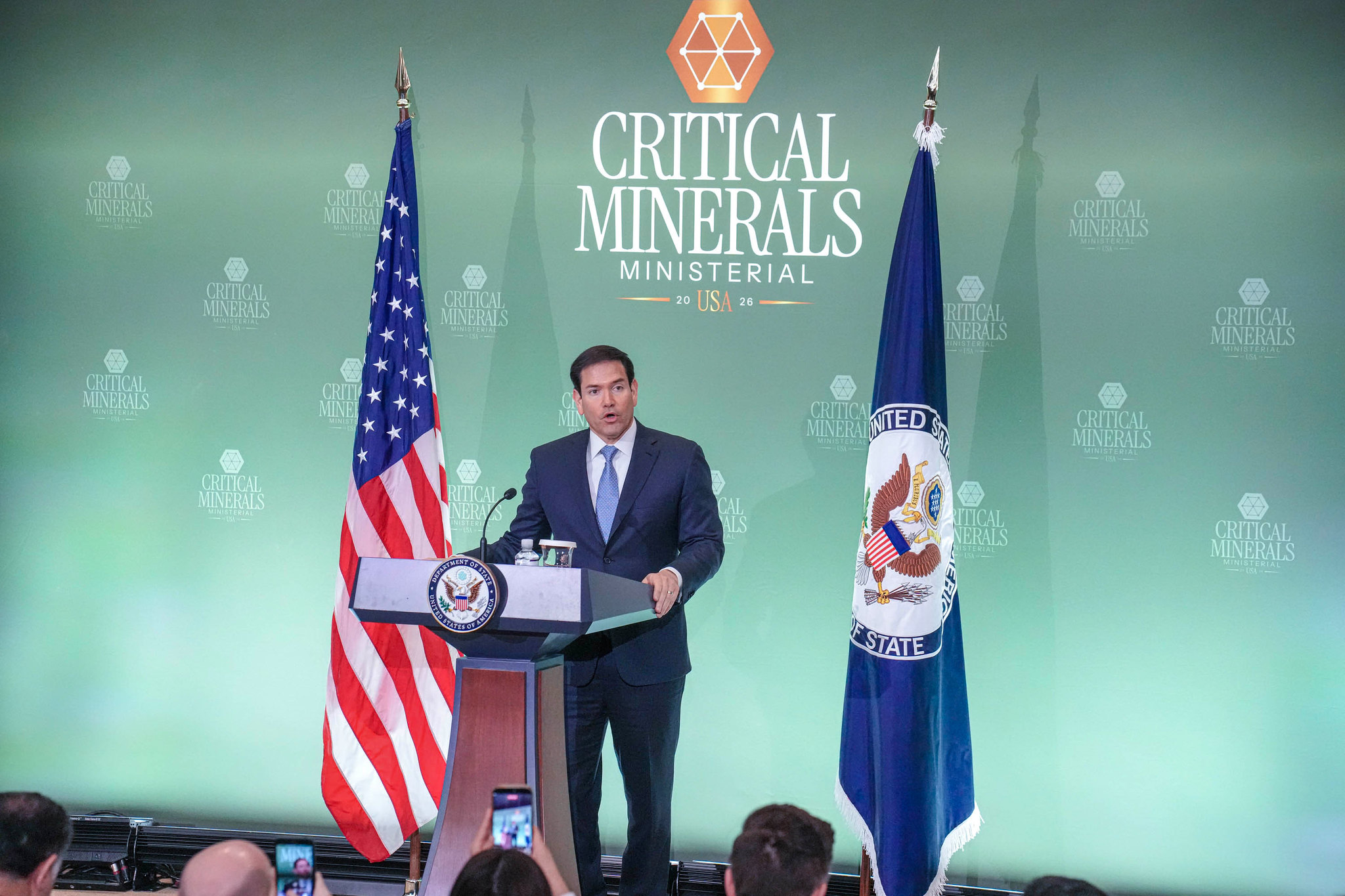
PHOTO: https://cl.usembassy.gov/2026-critical-minerals-ministerial/
US Secretary Rubio at 2026 Critical Minerals Ministerial
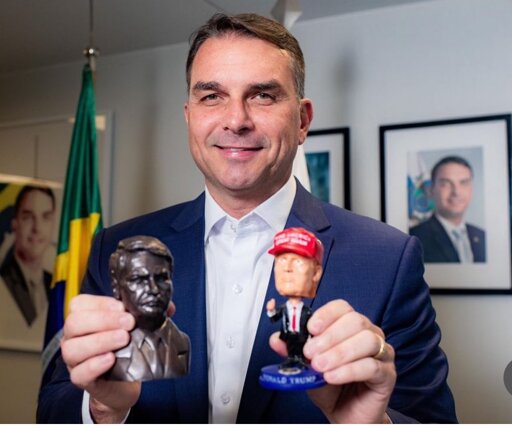
Flavio Bolsonaro – a missing piece for Trump
According to the Brookings Institute, Flávio Bolsonaro is the U.S.’s natural ally on technology collaborations, including platform regulation, artificial intelligence (AI) infrastructure, and critical minerals. They add:
“Flávio Bolsonaro has explicitly signaled a desire for Brazil to play a central role in reducing U.S. reliance on China for rare earths, raising the issue during a visit with Trump in May.”
The New York Times calls a potential Bolsonaro win as filling “in the biggest missing piece on Latin America’s right-wing map.”
According to the British establishment think tank Chatham House, the White House’s growing list of aligned leaders (either for transactional or ideological reasons) is now in Colombia, Venezuela, Paraguay, Argentina, Chile, Peru, the Dominican Republic, and Ecuador. They speculate that a Bolsonaro victory “would trigger, if not a pulling out, then a significantly reduced role in the BRICS group, which Trump has criticized for being anti-American.
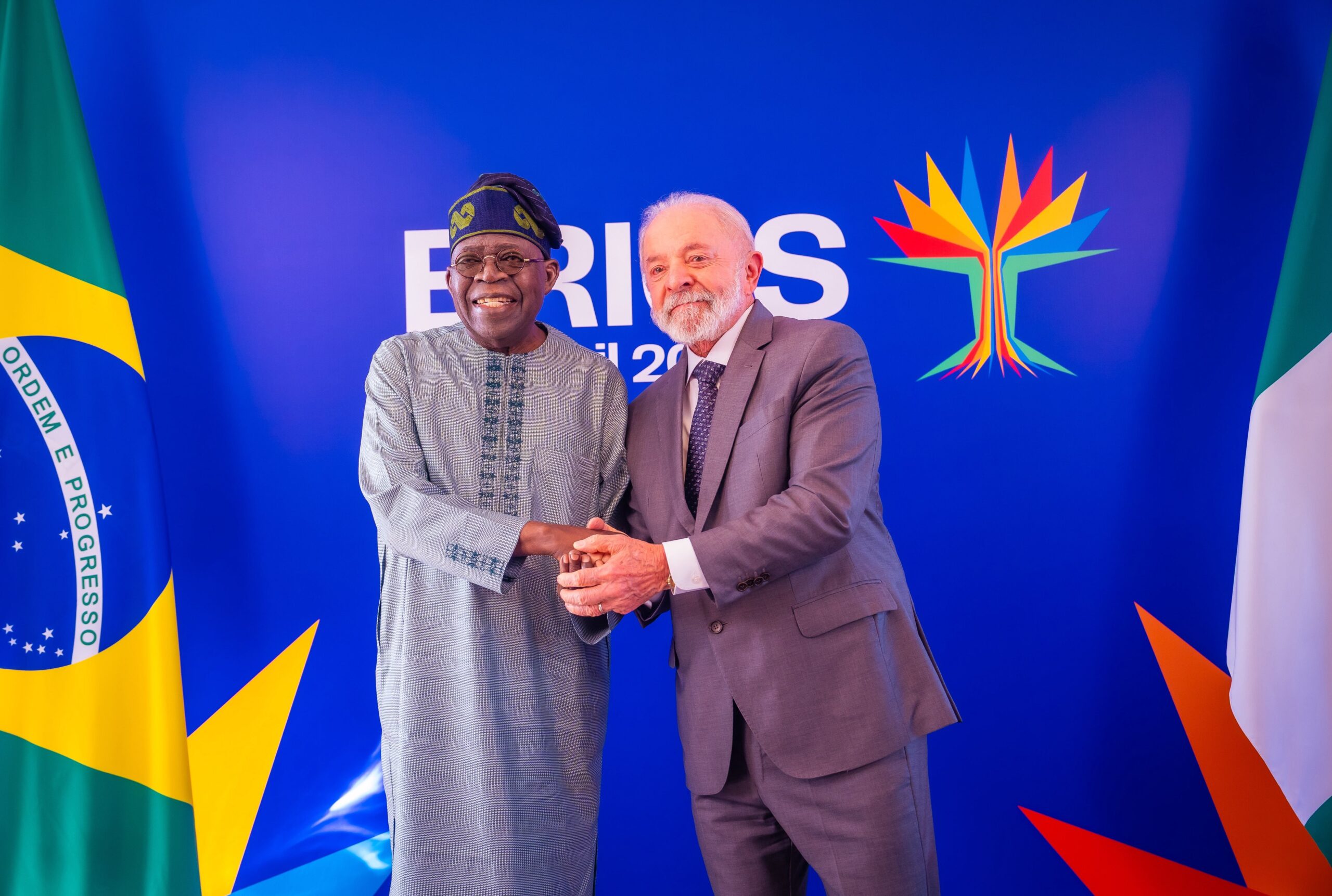
Photo: https://x.com/officialABAT/status/1941629016362070125/photo/1
Lula at the BRICS Summit with Nigeria’s Bola Ahmed Tinubu
Desperate for yttrium to drop more bombs
Headlines about the US ammunition shortage are everywhere as it wages war in the Caribbean, bombs Somalia, strikes Iran, and backs the genocide in Gaza.
But one thing its military desperately needs is yttrium, a critical rare earth element used in missile and aircraft manufacturing, and China is not being as accommodating as they would like.
According to Columbia, the most credible near-term source of non-Chinese yttrium is Serra Verde’s Pela Ema deposit in Brazil, which is ramping up production.
Yttrium is expected to make up 42% of output, but Serra Verde has not yet approved a separation facility. And its fifteen-year US-backed offtake covers four magnetic rare earths, not yttrium.
The US’s lust for critical minerals needed for its perpetual war machine is driving equity and offtake deals everywhere.
The Pentagon has taken stakes in MP Materials and Trilogy Metals, backed a $750 million offtake for Brazil’s Serra Verde, and funded tin refiner Nathan Trotter. Separately, the US has pursued arrangements with the DRC, Zambia, and Kazakhstan
The Biden administration preferred the term “transition minerals” instead of “critical minerals,” given that a lot of these minerals have a dual use, i.e., in electric vehicles, wind turbines, and other clean-energy technology. The Biden administration played down their role in warfare.
However, the Trump administration has completely dropped the pretence of calling them “transition” minerals, which is fully in line with its masculine white supremacist posturing.
Cullen Hendrix of the Peterson Institute notes that the Pentagon’s deals show the US is not “cosplaying soldier. It’s defence policy, full stop.”
Lula wants to avoid past mistakes
Washington has wanted a critical minerals deal with Brazil for years, and Trump ramped up pressure in recent months, but Lula has not given in.
Lula told journalists in Washington on May 7, after he met with U.S. President Donald Trump:
“We’re not going to repeat what happened with silver and gold in Latin America. With rare earths, we’re going to change our behavior. We want Brazil to be the big winner of these riches.”
Lula has made national sovereignty the defining theme of his current campaign.
He has vowed repeatedly to shield Brazil’s rare earths and other critical minerals from foreign control, framing them as strategic assets that belong to the Brazilian people.
He has also issued a direct warning to China, the United States and France: none will be granted access to Brazil’s mineral wealth unless they respect the country’s sovereignty.

PHOTO: https://x.com/LulaOficial/status/2104877471699202430
Lula campaigning in Sep. 2026
That message carried through to the U.N. General Assembly in late September. Even in New York, Lula used the world stage to reject what he called “technical oligarchies without rules or transparency” and insisted that AI and Big Tech must be governed and restrained.
Lula’s pro-sovereignty stance is dangerous for South American leaders because it invokes the same playbook that killed Allende in Chile in 1973, isolated Chávez in Venezuela until he died in 2013, and captured Maduro in Venezuela in 2026.
Digital sovereignty that is also being championed by Lula is another hard to swallow pill for US imperialists.
For instance, Zuckerberg’s Meta temporarily disabled the account “Eleições 2026 Luiz Inácio Lula da Silva Presidente” on September 23, telling the campaign only that “some of your activities don’t follow our rules” without specifying which rule had been violated. The account was restored later that same day. The episode comes after Meta donated $1 million to Donald Trump’s inaugural fund, while Zuckerberg himself co-hosted a reception for Trump’s inauguration alongside major Republican donors.
For Lula, as for his contemporaries and the Latin American leaders before him who faced pressure from Washington, sovereignty over minerals is one feature of the larger sovereignty that post-colonial nations still need to secure over their economies, their technologies, and their futures.
From Sovereign Media via This RSS Feed.
No! 🫨🙄