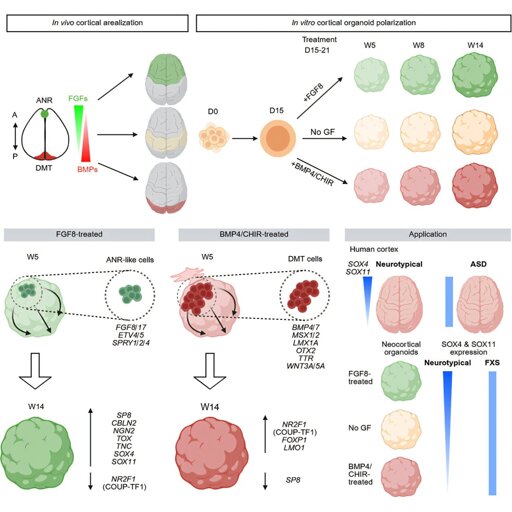
The human brain is often described as one of the most complex structures in biology, and much of its power comes from how it’s organized. Its outer layer, the cerebral cortex, is not one uniform sheet. As the brain develops, it divides into distinct areas that each take on different jobs, from movement and vision to memory, language and social understanding.
From Biology News - Evolution, Cell theory, Gene theory, Microbiology, Biotechnology via This RSS Feed.
The researchers wanted to know whether fragile X syndrome might affect not only individual brain cells but also the broader developmental patterns that help organize those cells across the cortex. They found that it did.
Two proteins important to brain development, called SOX4 and SOX11, normally appear at different levels in front and back tissue. That difference showed up reliably in organoids grown from donors without the condition. In organoids modeling fragile X syndrome, it largely disappeared. The broad front-to-back patterning was still there, but this particular difference had flattened out.
Other researchers have reported the same flattening in donated brain tissue from people with autism; the usual gap in SOX4 and SOX11 levels between the cortex’s front and back is smaller than expected.
The findings do not show that disrupted brain patterning causes autism. Instead, they highlight a potential developmental process that researchers can now investigate in a human tissue model with greater spatial detail.