

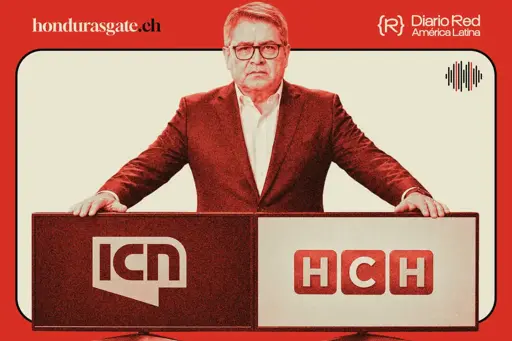
A new leak of audio recordings from the Hondurasgate platform reveals how former President Juan Orlando Hernández sought to acquire HCH and ICN, the country’s leading media outlets, and how current and past right-wing regimes have paid for and manufactured public opinion in Honduras. The documented method includes paying for entire programs, directly hiring reporters, synchronizing front pages, and when the operation requires it, buying the entire channel.
These recordings not only reveal who finances the coverage and who decides who is interviewed but also explain why, despite the fact that the Hondurasgate scandal uncovered by Diario RED and Hondurasgate has circulated in media outlets around the world, in Honduras, most local media maintained a complicit silence. This demonstrates how the public narrative is controlled by buying the voices of journalists.
In Latin America, the media have ceased to be mere operational arms of hegemonic power and have become promotional tools for right-wing leaders. In the past, the owners of these television conglomerates tended to remain in the shadows; however, today, they project their public image through their own platforms, aware that from there they can amplify partisan politics and campaign on a daily basis.
The main players
The most detailed audio recording in the release is a voice recording attributed to Vice President María Antonieta Mejía and addressed to journalist Renato Álvarez.
“Send me the prices for the paid segments because we’re going to pay for five full programs… Today we’re going to do the headlines and the featured stories with you,” says Mejía in the voice recording identified as Audio 223. “And we’re already finalizing all the front pages with the Canahuatis. So that we can do exactly what we did when President Juan Orlando was in office. Which is that everyone was in sync and only publishing achievements. The contracts are going to be increased by 150%… The 27 journalists you sent and the 115 journalists Dagoberto sent will all be earning. They will all be on the payroll as advisors. Only this time, so that you do not get your names tainted, we’re going to do it… as if it were a single company… In the name of Zuleyma Zablah.”
That report reveals many mechanisms that are used to manipulate the press: headlines and front pages agreed upon with the Canahuati family—owners of the country’s two main newspapers, La Prensa and El Heraldo; extended contracts for television programs; over 100 journalists placed on the payroll “as advisors;” and a shell company to hide the activities of those who have been bribed.
According to the recording, many of these journalists were allegedly provided by Dagoberto Rodríguez, twice president of the Honduran Journalists Association, and a journalist aligned with Honduran conservatism. Mejía herself admits that the plan constitutes repeating “what we did when President Juan Orlando was in office.”
A channel with a shadow ownerFounded in 2010 by journalist Eduardo Maldonado, who is publicly listed as its owner, HCH is the most watched news channel in the country. In the audio recordings, the former president refers to it, and other media outlets, as merchandise whose editorial line is for sale to the highest bidder.
In a voice recording identified as Audio 114, Juan Orlando Hernández states: “I’m going to start strongly accusing, by name, those who are obstructing my entire process of returning to Honduras. They’re also going to sell me ICN. HCH is already a done deal, because at ICN I only see Nasry, Jorge, and Tommy. I don’t see Juan Orlando there, so I’m going to go all out. I’ve been reading the news myself, which is why I decided to buy ICN. Because they gave coverage to everyone except me.”
HCH is already “a done deal”, says the former president and convicted criminal, ICN—a media outlet founded by Guillermo Bueso, owner of one of the main banks in Honduras—is “going to be sold.” In another note to Eduardo Maldonado, Juan Orlando Hernández reminds him who is in charge of the programming and warns him that his show “is going to stop being your show,” referring to the channel as his personal property:
In a voice recording identified as Audio 146, Juan Orlando Hernández says the following to Eduardo Maldonado: “My dearest Eduardo Maldonado, it is a pleasure. I am going to take up the whole channel issue again with my partner so you are aware, okay? Please don’t get all high and mighty like some other people have done to me because I am a bit confused, and tell Ariela and Allan that next time, when they call someone, when they interview someone, they should ask me first. Good.”
“Last night”: reward and punishmentReward and punishment go hand in hand. Hernández offers Maldonado a political future: launching him as a “Liberal candidate.” Those who deviate from the script face the opposite. In February 2026, on his personal podcast, host Allan Paul Ramos interviewed Rixi Moncada, now the deputy coordinator of Honduras’ left-wing political party Libre. Six days after the interview was published, Ramos was fired from HCH, the media outlet where he had worked for eight years. In a statement attributed to electoral councilor Cossette López-Osorio, she celebrated what happened.
The recording identified as Audio 147 reveals Cossette López-Osorio saying the following: “That guy, inviting that woman… Rixi. I think he deserved to be fired. Why are they inviting people from Libre? Why don’t they invite us… Invite me. She should videocall President Juan Orlando and tell that side of the story.”
Scheduling and controlling territory
Money and territory complete the picture. A note attributed to Nasry Asfura asks how much is being paid for television and conflates, in the same sentence, state and party finances:
Nasry Asfura says to Tomás Zambrano, in a recording identified as Audio 106: “Tomás, how much are we spending on advertising? How much is Congress spending on Frente a Frente? [a popular Honduras morning news program]. I’d like to know how much we’re giving to the media monthly so we can get an idea and restructure the communications budget for both the party and ourselves as the government…”
In that recording, Asfura speaks of the “communications budget for both the party and ourselves as the government,” as if they were the same fund. There, in a single sentence, is what runs through all these recordings: the use of state money to manufacture a media narrative that is aligned with the ruling party.
This payment helps explain a silence. While Hondurasgate was being reported in Spain, Mexico, Argentina, Lebanon, and Turkey, the major Honduran media outlets—such as those who appear in these recordings—barely mentioned it. The audio recordings offer the key to this silence: they reveal that a large part of the local press is integrated into the same network that, according to previous installments of this investigation, has extensive criminal networks and links to drug trafficking. Therefore, it was impossible for someone who, according to these conversations, was part of the network to investigate the political interference scandal.
Forensic verification
The audio recordings cited in this piece were subjected to an independent forensic audit by the British organization Earshot, which validated them as authentic recordings and ruled out the possibility that they had been generated by artificial intelligence. Earshot (earshot.ngo) concludes that Audios 114 and 146 of Juan Orlando Hernández, Audio 106 of Nasry Asfura, Audio 223 of María Antonieta Mejía, and Audio 147 of Cossette López Osorio are, in all cases, with a high probability, authentic recordings and not generated by artificial intelligence. The audit can be consulted at this link.
Earshot reached its conclusions through two lines of analysis: critical listening to audio artifacts consistent with authentic speech, and machine learning voice comparison with known recordings of the alleged speakers.
Translation: Orinoco Tribune
OT/CB/SL
From Orinoco Tribune via This RSS Feed.
 1·2 hours ago