

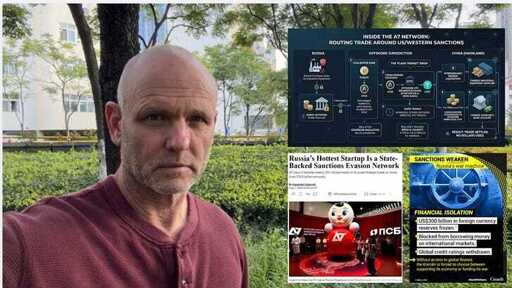
Bullets:
Russian sovereign assets were seized by European regulators in 2022, and heavy economic sanctions were placed on Russian banks and companies.
Since then, Russia and other countries have completed alternative systems of global trade finance, completely outside the oversight of Brussels and Washington.
The A7 system is just two years old, and already moves tens of billions of dollar equivalent in trade, monthly.
So called “pariah regimes” are heavy users of A7, and other new systems.
But they are also widely appealing to commercial users everywhere, who face far longer processing times and costs by going through SWIFT networks.
Inside China / Business is a reader-supported publication. To receive new posts and support my work, consider becoming a free or paid subscriber.
Report:
Good morning.
Mish Shedlock runs a contrarian economic blog we like, and a few years back he pointed out that sanctions just create new markets. They never work for long, and so when policymakers put on trade restrictions, especially against smart people, it’s just a matter of time before they fall apart. Mish is as cynical as we are, maybe more so.
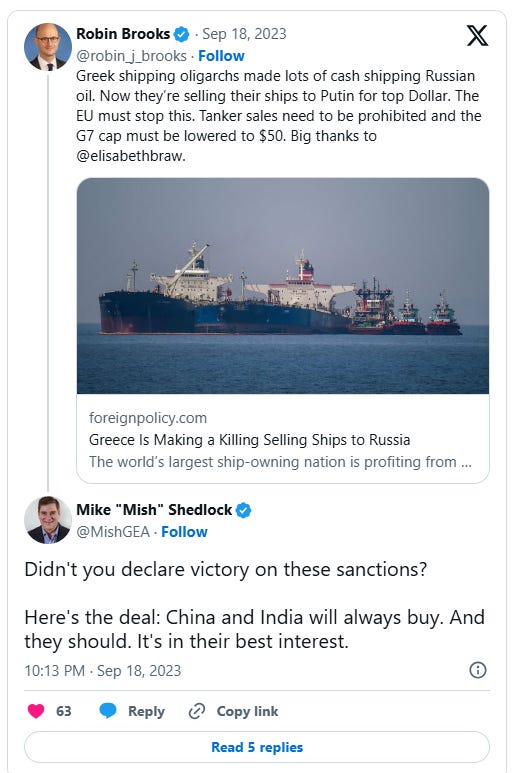
And we are all unsurprised that the plans to destroy China’s semiconductor industry didn’t work out. We’re not surprised that European sanctions on Russian oil and gas industries just resulted in a new business, that just buys whole ships outright. Or that new pipelines would be built to Asia, to open new markets here.
What was completely predictable, too, was what we’re seeing now in global banking systems. When Washington and Brussels froze, then seized, Russian FX reserves in Western banks, and banned Russian companies from using the SWIFT system, countries across the world understood that the same thing could happen to them, at any time, and the race was on to develop alternative systems of global trade finance, which could not be sanctioned by Western regulators.
Today lots of people are busy in lots of places, doing just that—building the financial plumbing for networks that are completely outside the US dollar and SWIFT banking systems.
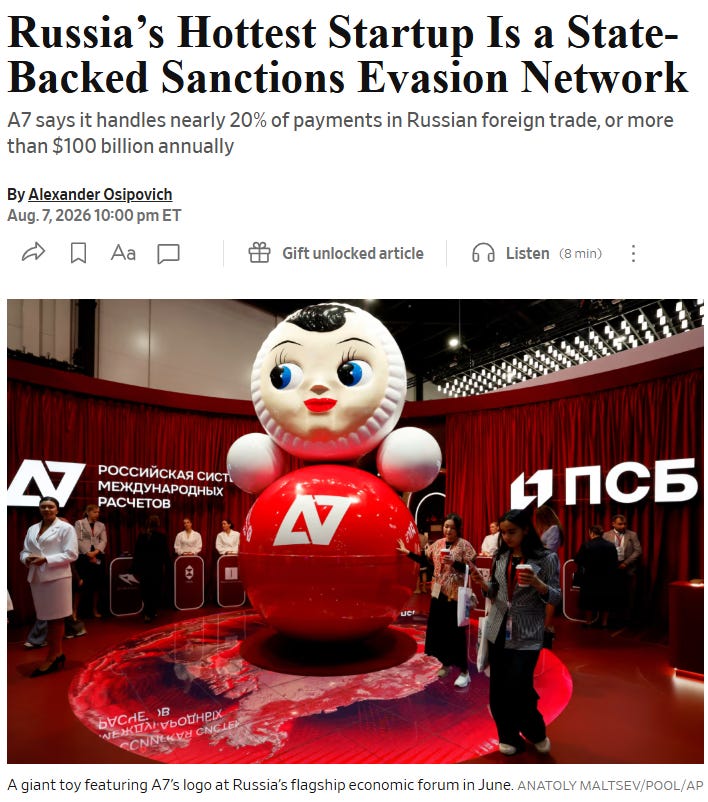
Let’s take a second here to appreciate that these systems exist BECAUSE OF those sanctions that were put on Russia just four years ago, and they’re already here. The A7 is a new Russian system, just two years old, and it’s one vehicle that is keeping Russia well-supplied with military gear, cars, and food. Today A7 is the gateway for over $100 billion in foreign trade every year.
Now A7 is expanding, to fulfill the “vision of an alternative financial system outside the control” of the United States or Europe. A7 executives don’t see “pariah countries” as problems to avoid; they’re new markets. The threats of Western sanctions aren’t problems to avoid–they’re marketing tools, to generate new business.
The A7 system is immune to sanctions. Western regulators did switch off access to Russian banks and companies. So A7 is the result of what happens, when those regulators in Brussels tried to shut off the people who seem to win all the chess tournaments. A7 advertises itself as a new trading system, and their mascot is that thing – “a tenacious person” who soldiers on despite adversity.
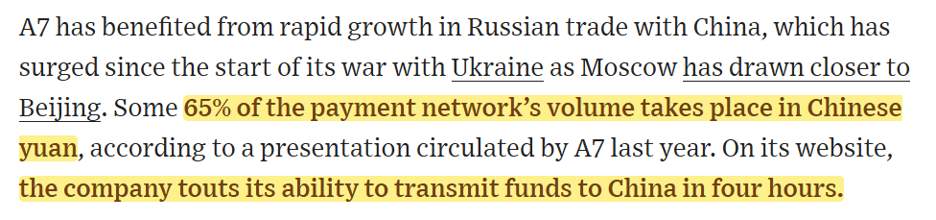
Two thirds of the payments going through A7 are in Chinese renminbi, and this jumped out at us right away: the Russian system transmits funds to China in four hours. To anyone doing business in China, and going through banks back home, that’s miraculous. Not only did the sanctions push people in Russia and China to build a different system; they built a better one, that is literally 20 times faster:
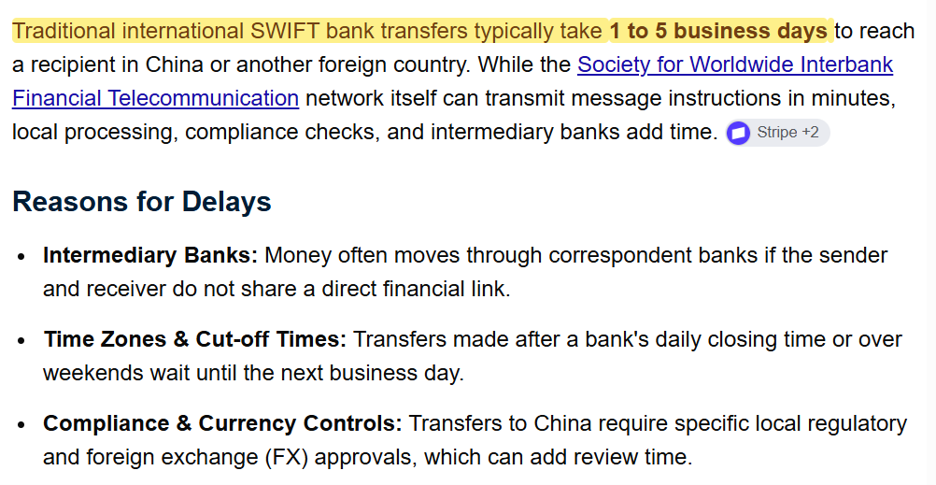
When paying for Chinese product through the SWIFT system, the money is frozen in place until the bankers show up to work again, so if it’s later in the afternoon, or just before a holiday weekend, too bad for you. Then someone notices the money is going to China, and so expect a few more hours, or days, for that.
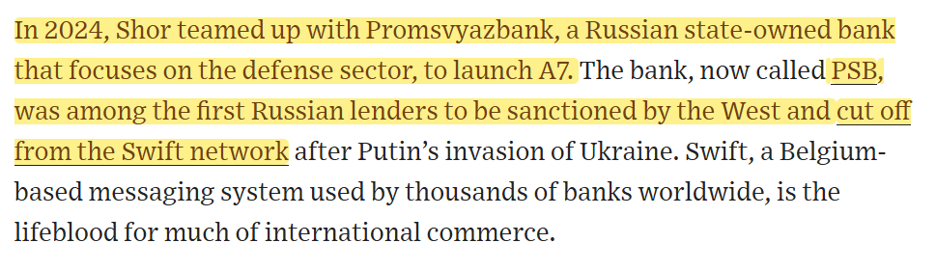
This part is important too: In 2024, A7 partnered up with Promsvyazbank. PSB is a Russian government bank that handles defense business, and was one of the first banks sanctioned by the West and cut off from SWIFT.
But the sanctions on PSB weren’t a problem; they were a solution to one. For a bank still on SWIFT, regulators in Brussels can see what’s happening, and monitor the flows of funds in and out of accounts. To work properly, A7 needs banks in Russia that ARE under sanction; they then move money through companies in Kyrgyzstan, Hong Kong, and the Middle East.
The little that these analysts do know and understand of the A7 networks is a result of a data breach, from hackers. We’ll come back to that point later. A pillar of the A7 system is the A7A5 token; a stablecoin pegged one-to-one with the Russian ruble. The A7A5 is swapped with US-dollar-backed stablecoins, like Tether, and those proceeds are sent to companies or countries under sanction. The network now spans over 100 countries, with $140 billion in transaction volume since inception. It’s now the largest non-USD stablecoin in the world.
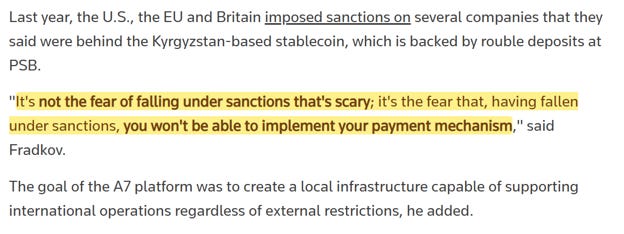
Regulators are trying to catch up, and targeting the stablecoin, based in Kyrgyzstan, backed by rubles, held on deposit at the PSB. And here’s a money quote: nobody worries about Western sanctions anymore. The fear is that they can’t do business as usual, “cannot implement” payments:
Last August, the UK sanctioned the new financial networks that were getting around the earlier sanctions: eight individuals and entities that had, at that time, moved $9.3 billion in four months.
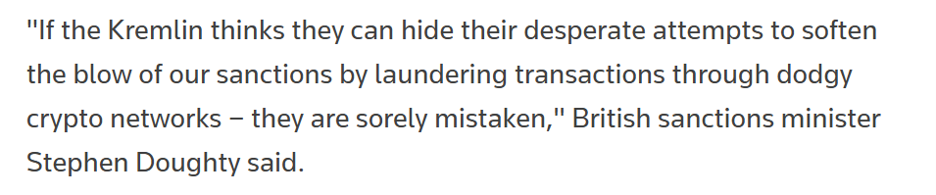
Did you know that Britain has a sanctions minister? He said, if the Kremlin believes they can set up new crypto networks and dodge sanctions, they are “sorely mistaken”. That quote aged badly: in the year since, Russia moved another $130 billion through.
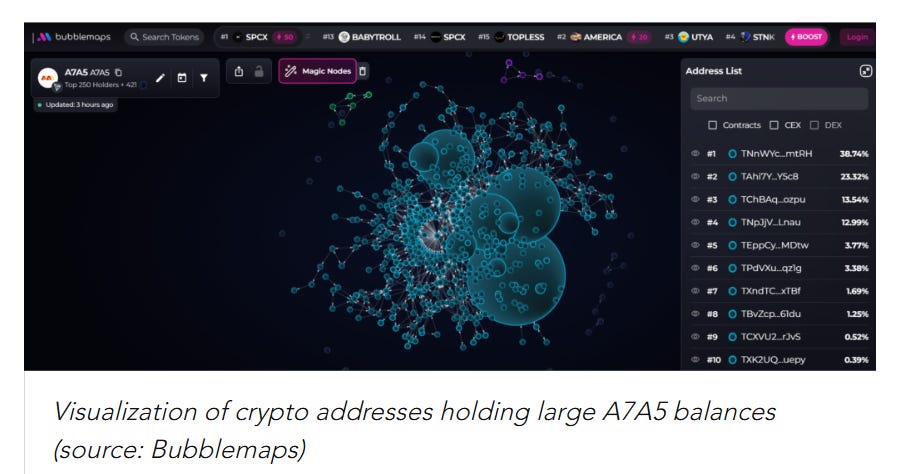
Distributed networks pose particular problems for regulators, because they’re everywhere. Shut off 8, or 80, or 800—the funds simply flow through other nodes and wallets. It’s a global game of whack-a-mole, and Western regulators are always behind, and can only reconstruct what happened in the event of a major breach—like in this case—and long after the fact.
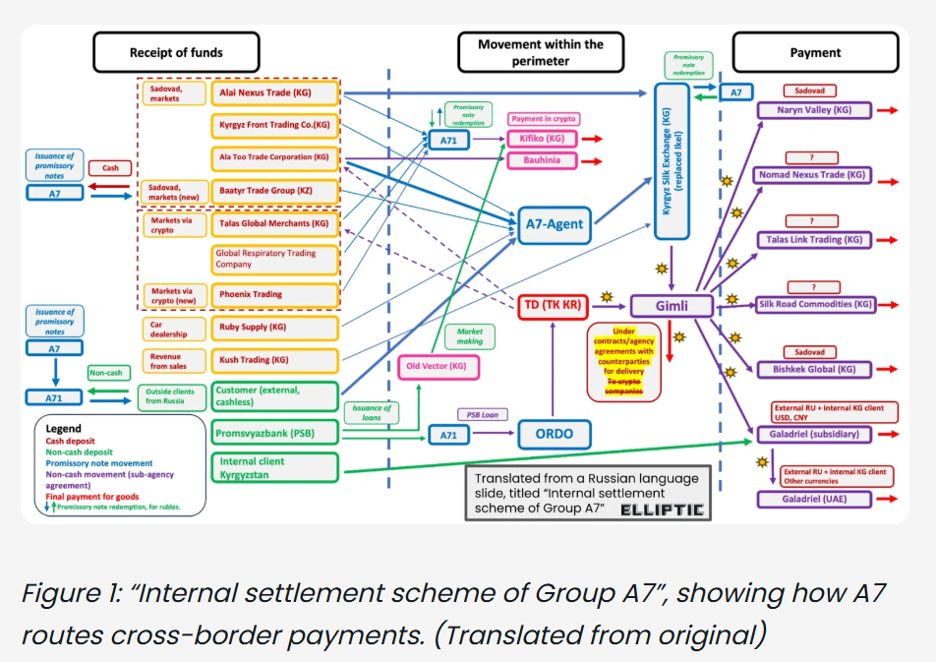
Elliptic works with Western agencies, and analysts there pieced together some of the data from the A7 leaks. This was from a presentation slide, translated into English from Russian, and is a schematic of the A7 architecture, at that time:
The system made heavy use of Tether, and just a single wallet in that network handled $677 million in Tether payments.
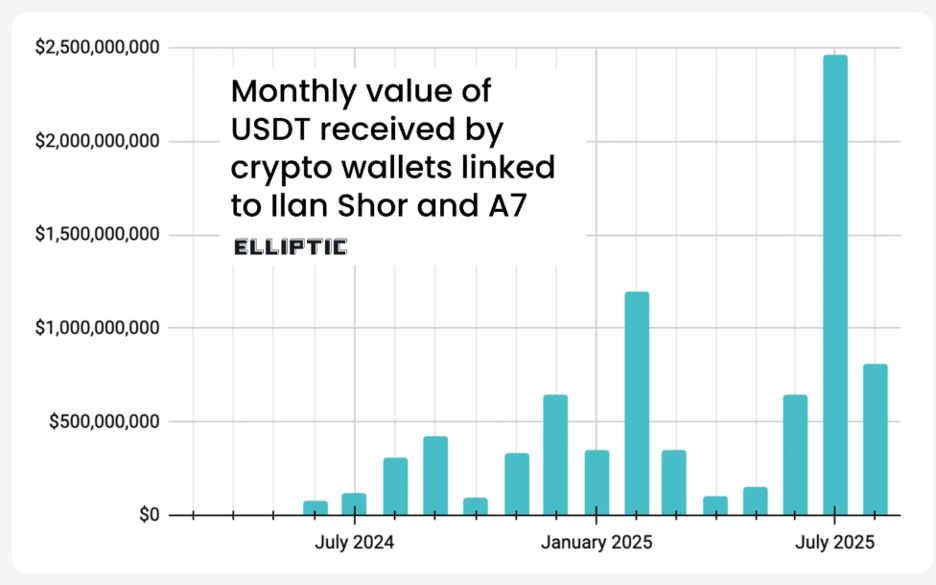
But then came the data breaches, so the system managers just changed to different wallets. And that’s important too. Tether does cooperate closely with officials at the Treasury Department, and has frozen wallets in the past. In fact, Elliptic itself worked with the Secret Service to freeze $26 million in stablecoin.
And that was the mistake that the Iranian Central Bank made, here—if the USDT balances are held in wallets for too long, analysts may eventually find them and get Tether to lock them up. But if they’re moved quickly, that risk goes away.
This is how the A7 system works. It’s reliant on companies outside Russia, and the A7A5 is the bridge between Russia and everyone else. A Russian company puts rubles into PSB bank, or another one in network, which are converted into the stablecoins. Those tokens are then sent to crypto exchanges outside Russia, and exchanged for Tether or another crypto.
Those are then transferred again—fast—and converted into foreign currency and put into a bank abroad, to buy products.
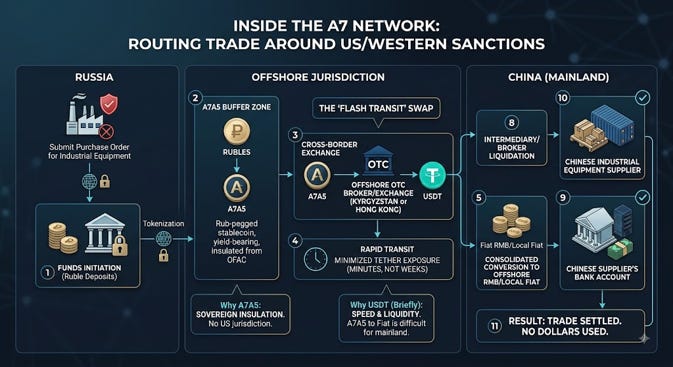
Step #4 is critical, the “Flash Transit Swap” which converts the funds into Tether, then quickly back out again. So it doesn’t matter that Tether works hand-in-glove with the Treasury Department, and the Secret Service. It doesn’t matter, that Tether’s asset custodian and personal banker is now the Commerce Secretary of the United States. It doesn’t matter what the UK sanctions minister has to say about it.
Once the funds are converted to Tether, it moves anonymously, in just minutes. Western regulators cannot even see where the money is or where it’s going, let alone have any way to stop it.
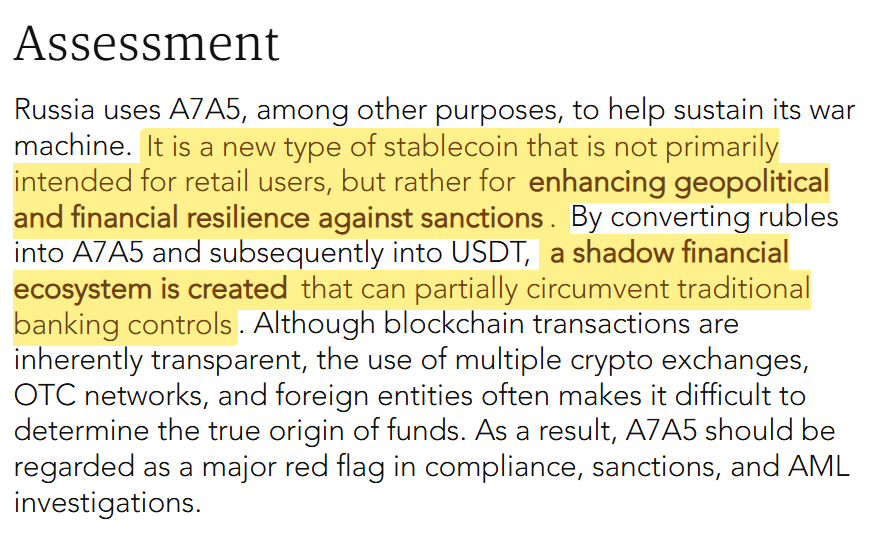
That’s where we find ourselves, just four years after Russia got kicked out of SWIFT, and just two years after A7 turned their computers on. They built a new financial system. It’s a system that circumvents financial banking controls, and is resilient against sanctions.
It goes without saying they’re getting a lot of new business: over $100 million in Iranian oil sales, large financial transfers to the Houthis. In the past, to move that money around they had to send pallets of cash, or barter it somehow. A few short years ago, being under sanction meant that business would simply stop, cold.
Now the business is bigger than ever, it’s faster than ever, and nobody in Washington or Europe has any clue what is happening right now, or what has happened—ever—until hackers find some more old emails.
Be Good.
Resources and links:
Mish Talk
https://mishtalk.com/
Lesson of the Day: Sanctions Don’t Work Because They Create New Markets
https://mishtalk.com/economics/lesson-of-the-day-sanctions-dont-work-because-they-create-new-markets/
The Chip War with China Is Failing
https://fpif.org/the-chip-war-with-china-is-failing/
America’s chip sanctions backfired: China’s innovation engine is now unstoppable
https://medium.com/enrique-dans/americas-chip-sanctions-backfired-china-s-innovation-engine-is-now-unstoppable-b7b2d80ddb76
Russia’s Expanding Energy Ties in Central Asia
https://www.energypolicy.columbia.edu/russias-expanding-energy-ties-in-central-asia/
Russia’s Hottest Startup Is a State-Backed Sanctions Evasion Network
https://www.wsj.com/world/russia/russias-hottest-startup-is-a-state-backed-sanctions-evasion-network-7afc488c
The Morning Risk Report: Russia’s Hottest Startup Is a State-Backed Sanctions Evasion Network
https://www.wsj.com/wsjplus/dashboard/articles/the-morning-risk-report-russias-hottest-startup-is-a-state-backed-sanctions-evasion-network-884b7abf
Rouble-backed A7A5 stablecoin turnover nears $140 billion from launch, says PSB head
https://www.reuters.com/business/finance/rouble-backed-a7a5-stablecoin-turnover-nears-140-billion-launch-says-psb-head-2026-08-10/
The A7 leaks: The role of crypto in Russian sanctions evasion and election interference
https://www.elliptic.co/insights/the-a7-leaks-the-role-of-crypto-in-russian-sanctions-evasion-and-election-interference/
A7A5: inside Russia’s emerging blockchain financial infrastructure
https://www.cense.com/news/a7a5-a-thematic-study/
The A7 Leaks: TRM’s On-Chain Analysis of Russia’s Cryptocurrency Connections
https://www.trmlabs.com/resources/blog/the-a7-leaks-trms-on-chain-analysis-of-russias-cryptocurrency-connections
EU bars 7 Russian banks from SWIFT, but spares those in energy
https://www.reuters.com/business/finance/eu-excludes-seven-russian-banks-swift-official-journal-2022-03-02/
UK targets Russian crypto networks and Kyrgyz firms in new sanctions
https://www.reuters.com/business/finance/uk-targets-russian-crypto-networks-kyrgyz-firms-new-sanctions-2025-08-20/
Treasury Secretary Bessent confirmed the $344 million Tether freeze
Binance Square, Tether freezes wallets linked to Iran central bank
https://www.binance.com/en/square/post/318759455947378
As Lutnick Sold Cantor to His Children, Tether Gave Them a Loan
https://www.bloomberg.com/news/features/2026-03-18/tether-made-loan-to-lutnick-s-children-as-they-bought-his-assets
Inside China / Business is a reader-supported publication. To receive new posts and support my work, consider becoming a free or paid subscriber.
From Inside China / Business via This RSS Feed.
 1·3 hours ago