
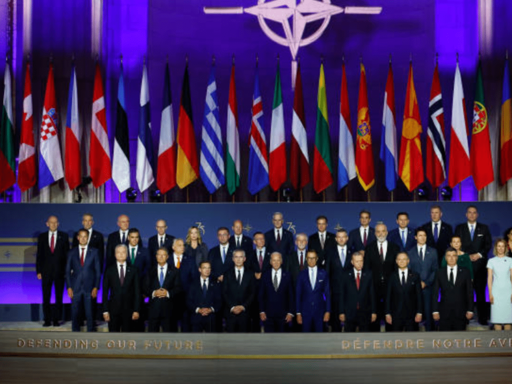

The North Atlantic Treaty Organisation (NATO) has been urged to “stop treating ‘more nukes in more places’ as the answer to everything” by anti-nuclear campaigners, as Western defence leaders meet at the NATO Summit in Türkiye.
Defence industry top of the agenda
NATO Summit 2026 is taking place in Ankara, Türkiye, on 7 and 8 July, with the formal purpose of reviewing “progress made since the 2025 Summit in The Hague”, and to “set out a roadmap to continue delivering on NATO’s key objectives”.
Key topics on the agenda are defence industry, support for Ukraine and defence investment. NATO allies have agreed to aim to spend 5% of their gross domestic product (GDP) on defence, and some are expected to meet that goal within 2026, according to NATO.
Speaking ahead of the summit on 22 May, NATO secretary general Mark Rutte said:
The task ahead is clear: to turn Allied commitments into concrete results. Increased investment, industrial production and continued support for Ukraine.
All of this contributes to a stronger NATO and greater security for all of us.
On 8 July, the summit issued a statement called The Ankara Summit Declaration. Among other lines on collective responsibility and commitments to investment, the Declaration says:
NATO’s deterrence and defence rest on an appropriate mix of nuclear, conventional, and missile defence capabilities, complemented by space and cyber assets.
The summit comes at a time when Western leaders feel a deepening sense of insecurity due to conflicts directly or indirectly involving NATO interests in Ukraine and the Middle East, and with NATO and its adversaries engaging in a new nuclear arms race.
In February, the UK Labour government was accused of “sitting on the sidelines” of international nuclear weapons risk reduction diplomacy following the expiration of New START (New Strategic Arms Reductions Treaty). The treaty limited the number of nuclear weapons the US and Russia could hold.
Dangerous nuclear escalation
During the NATO Summit, International Campaign Against Nuclear Weapons (ICAN) advocacy coordinator Florian Eblenkamp spoke to the Canary about how NATO and the UK are involved in dangerous nuclear escalation with Russia.
Eblenkamp said:
Nuclear weapons have become a strategic liability for NATO. The P3 – the US, UK and France – spent $89.5bn on nuclear weapons last year. Russia spent $9.5bn. That’s nearly ten times more, yet NATO governments still say they feel threatened.
If ten times the spending doesn’t buy a genuine sense of security, how much would? Twenty times? Fifty? At what point does anyone admit the money isn’t buying the thing it’s meant to buy?
Nuclear weapons are indiscriminate by design. There’s no way to use them that complies with international humanitarian law’s core principles of distinction and proportionality.
They can’t be deployed “effectively” in any conventional sense, because their only real function is threat, not use. An extraordinarily expensive category of military spending built around never actually being used.
According to Eblenkamp, NATO is moving “the wrong way”, and he raised concerns that the summit will be “about spending targets and industrial output, with the nuclear ‘guarantee’ treated as the one untouchable constant”.
Eblenkamp added:
That’s backwards, you don’t de-escalate by making the nuclear umbrella bigger. A real de-escalation posture means freezing the nuclear-sharing footprint instead of expanding it – the UK joining the Dual Capable Aircraft mission is a step in exactly the wrong direction.
UK must stop hosting US nukes
In April, campaigners told the Canary that the UK Government must stop hosting US nuclear weapons as part of the NATO dual capable aircraft nuclear mission, after President Trump issued a veiled threat to nuke Iran.
Eblenkamp continued:
NATO needs to reduce the alliance’s reliance on nuclear weapons, and reduce the spending on them. Every new basing arrangement is a new target and a new escalation trigger. NATO needs to stop treating “more nukes in more places” as the answer to everything.
He said the UK “absolutely” has a special responsibility to deescalate the nuclear arms race because of its hosting of two nuclear arsenals. He told the Canary:
The UK overtook Russia in 2025 to become the world’s third-largest nuclear spender, and commitments already on the books mean that spending will keep climbing – toward close to 25% of the entire defence budget.
All that for weapons of mass destruction, run under a policy that can’t function independently of the US, and that only stacks up more costs down the line when the RAF acquires its own nuclear-capable F35s to drop US nuclear bombs.
The UK is now the only country on Earth sitting under its own arsenal and a US one simultaneously. Trident patrols out of Faslane; it is assessed that RAF Lakenheath’s US F-35s hit full operating capacity to drop US nuclear weapons last autumn, and nobody in government will say what’s actually in the vaults at the airbase.
Suffolk County Council reportedly has no evacuation plan for a nuclear incident at Lakenheath. That, on its own, should be reason enough to shift the UK’s posture toward less reliance on nuclear weapons, not more.
The fact that, as of September 2025, Suffolk County Council had no evacuation plans in case of an incident involving the US nuclear weapons – which are widely believed to be held at RAF Lakenheath – was revealed in response to a Freedom of Information Act request by the Canary.
The UK’s Foreign, Commonwealth and Development Office (FCDO) and Ministry of Defence (MOD) were approached for comment.
Other NATO members escalating nuclear arms race
Eblenkamp also took aim at the US, France and other NATO allies for their behaviour around nuclear escalation.
He said:
The US is probably pulling a lot of the strings here, but it’s worth remembering that NATO comprises 32 independent democracies. Each of them has the ability, and frankly the responsibility, to work out for themselves whether threatening to use weapons of mass destruction actually serves their own security.
France is doing something similar from a different angle. President Macron’s ‘forward deterrence’ doctrine opens the door to French nuclear-capable aircraft being based in partner countries and closer nuclear coordination with allies, even though Paris keeps sole control over the button. It’s a second track toward the same outcome: more European states drawn into nuclear arrangements they don’t control.
All this happens while several European governments are trying to reduce their military dependence on the US. But by leaning harder into nuclear weapons – whether American or French – they’re doing the opposite. Nuclear deterrence in Europe still runs through Washington one way or another. You can’t reduce dependence on the US while increasing your reliance on nuclear weapons.
Eblenkamp concluded by highlighting apparent contraventions of the Treaty on the Non-Proliferation of Nuclear Weapons (NPT), which NATO countries are responsible for, saying:
Article II of the NPT says every non-nuclear-weapon state party “undertakes not to receive the transfer from any transferor whatsoever of nuclear weapons or other nuclear explosive devices or of control over such weapons or explosive devices directly, or indirectly.” Article VI commits every signatory to negotiate complete disarmament in good faith.
As of today, the US stations nuclear weapons in five non-nuclear states – Germany, Belgium, the Netherlands, Italy and Türkiye – and probably in the UK already or in the near future. In the event of their use in a war, it would be pilots from those countries flying aircraft under their flags dropping the bombs.
NATO’s argument is that this arrangement predates the NPT, so it doesn’t count, and that keeping US nuclear weapons spread out this way is actually what stops them spreading further. Most NPT parties have never accepted that argument, and it’s one of the reasons the treaty has been in deadlock since 2010.
NATO was approached for comment.
Labour remains committed to escalation
With Labour’s commitment to increase defence spending by £15bn under the Defence Investment Plan (DIP) – including a £4.7bn funding black hole left to the next Prime Minister to deal with – it appears likely that the UK will continue to rely on nuclear weapons for its defence and security.
Featured image via the Canary
By Tom Pashby
From Canary via This RSS Feed.
The fact that, as of September 2025, Suffolk County Council had no evacuation plans in case of an incident involving the US nuclear weapons – which are widely believed to be held at RAF Lakenheath – was revealed in response to a Freedom of Information Act request by the Canary.
The UK’s Foreign, Commonwealth and Development Office (FCDO) and Ministry of Defence (MOD) were approached for comment.