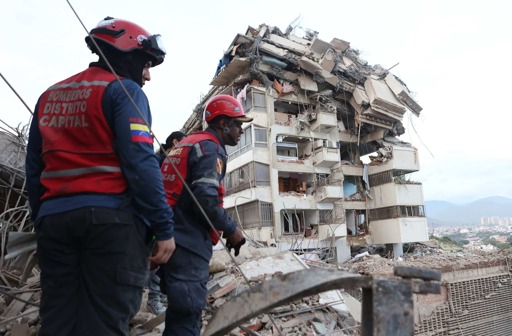
Two powerful earthquakes hit northern Venezuela on June 24, causing hundreds of deaths and thousands of injuries. Neighborhoods, including in Caracas, have been left in ruins. While Venezuelans try to recover from this natural disaster, one thing is clear: their plight is made far worse by years of economic and social crises, as well as imperialism. The impact of the earthquake is concentrated in decaying working-class neighborhoods plagued by these precarious living conditions, where people have less capacity to evacuate and face greater hurdles to rebuilding their lives.
While acting president Delcy Rodríguez has mobilized state resources to help the recovery effort, the past two days have revealed the severe limits of this response. Government teams have yet to reach many areas, and some volunteers have resorted to working with their bare hands to help dig victims out from under the rubble. Hospitals, meanwhile, are overwhelmed.
These conditions are the predictable outcome of years of state neglect and social inequality, which have left two thirds of people in Venezuela living in poverty and precarity, with poor access to basic services like health care. While many in the United States see this as a consequence of “socialism,” the truth is that Venezuela was never socialist.
Even under Hugo Chávez and Nicolás Maduro, the country remained capitalist. Venezuela has never expropriated the national bourgeoisie and it has a large private sector — aided by Maduro’s deals with dozens of foreign multinationals to sell off energy assets. As profits from the oil industry, in particular, kept bankers and businessmen wealthy, the Venezuelan masses received limited benefits via social programs. But as this wealth dried up, the government could offer nothing to the country’s working class and poor, besides economic and social crises.
But the crises facing Venezuelans today cannot be left at the feet of the Chavez, Maduro, or even the Rodriguez administrations alone. Imperialism has also played a devastating role.
For years, the United States in particular has imposed crippling sanctions which have hit Venezuela’s working masses the hardest. As we have written before, “sanctions are a tool of economic warfare.” They have deadly consequences for the working class and poor, including in Venezuela, who suffer from shortages of food, fuel, and medicine. As part of its campaign of domination against Venezuela since January 3 and President Trump’s neocolonial offensive, the U.S. has tightened these sanctions.
In this sense, discussions about rescue and reconstruction following this earthquake cannot be separated from the fight against imperialism in the region. After all, far from being a neutral mechanism of solidarity, humanitarian aid can be used as a tool for political coercion. Nor can we overlook the importance of the independent self-organization of the Venezuelan masses, who must both fight the Rodríguez government’s subordination to international imperialist interests and demand that the cost of reconstruction not fall on those already bearing the brunt of Venezuela’s crises. Rather, emergency resources must be allocated toward the urgent needs of the working class and poor.
As our comrades of the League of Workers for Socialism declare:
In the face of this tragedy, solidarity with the affected working families and the Venezuelan people is essential. Immediate aid is indispensable for rescue efforts, treating the injured, and supporting those who have lost everything. But alongside this urgent response, it is necessary to open a discussion about the social conditions that transform a natural phenomenon into a major catastrophe for the working class, and about how reconstruction will be organized in the coming days, months, and even years, in a country that has endured more than a decade of economic crisis, deteriorating public services, and the impact of the U.S. blockade and sanctions.
Adapted from an article published in Spanish on June 25 in La Izquierda Diario
The post Earthquakes in Venezuela Show Consequences of State Neglect, Social Inequality, and Imperialism appeared first on Left Voice.
From Left Voice via This RSS Feed.
These conditions are the predictable outcome of years of state neglect and social inequality, which have left two thirds of people in Venezuela living in poverty and precarity, with poor access to basic services like health care. While many in the United States see this as a consequence of “socialism,” the truth is that Venezuela was never socialist.
What is this liberal slop masquerading as “leftist?”
SANCTIONS NOT NEGLECT, YOU ABSOLUTE POSERS!‼️🤦♀️