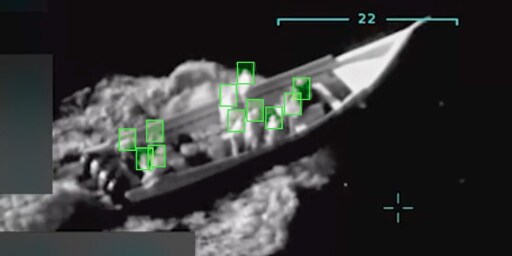
NIne months into the Trump administration’s deadly campaign against so-called drug boats, there is a pattern to the strikes. And a glaring anomaly.
The U.S. military has conducted more than 60 attacks, resulting in over 200 extrajudicial killings in the Caribbean Sea and Pacific Ocean. In almost all the strikes, between one and four people lost their lives. In only one strike did the death toll of a single boat reach double digits: the first attack on September 2, 2025.
Since then, experts, lawmakers, and even military officials behind the scenes have been asking a simple but haunting question: Why was that boat packed with 11 people?
“Why would 11 people be on board a boat carrying drugs?” said a government source who attended a classified briefing where the large crew on the first boat attacked was discussed. “It’s a high risk for the cartels. That always stood out.”
One top military officer provided a plausible explanation, behind closed doors on Capitol Hill, The Intercept has learned. His admission raises even more questions about a strike that a high-ranking Pentagon official called a criminal attack on civilians and resulted in a firestorm in Congress last year.
In the briefing, the high-ranking officer on the Pentagon’s Joint Staff stated that some of the people killed by the U.S. military may have been the victims of human trafficking.
A 40-foot go-fast boat with four 200-horsepower engines sped off from San Juan de Unare on Venezuela’s Paria Peninsula deep in the night of September 1. It was “probably headed to Trinidad or some other country in the Caribbean,” Secretary of State Marco Rubio would later say.
As the peñero cut through the warm waters of the Caribbean Sea, a secret U.S. Special Operations plane flew high above. Its transponder was “squawking” its military identity by radio. But to the 11 people on the boat below, the plane — a secret Special Operations aircraft with a non-military appearance — would have looked like a civilian aircraft. Its munitions were hidden inside the fuselage, rather than affixed visibly under its wings.
A month earlier, War Secretary Pete Hegseth signed an execute order directing Special Operations forces to attack suspected drug smuggling boats and kill their crews, according to three government officials who spoke with The Intercept. Hegseth gave the go-ahead order to attack the boat to Adm. Frank Bradley — then the head of the secretive Joint Special Operations Command, or JSOC, who presided over the September 2 mission — according to four sources.
Now, Hegseth and numerous military officers were watching live video of the boat as it plowed through the Caribbean waters. The Americans gathered at the JSOC joint operations center at Fort Bragg, North Carolina, could see the men in the boat clearly, according to three government officials briefed on the matter.
The secret plane dove low enough that those on the boat noticed it, said three government officials familiar with the operation. It apparently unnerved the men aboard so much that they turned the boat around and headed back toward Venezuela.
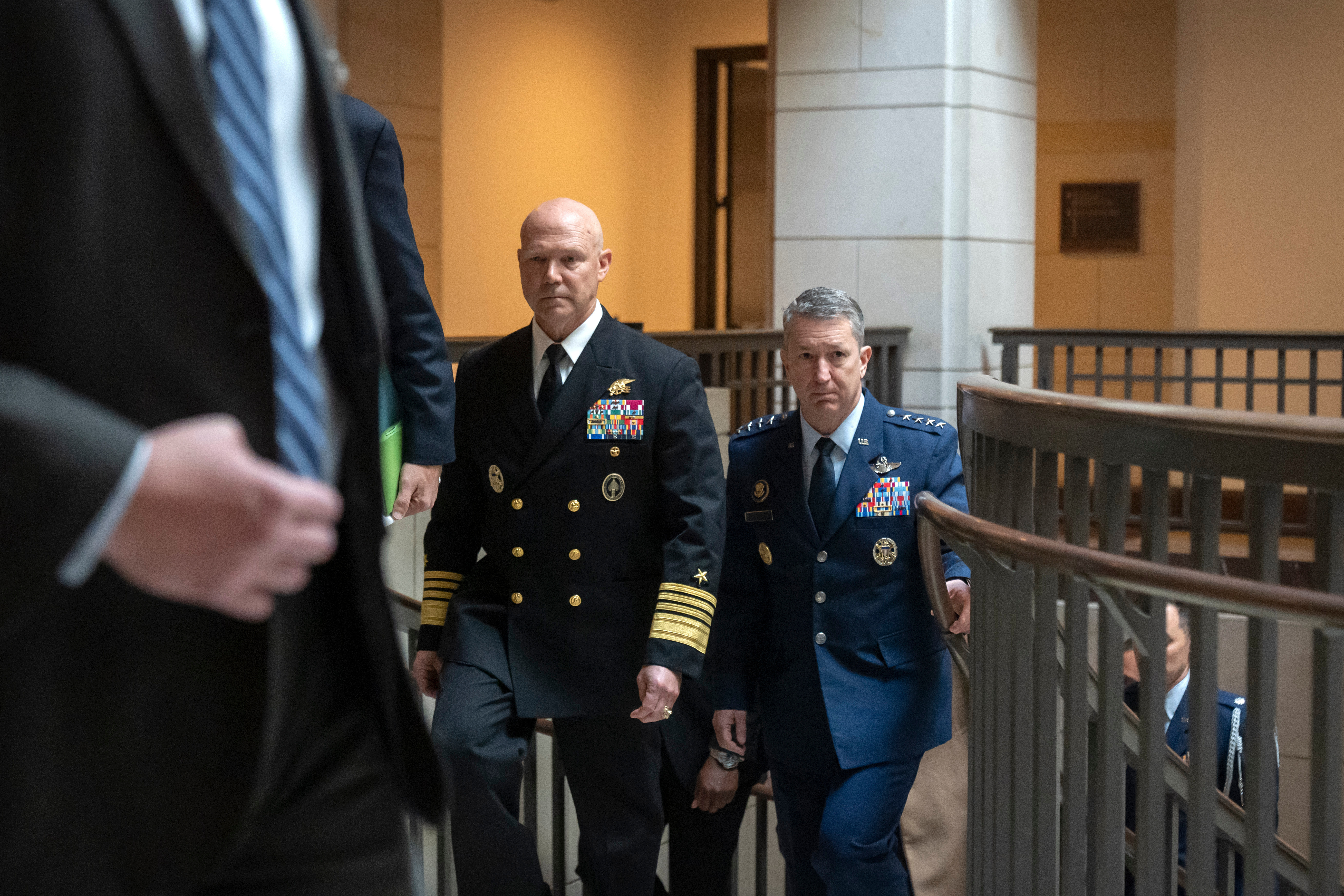
Adm. Frank M. Bradley, left, accompanied by Gen. Dan Caine, chair of the Joint Chiefs of Staff, right, walks to a meeting with senators on Capitol Hill on Dec. 4, 2025, in Washington, D.C. Photo:Mark Schiefelbein/AP
Bradley — now the four-star chief of Special Operations Command — consulted with Col. Cara Hamaguchi, JSOC’s staff judge advocate, before ordering SEAL Team 6 operators to attack the packed speedboat, according to government sources. In an instant, the vessel exploded and was engulfed in fire and shrouded in smoke. Two survivors pulled themselves onto a fragment of the overturned hull as the Americans watched from above.
According to officials, Bradley explained in briefings that because the September 2 attack was the initial strike of the campaign and was conducted by the secret plane, the survivors would have had no idea they were attacked by the aircraft. They probably believed the explosion was caused by a catastrophic engine malfunction, Bradley said in the briefing.
The two men were shipwrecked, helpless, or clearly in distress, six people who saw video of the attack said. Bradley watched as the injured men clung to what remained of the boat. “You had two shipwrecked people on the top of the tiny little bit of the boat that was left that was capsized,” Rep. Adam Smith, D-Wash., the ranking member of the House Armed Services Committee, said on CNN after viewing video of the attack.
Three sources familiar with briefings by Bradley provided to members of the House Permanent Select Committee on Intelligence as well as the Senate and House Armed Services committees confirmed that the men bobbed along, drifting with the current, for roughly 45 minutes. “They had at least 35 minutes of clear visual on these guys after the smoke of the first strike cleared. There were no time constraints. There was no pressure. They were in the middle of the ocean and there were no other vessels in the area,” said one of the sources.
[
Related
U.S. Military Killed Boat Strike Survivors for Not Surrendering Correctly](https://theintercept.com/2025/12/23/boat-strikes-venezuela-hegseth-bradley-legal/)
Bradley again turned to Hamaguchi for guidance on whether he could legally attack the shipwrecked men. Bradley, according to a lawmaker who spoke to The Intercept on the condition of anonymity to discuss a classified briefing, said that the JSOC staff judge advocate deemed a follow-up strike lawful. In the briefing, Bradley said no one in the room voiced objections, according to the lawmaker.
Five people familiar with briefings given by Bradley, including that lawmaker who viewed the video, said that the survivors waved their arms and, logically, must have been waving at the U.S. aircraft flying above them. All believed the men were signaling for help, rescue, or surrender. “Obviously, we don’t know what they were saying or thinking,” said one of the sources, “but any reasonable person would assume that they saw the aircraft and were signaling either: don’t shoot or help us.”
Raising one’s hands is a universal sign of surrender for members of armed forces. Under international law, those who surrender — like those who are shipwrecked — are considered hors de combat, the French term for those no longer in the fight, and may not be attacked. The Pentagon’s Law of War Manual is explicit on this point. “Persons who have been incapacitated by wounds, sickness, or shipwreck are in a helpless state, and it would be dishonorable and inhumane to make them the object of attack,” readsthe guide.
Bradley found a workaround. While he declined to comment to The Intercept, a U.S. official familiar with his thinking said he did not perceive their waving to be a “two-arm surrender.” About 45 minutes after the men had been thrown into the water, a second missile screamed down on Bradley’s order, killing them. Two more missiles followed in rapid succession, sinking the remnants of the boat.
In the immediate aftermath of the attack, President Donald Trump claimed in a Truth Social post that those killed by U.S. forces were “positively identified Tren de Aragua Narcoterrorists,” and members of a “designated Foreign Terrorist Organization.”
But from the very beginning, questions swirled among members of Congress and their staffers about the identities of those killed in the attack — and why there were so many of them.
During a classified briefing on Capitol Hill last fall, Rear Adm. Brian H. Bennett — a military officer overseeing Special Operations for the Pentagon’s Joint Staff — was asked if any of the people aboard the boat on September 2 could have been human trafficking victims. “They could be,” Bennett replied, according to two people present at the briefing.
One of the government officials at the briefing explained that questions arose about the few boats targeted by the U.S. with greater-than-expected numbers of people on board; the September 2 strike was singled out due to the especially large number of passengers.
Out of more than 60 strikes since, only four involved boats with six or more people aboard, almost all of them in the initial wave of attacks. In October 2025, there were two strikes on boats with six crew members and one with eight people on board. Since then, just one other vessel has had as many as six crew.
Sources and methods of identification were a major topic of the fall briefing, where it became increasingly clear that JSOC did not positively identify everyone on the boats, said the official. “Questioning then led to trying to understand who these people could be,” that official said.
“I was surprised. But only by the admission.”
The second source at the briefing said they were astonished by Bennett’s candor that victims of human trafficking might have been among those killed. “I was surprised. But only by the admission,” said that official.
Military officials with knowledge of the strikes also discussed the likelihood that some of those on board were being trafficked, were part of a more generalized smuggling operation, or had simply hitched a ride on the vessel, said another government official who was not at that briefing.
[
Related
Trump Administration Conjures Up New “Terrorist” Designation to Justify Killing Civilians](https://theintercept.com/2025/10/01/trump-venezuela-boat-strike-designated-terror-organization/)
In later classified briefings, the Pentagon’s story of who was aboard the vessel changed — but only marginally, said two government officials. Just one person aboard the go-fast boat on September 2 was a member of a so-called “designated terrorist organization,” while 10 were “DTO affiliates,” according to the officials who received those later briefings. Both said that they were under the impression that little more than a conversation with a DTO member might confer affiliate status but said that the military’s explanations were vague.
For weeks, The Intercept has sought to speak to Bennett, the deputy director for Special Operations on the Joint Staff, about the strikes and his briefings. “RADM Bennett is unavailable for an interview,” Maj. Annabel Monroe, a spokesperson for the Joint Chiefs of Staff, told The Intercept. “As a matter of policy, the Joint Staff does not confirm specific operational details or comment on ongoing or potential future military actions.”
Asked specifically for comment from Bennett and the Joint Staff about the trafficking remark and about how many victims of U.S. boat strikes may have been passengers of any sort, such as trafficking victims, smuggled persons, or paid passengers, Monroe replied: “Nothing further to add.”
Col. Allie Weiskopf, the director of public affairs at Special Operations Command, said the command was unaware of any allegations of victims of trafficking being killed on September 2 or in subsequent strikes.
“Targeting decisions are based on comprehensive assessments and reviewed through established processes,” a spokesperson for U.S. Southern Command told The Intercept. “Every narco-terrorist killed … was an affiliated member of a Designated Terrorist Organization actively transporting illicit material along known trafficking routes in international waters.”
A classified opinion from the Justice Department’s Office of Legal Counsel — drawn up by an interagency lawyers working group including representatives of the CIA, the State Department, White House counsel, Department of Justice, and the Department of War — claims that narcotics on supposed drug boats are lawful military targets because they generate revenue for cartels with whom the Trump administration claims they are in a “non-international armed conflict.” Government officials told The Intercept that the memo was not actually signed by Assistant Attorney General T. Elliot Gaiser until days after the September 2 attack. Attached to that secret memo is a similarly secret list of designated terrorist organizations.
Six current and former government officials briefed on the boat strikes or with experience in counter-narcotics smuggling efforts said that while the vessel struck on September 2 might have had cocaine on board, the sole intent of its voyage was not drug trafficking.
“No one would smuggle cocaine with 11 people on board their drug-running boat.”
“No one would smuggle cocaine with 11 people on board their drug-running boat,” said one of the current officials, noting that it was a waste of space, fuel, and created security risks. “It just is not done. Full stop.”
That official, who talked with The Intercept on the condition of anonymity to speak freely, said that the vessel’s profile more closely matched that of a ship smuggling various types of cargo, including people.
Retired Rear Adm. William Baumgartner, the former commander of the Seventh Coast Guard District who oversaw drug-interdiction operations in the Southeast U.S. and the Caribbean Basin, said the number of passengers was an obvious red flag. “I’m disappointed in the quality of planning for this operation,” he told The Intercept. “There appears to have been a lack of knowledge and expertise in what cocaine smuggling operations look like.”
The vessel that would become the target of the first Trump administration boat strike reportedly left San Juan de Unare in Venezuela on the night of September 1. The 11 men aboard all hailed from that town or nearby Güiria, coastal communities on the Paria peninsula in Venezuela’s Sucre state. It’s an impoverished region where 90 percent of the population is food insecure; the nongovernmental organization Transparencia Venezuela identified the area as the country’s prime center of, and transit hub for, human trafficking.
Reporting by Venezuela’s El Nacional identified Güiria and San Juan de Unare as having gone from fishing and tourist centers to “corridors of organized crime,” as the economic crisis in the country “drove many fishermen to replace fishing with smuggling gasoline, migrants, and eventually, drugs.” Some boats are known to carry mixed cargos of drugs, weapons, and people.
A 2020 report on human trafficking in the Caribbean found that Venezuela was “the greatest supplier of trafficking victims to Trinidad and Tobago” — and that 43 percent of those trafficked from Venezuela to Trinidad and Tobago travel from Sucre. It cited a Venezuelan government official who drew specific attention to Güiria due to its proximity to Trinidad and Tobago, stating it was “frequently used clandestinely for human trafficking.” A 2025 U.S. State Department report also highlighted the “long-standing allegation that national guard and coast guard members active in coastal states, such as Sucre and Falcon, facilitated the transport of trafficking victims to Aruba, Curaçao, and Trinidad and Tobago.”
A recent investigation by a consortium of journalists from Venezuelan outlets noted immigrant transport, people smuggling, and human trafficking is integral to the desperately poor population of Güiria and “as ordinary a job as teaching school — only far better paid.” The journalists wrote:
In this Venezuelan town, people do not call the illicit transportation of drugs and other goods … to neighboring Caribbean islands or Colombia’s Guajira Peninsula “drug trafficking” or “smuggling.” They call them vueltas—literally “runs” or “jobs”—borrowing the slang Colombian traffickers use for narcotics shipments, contract killings, or debt collections.
For many people in Güiria, those vueltas are the only path to a decent life.
According to a 2025 analysis by InSight Crime, a think tank that studies organized criminal activity in the Americas, gangs from Sucre are involved in “cocaine trafficking, human trafficking and smuggling, arms trafficking, and the contraband of animals and minerals.” Roughly 30 percent of trafficking victims who pass through the region wound up in sexual exploitation networks, Transparencia Venezuela found.
While trafficking victims are often assumed to be women and girls forced into sexual slavery — and many are — men and boys represent nearly half of the total number of human trafficking victims worldwide. And males are frequently mentioned in reports on Venezuela. A 2019 State Department investigation of human trafficking, for example, noted Venezuelan men were “increasingly vulnerable to forced labor in destination countries, including islands of the Dutch Caribbean.” A 2023 State Department report noted “an increase in male Venezuelan labor trafficking victims” in Trinidad and Tobago. It also details “migrant smuggling, which serves as traffickers’ primary method of transportation of victims from Venezuela.”
Between 2019 and 2022, 69 percent of Venezuelan immigrants in South America interviewed by the Mixed Migration Center reported having hired smuggling services to leave their country.
In 2023, the Curaçao Public Prosecutor’s Office also put out a warning about child trafficking, particularly from Venezuela: “Trafficked children range in age from 4 to 15 years old and are often transported in boats that also carry drugs and firearms on board.”
[
Related
“Trump Has Appointed Himself Judge, Jury, and Executioner”](https://theintercept.com/2025/12/12/venezuela-boat-strikes-video-press-coverage/)
An investigation by The Associated Press into the lives of nine of those slain in boat strikes examined the life of one of the men killed in the September 2 attack: Luis “Che” Martínez. The AP found that Martínez, a 60-year-old local crime boss, made his living smuggling both drugs and people across borders, according to several people who knew him. He had been incarcerated in late 2020 on human trafficking charges after a boat he had operated capsized, killing almost 25 people — including two of his sons and several other relatives, according to local reporting at the time. He was eventually released from custody and returned to smuggling people and narcotics, acquaintances told the news outlet.
In the aftermath of Trump’s first boat strike, the size of the death toll immediately surprised those knowledgeable about illicit trade in the region. “With 11 people on board, there could have been a human smuggling element as well,” InSight Crime observed just after the September 2 attack, noting that such go-fast boats generally have a crew of two or three people. “You do not need 11 people on board a single vessel to smuggle drugs, even for a very big consignment.”
“I would have expected much more attention to what smuggling operations look like and how to distinguish serious bulk cocaine smuggling boats from inter-island smugglers that might be primarily carrying passengers,” said Baumgartner, the retired Coast Guard rear admiral.
When questioned just a day after the initial strike, at a press conference in Mexico City, Rubio explained the reasons for the attack by first mentioning human trafficking. “The President of the United States has determined that narcoterrorist organizations pose a threat to the national security of the United States,” he explained. “They are traffickers of people, they are traffickers of deadly drugs,” he said.
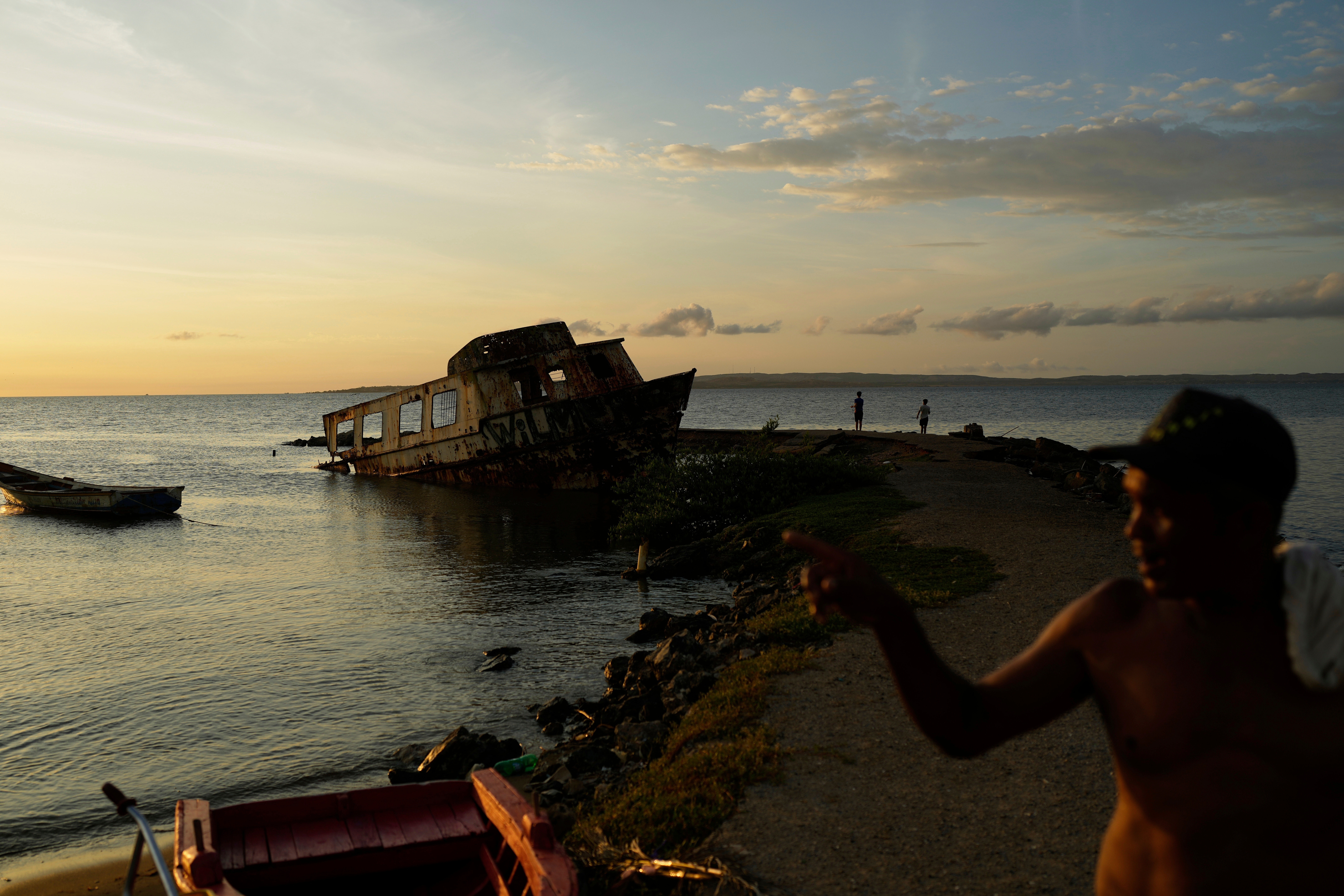
A boat sits stranded along the shore in Cumana, the capital of Venezuela’s Sucre state, on Sept. 12, 2025. Photo: Ariana Cubillos/AP File
Facing outrage over the extrajudicial killings, Bradley has attempted to quiet questions about who the U.S. has targeted.
In recent testimony before the Senate Armed Services Committee, Bradley confirmed significant involvement in the boat strikes by the National Security Agency. He has also reportedly told lawmakers that U.S. intelligence officials had verified the identities of the 11 people on the boat on September 2 and validated them as legitimate targets. But Special Operations Command would not confirm what Bradley told lawmakers about the identities of the 11 people killed. And numerous government officials who spoke to The Intercept said that claims that intelligence “confirms who these people are” — as Pentagon press secretary Kingsley Wilson asserted in December — is a rhetorical sleight of hand, if not an outright lie.
JSOC did not know the names or supposed affiliations of all persons aboard the vessel struck on September 2, numerous government sources told The Intercept.
Two sources specifically mentioned that some passengers were identified only by an obvious nom de guerre. “I don’t think we knew the identities of any of the people in the boat. We might have known one or two. … But we certainly didn’t know the identities of all 11,” Democratic Rep. Jim Himes, D-Conn., said in December. “I don’t think we have any idea, who precisely, any of the individuals in these boats are.”
“Srikes [sic] are deliberate, lawful, and precise — aimed squarely at narco-terrorists and their enablers, not civilians,” a Southern Command spokesperson told The Intercept by email. “SOUTHCOM has full confidence in the operational and intelligence professionals who inform our missions.”
[
Read Our Complete Coverage
License to Kill ---------------](https://theintercept.com/series/license-to-kill/)
SOUTHCOM routinely claims, in fact, that “intelligence” confirms that targeted vessels are “engaged in narco-trafficking operations.” But last week, Sen. Tim Kaine, D-Va., a member of the Senate Armed Services Committee, revealed that “the presence of narcotics on a boat is not one of the targeting criteria” involved in the boat strikes.
Behind closed doors, in fact, Pentagon officials don’t even pretend that they need to know who they are attacking. “They said that they do not need to positively identify individuals on the vessels to do the strikes,” Rep. Sara Jacobs, D-Calif., a member of the House Armed Services Committee and the Subcommittee on Intelligence and Special Operations, toldThe Intercept in October. “They just need to show a connection to a DTO or affiliate.”
Most of the government officials, including lawmakers briefed on the attacks, who spoke with The Intercept said that they believed the vessels targeted in the campaign are involved in illicit trafficking and are not simply fishing boats. But without stopping and searching boats, many said it was impossible to know for certain who and what is aboard a particular vessel.
In late April, Bradley told members of the Senate Armed Services Committee that the boat strikes are built upon the targeting procedures of the post-9/11 drone wars. “It is based off of the lessons learned and the processes perfected over the last 25 years of persona targeting,” he said, referring to strikes targeting people. Over that span, the U.S. has consistently killed civilians the world over — from Afghanistan to Iraq, Pakistan to Somalia and Libya to Yemen — due to intelligence failures and targeting errors.
“There has never been a ‘perfecting’ of persona targeting.”
“There has never been a ‘perfecting’ of persona targeting. Just because the U.S. military — and other U.S. forces — conducted many strikes against known targets under the moniker of counterterrorism does not mean that they became significantly better at it over time,” said Sarah Yager, a former senior adviser to the chair of the U.S. Joint Chiefs of Staff. “Over those same two decades being lauded as a time of learning lessons for the U.S. military, human rights groups documented repeated civilian deaths tied to flawed intelligence or assumptions or bias.”
A 2023 investigation by The Intercept, for instance, revealed a raft of errors leading up to a drone strike in Somalia that killed three, and possibly five, civilians, including 22-year-old Luul Dahir Mohamed and her 4-year-old daughter, Mariam Shilow Muse. The Pentagon’s inquiry found that the Special Operations forces who conducted the strike were confused, despite months of “target development,” and argued about basic details, like how many passengers were in the targeted vehicle. They mistook a woman and child for an adult male and never even knew how many people they killed.
“When Adm. Bradley references ‘the lessons learned and the processes perfected over the last 25 years of persona targeting,’ he’s actually invoking an architecture that human rights groups criticized regularly for overconfidence in the intelligence, confirmation bias and assumptions, and institutional incentives to interpret ambiguity as threat confirmation,” Yager said.
[
Related
The U.S. Still Owes Money to Family of 10 Afghans It Killed in “Horrible Mistake”](https://theintercept.com/2023/05/17/kabul-drone-strike-survivor-payment/)
Five experts, including current and former government officials, say that it’s impossible that the U.S. has not killed innocent people in its boat strike campaign given the long-standing limitations of U.S. targeting procedures, such as an overreliance on signals intelligence, or SIGINT. In recent testimony before the Senate Foreign Relations Committee, Rubio admitted that the U.S. has erroneously identified boats as possible targets, only to pull back. “I can tell you they do walk away from strikes,” he said. “There are multiple times that I’ve been aware of … because it doesn’t meet the criteria or because there’s doubt.”
“Secret planes and SIGINT aren’t the answer. Confirmation bias continues to be a problem,” one government official briefed on the boat strikes told The Intercept. That official said it was far more likely that U.S. forces had misidentified or outright failed to notice a person aboard one of the boats that have been struck than that they knew the names and affiliations of everyone they had killed.
Government statistics confirm the limitations of intelligence, profiling, and the ability of U.S. personnel to identify supposed drug traffickers from afar. Between September 1, 2024, and October 7, 2025, the Coast Guard interdicted 212 boats headed toward the U.S. that it suspected of drug-trafficking. Forty-one of them, or about 20 percent, had no illicit contraband on board, according to official statistics. As for ships just off the coast of Venezuela, the amount wrongly suspected of carrying drugs was a shade higher: 21 percent.
When asked about the statistics showing 1 in 5 vessels had no drugs aboard, Yager told The Intercept that “positive identification of both targets and civilians has been a known problem in the U.S. military kill chain.”
“In the case of the boat strikes, that’s a high rate of mistaken identity,” she said. “My guess is that the U.S. military has no idea who these people actually are before moving to kill them.”
The post Top Pentagon Official Admits Boat Strike May Have Killed Victims of Human Trafficking appeared first on The Intercept.
From The Intercept via This RSS Feed.

With regards to “trafficking”:
https://globalsanctions.com/region/venezuela/
Venezuela At a glance There are no UN sanctions on Venezuela. The EU and UK have imposed sanctions on Venezuela since 2017. The US first imposed sanctions on Venezuela in 2005 in response to what the US said was Venezuela’s absence of cooperation with US anti-drug and counter-terrorism efforts. The US imposes sectoral sanctions related to transactions with the Venezuelan government and targeted sanctions on those involved in actions or policies undermining democratic processes or institutions.
Overview UN Sanctions
There are no UN sanctions on Venezuela.
EU Sanctions
In 2017 the EU adopted sanctions in response to the “deterioration of democracy, the rule of law and human rights” in Venezuela. These are still in place; an arms embargo, travel restrictions and asset freezing measures on those responsible for serious human rights violations or abuses or the repression of civil society and democratic opposition, and those whose actions, policies or activities otherwise undermine democracy or the rule of law in Venezuela by Council Regulation (EU) 2017/2063 and Council Decision (CFSP) 2017/2074.
UK Sanctions
UK sanctions are in the Venezuela (Sanctions) (EU Exit) Regulations 2019 – an arms embargo, asset freezes, and travel bans.
US Sanctions
The US first imposed Venezuela sanctions in 2005 in response to Venezuela’s absence of cooperation with US anti-drug and counter-terrorism efforts. Since then, the US has made annual determinations that Venezuela has failed to adhere to its commitments under international narcotics and anti-terrorism agreements.
In 2015, the Obama administration issued EO 13692, which targets (for asset blocking and visa restrictions) people and entities involved in human rights abuses and corruption. Government figures including President Nicolás Maduro were sanctioned in 2017. The US issued further EOs in 2018 and 2019, which prohibited access to US financial markets and blocked the property and interests of the Maduro government in the United States and within the control of US persons. The US has issued various Venezuela-related licences and revoked licences enabling oil business in Venezuela in March 2025. Since April 2025, any country that imports Venezuelan oil may be subject to a 25% tariff on its exports to the US.
In December 2025, the US seized two oil tankers off the coast of Venezuela and ordered a blockade of sanctioned vessels travelling to/from Venezuela. In January 2026, Nicolás Maduro and his wife, Cilia Flores, were brought to the US to face narcoterrorism charges. 4 other people, including Mr Maduro’s wide and son, were also charged with similar offences.