

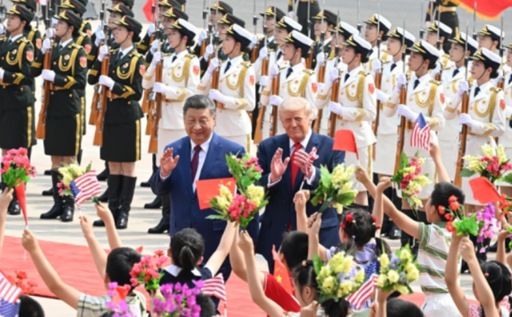
In the following article for the Palestine Chronicle, veteran Palestinian-American journalist Ramzy Baroud reflects on the deeper significance of Donald Trump’s recent state visit to China, and on what the accelerating decline of US hegemony means for the Arab world. Baroud argues that Trump’s visit will be remembered as the moment Washington tacitly acknowledged Beijing’s … Continue reading The rise of China and the imminent US exit: What must the Arabs do?
The post The rise of China and the imminent US exit: What must the Arabs do? appeared first on Friends of Socialist China.
From Friends of Socialist China via This RSS Feed.
The moment is comparable only to Richard Nixon’s historic 1972 visit to Beijing, though the circumstances are entirely different. Back then, the US’s aim was to exploit the Sino-Soviet split and gain leverage over the Soviet Union in exchange for the normalization of diplomatic ties.
In 1972, China was an economically isolated, agrarian society recovering from internal upheaval. Today, Beijing is a financial giant boasting the world’s largest economy by purchasing power parity, a critical hub of global supply chains, and a leader in next-generation technologies like Artificial Intelligence.
Militarily, the People’s Liberation Army has transformed into a powerful navy and high-tech force capable of denying access to the Western Pacific. This vast economic and military expansion translates into unparalleled global influence, altering the balance of power across Asia, Africa, and Latin America.
All this in mind, Trump’s visit to China appears to be more about a declining empire attempting to manage its own contraction—a move that will likely lead to serious concessions.
Nowhere is the US’s dwindling status more apparent than in the Middle East. Decades of disastrous military campaigns, political alienation, and the unraveling of traditional alliances have eroded Washington’s credibility. Regional powers no longer view the US as an indispensable security guarantor, looking instead toward a multipolar future.
