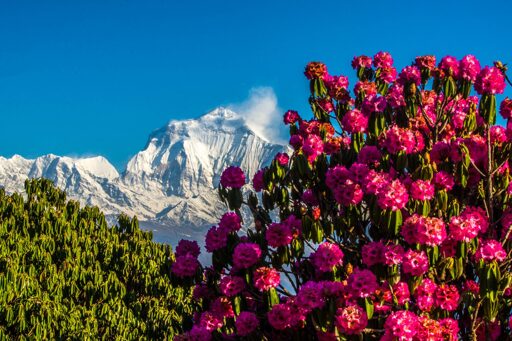
TINJURE-MILKE-JALJALE, Nepal — Every April, Nima Sherpa’s family used to picnic in a rhododendron (lali guras in Nepali) forest about 5 kilometers (3 miles) from her home at Basantapur Bazaar in Tehrathum in the Tinjure-Milke-Jaljale (TMJ) region, which stretched across the eastern districts of Tehrathum, Taplejung and Sankhuwasabha. It has been five years since her family has done so as they no longer have the time. Instead of enjoying their time in the forest, they said, they are busy running their hotel in Basantapur Bazaar, which sees a big surge in tourism for only a few weeks. This is when the hillsides get covered in crimson, pink and white blooms of at least 26 species of rhododendron (Rhododendron spp.), the national flower. All family members get busy welcoming guests with smiles and souvenirs. This year alone, local officials estimate that around 500,000 visitors entered the TMJ area between April 1-15. One of the “souvenirs” growing in popularity among visitors is the flower-based alcohol, bottled in reused containers with handwritten labels and openly displayed in shops across. But authorities remain unaware of where the flowers are harvested, whether extraction levels are sustainable, and of the safety of the unlabeled products. Rhododendron trees in Tinjure. Image by Nirmal Dulal via Wikimedia Commons (CC BY-SA 4.0). A trade hiding in plain ssight In April this year, Mongabay found bottles of rhododendron liquor displayed openly in shops catering to tourists in Basantapur Bazaar and nearby Gufa Pokhari, in Chainpur municipality, Sankhuwasabha district. Several shopkeepers…This article was originally published on Mongabay
From Conservation news via This RSS Feed.
The products are typically sold in reused bottles of popular soft drinks with handwritten labels or no labels at all. Shopkeepers said most buyers are domestic tourists from cities such as Kathmandu and Dharan, although Indian visitors from West Bengal and Assam states also buy the bottles as a souvenir linked to the flowering season.
“I bought a bottle because everyone was talking about it,” said Balaram Jaisi, a tourist from Guwahati, Assam. “People think it is organic and traditional. I didn’t really think about where the flowers came from.”
Khem Dahal, a shopkeeper in Basantapur, acknowledged selling rhododendron alcohol from his store. He insisted, however, that his family uses flowers grown in private gardens rather than harvest from forests. “My family makes this alcohol from flowers grown in our garden,” Dahal said. “We do not collect them from the forest.”
Nepal’s conservation laws ban commercial harvesting of rhododendron flowers from community forests without approval. But officials say they don’t know how to apply the rules to flowers grown in private gardens. However, local officials acknowledged there is little clarity over whether small-scale alcohol production from privately cultivated flowers falls under forest law, local excise regulation, or food safety oversight. The law also allows local people to brew alcohol up to 10 liters (2.6 gallons) for personal use if they belong to a community where the consumption of traditional alcohol is culturally accepted.