
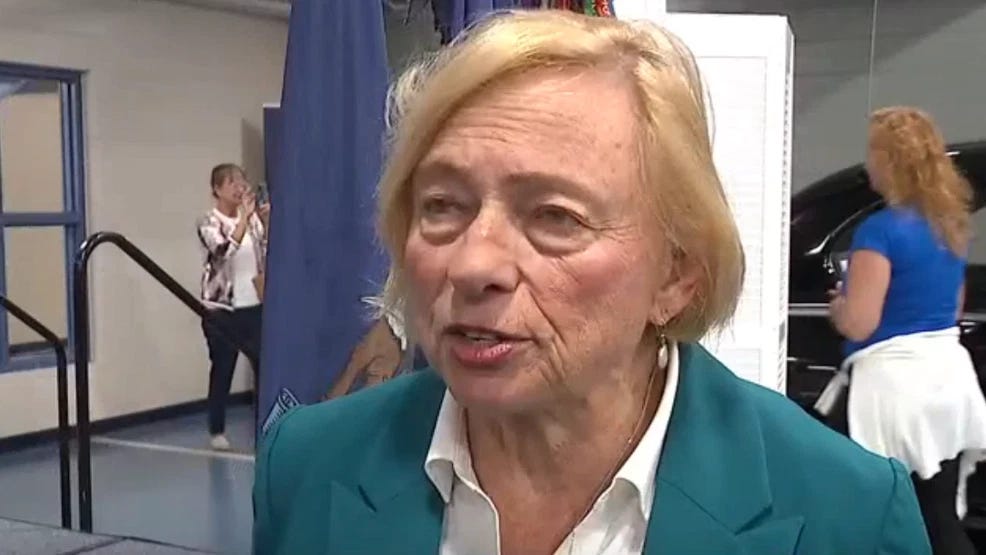
Janet Mills (be nice!)
Subscriptions have been declining; please become a paid subscriber so I can keep doing this work
Janet Mills is out.
The 78-year-old Maine Governor suspended her Senate campaign today. The official story — dutifully repeated by Washington-obsessed major media — is that she didn’t have enough money.
The truth is that she didn’t have enough people.
While the major media chews over campaign strategy and timing and what she shoulda woulda coulda done differently, here’s what actually happened: Americans didn’t want her, and they refused to budge. It’s an extraordinary victory of public will.
Mills was handpicked by Senate Leader Chuck Schumer himself. Party leadership saw her as their best shot at toppling Susan Collins — the only Republican senator from a state Kamala Harris won. Voters were endlessly browbeat about how inexperienced her primary opponent was, how this race was existential, how a vote against Mills was a vote for the political abyss.
There was a time when that kind of emotional blackmail worked. Not anymore.
And no, this didn’t happen because Mills “did not want to run for Senate,” as The New York Times put it. If you take a look at Mills’ announcement today, you can practically hear her grinding her teeth through it:
“While I have the drive and passion, commitment and experience, and above all else — the fight — to continue on, I very simply do not have the one thing that political campaigns unfortunately require today: the financial resources. That is why today I have made the incredibly difficult decision to suspend my campaign for the United States Senate.”
That is not how someone whose heart isn’t in it sounds. From the start of her campaign it was clear that she was hellbent on winning. Mills opened with one of the most brutal opposition research salvos I’ve ever seen one Democrat throw at another — even digging up Reddit posts her opponent had written more than a decade ago and turning them into TV ads. When that didn’t work, she tried to defuse the age issue by pledging to serve only one term.
She was absolutely playing to win. She just lost.
Or, put another way, the voters won.
Not that the legacy media noticed. Virtually every major outlet ran with Mills’ own “I ran out of funds” line — a verbal sleight of hand that makes it sound like a budgeting problem, like her campaign manager overdrew her checking account. None of them asked the obvious follow-up: why didn’t she have the money? That question doesn’t get asked because asking it puts voters at the center of the story instead of Washington donors and consultants. Mills’ opponent, Graham Platner, had money — because people gave it to him. People who wanted him to win.
That’s the whole story, and it’s the one none of these major media organs are telling. Instead we get “she said she ran out of financial resources.” Consider the lede sentences of the three biggest papers’ stories on her exit:
New York Times: “Gov. Janet Mills of Maine, the Democratic establishment’s choice to run for the Senate seat long held by Senator Susan Collins, a Republican, suspended her campaign on Thursday, saying she no longer had the financial resources to compete against Graham Platner, a progressive political newcomer.”
Washington Post: “Maine Gov. Janet Mills announced Thursday she is dropping out of her race to take on Republican Sen. Susan Collins in the crucial state for Democrats’ hopes of winning Senate control, saying she had run out of money to compete.”
Wall Street Journal: “Maine Gov. Janet Mills dropped out of the Democratic Senate primary on Thursday, saying she didn’t have the financial resources to stay in the race after months of trailing behind her progressive opponent Graham Platner in opinion polls.”
This is a beautiful illustration of the problem with news media conventions (what I call Journalism 1.0), which hold that the reporter must quote what the official person said — even if it’s obvious bullshit. And boy does this one reek.
The numbers tell the real story. Platner — an oyster farmer who was a complete unknown until last August — outraised Mills nearly 4 to 1, $4.8 million to $1.5 million. He led her by as much as 27 points in primary polling. He drew crowds to more than 60 town halls in a state with barely a million voters.
Mills didn’t just “run out of money.” The voters rebelled against her and the party machine, and she couldn’t keep up.
But again, to tell that story, the major media would have to put voters on center stage instead of Washington wonkery about cashflow and ad spend. It would also force an uncomfortable question on the people who run the Democratic Party: what does it mean that Schumer’s hand-picked recruit — a sitting governor, the first woman elected attorney general in Maine, the first woman elected governor in Maine — couldn’t generate any support?
As for Platner, his simple anti-old ways message and affordability patter is clearly what people want right now. The press has spent months pointing out that he has no credentials, no qualifications, believes the wrong things, is anti-party, an “upstart,” a “newcomer” — at a time when rank-and-file voters could not possibly care less.
The candidates the party keeps putting up — are old, scripted, allergic to risk, and fluent only in the dialect of cable news. They are not who voters want. Mills would have been the oldest freshman senator in American history. She would have been 86 at the end of her first term. Think about that. At a moment when even mainstream Democrats are begging for generational change, the party’s solution to flipping a must-win seat was a 78-year-old whose pitch was essentially “I have been around a long time.”
People are fed up with an establishment that doesn’t listen, that tells them everything is under control even as it drives the country into a ditch. So they’re taking the keys away.
And here’s the thing I keep coming back to: this is the same energy, the same rage, the same loss of faith in institutions driving everything else right now — including the wave of political shootings we keep seeing. I’m not equating them. Voting a geriatric establishment hack out of a primary is a healthy democratic outcome. Shooting a CEO or a politician is not. But they spring from the same well. People do not believe their voices are heard through normal channels. They do not believe the people in charge are competent, honest, or even particularly aware of what life is like outside the bubble they live in.
And the thing is, they’re right.
Subscribe if you think it’s insane that a 78-year-old was running for Congress
— Edited by William M. Arkin
From Ken Klippenstein via This RSS Feed.
You must log in or # to comment.
While the major media chews over campaign strategy and timing and what she shoulda woulda coulda done differently, here’s what actually happened: Americans didn’t want her, and they refused to budge. It’s an extraordinary victory of public will.
Mills was handpicked by Senate Leader Chuck Schumer himself. Party leadership saw her as their best shot at toppling Susan Collins — the only Republican senator from a state Kamala Harris won. Voters were endlessly browbeat about how inexperienced her primary opponent was, how this race was existential, how a vote against Mills was a vote for the political abyss.
There was a time when that kind of emotional blackmail worked. Not anymore.