

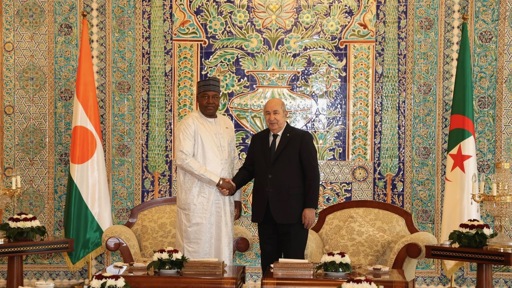
The president of the Republic of Niger, Abdourahamane Tchiani, paid a two-day official visit to Algiers from February 15–16, 2026, where he was received at the El Mouradia Palace by his Algerian counterpart, Abdelmadjid Tebboune. Both governments framed the visit as a turning point in bilateral relations, following months of strain that had unsettled diplomacy across the Sahel.
Relations between Algeria and Niger deteriorated sharply in April 2025 after Algeria shot down a drone linked to Mali, a key member of the Alliance of Sahel States (AES). The incident triggered a coordinated diplomatic response; Mali, Niger, and Burkina Faso recalled their ambassadors from Algiers. Against this, the Algiers meeting sought to repair ties, reaffirm principles of good neighborliness, and reposition Algeria–Niger relations as a stabilizing anchor in a volatile region.
Security and regional cooperation
In a joint media appearance, President Tchiani stressed the indivisibility of the two countries’ security, declaring that “the security of Niger is from the security of Algeria … and [we are] in the same trench in all circumstances.” The Algerian presidency echoed this sentiment, reiterating effective solidarity in the face of terrorism and cross-border organized crime.
To operationalize this commitment, the leaders agreed to immediately reactivate bilateral security mechanisms, intensify border surveillance, and strengthen coordination strategies to combat terrorism and related threats along their shared border.
Both presidents reaffirmed adherence to core diplomatic principles, respect for sovereignty, territorial integrity, non-interference, and African-led solutions to African crises. They jointly rejected foreign interference on the continent and argued that the future of the Sahel must be shaped by local, inclusive approaches led by states of the region themselves.
According to a published statement, their meeting converged on broader regional and international issues, calling for African-led political solutions to regional crises, the restructuring of the regional security architecture, and reform of the international financial system to guarantee fair access to climate and development finance for African countries. They also committed to revive and institutionalize bilateral cooperation mechanisms through regular high-level consultations and the reactivation of joint frameworks.
Diplomatically, the two sides agreed to maintain relations at the highest level and to revive stalled cooperation frameworks by convening the Algeria–Niger Joint High Committee in Niamey before the end of the first half of 2026, instituting regular political and sectoral consultations, and accelerating the adoption of pending agreements across multiple sectors. Such agreements include priority areas, including geological and mineral research, SMEs and start-ups, postal and telecommunications, digitalization, culture, youth and sport, and broader integration initiatives.
Infrastructure and connectivity
Algeria and Niger committed to fast-tracking major structural and connectivity projects, including the completion of the Desert Transit Road Project, the establishment of a trans-border fiber-optic link, progress on the Desert Transit Gas Pipeline, and expanded energy cooperation encompassing hydrocarbons and renewable energy, with particular concentration on electrifying rural border areas.
Turning point?
Tensions between Algeria and Mali have shaped recent debates across the Sahel, especially as Niger redefines its diplomatic and security posture. Cooperation with Algiers has elicited mixed reactions on the continent, particularly given Algeria’s perceived hostility toward Mali’s transitional authorities, a central member of AES. But, Aboubakar Alassane of the West Africa Peoples Organization (WAPO), in dialogue with People Dispatch, frames the situation differently. He argues that “the fight against terrorism unfortunately passes through Algiers in the Sahel,” emphasizing Algeria’s long counterinsurgency experience and its strategic weight in North and West Africa. He further links this to Russia’s growing presence, suggesting that Algiers and Moscow remain key geopolitical reference points for Sahelian regimes seeking alternatives to Western security frameworks.
The recent summit of the African Union in Addis Ababa pointed to a renewed emphasis on “African solutions to African problems.” For proponents of Niger–Algeria relations, this represents an opportunity; the AES, they argue, cannot afford isolation if continental diplomatic momentum is shifting toward negotiated settlements, as Alassane notes. And importantly, Niger, remains anchored in what it presents as a genuine struggle for sovereignty in the Alliance of the Sahel.
Read more: AU adopts landmark resolution on slavery, colonialism, and reparatory justice
The post Niger and Algeria rebuild ties following Sahel diplomatic strains appeared first on Peoples Dispatch.
From Peoples Dispatch via This RSS Feed.
They choose empire.
