

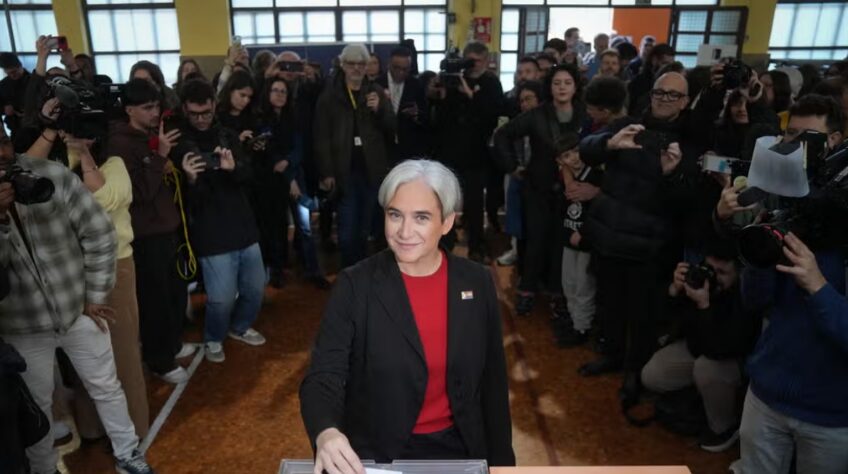
Ada Colau election day puts women’s votes at the center as she condemns Feijóo’s “calladita” remark and urges a massive turnout.
Ada Colau Election: 1 Fierce Call to Women Shakes Spain’s Vote
The Ada Colau election campaign ended with a direct appeal to women and a sharp confrontation over machismo. The Frente Amplio candidate voted shortly after 11:00 a.m. at the Institut La Sedeta in Barcelona’s Gràcia district.[huelvainformacion]
After casting her ballot, Colau called for a massive turnout. She warned that “there is a great deal at stake” and that these are “not just any elections.”[huelvainformacion]
Her message focused on participation and on the role of women. “Women are not going to stay quiet” in the face of fear and polarization, she said, urging voters to defend democracy at the polls.[metropoliabierta.elespanol]
[Polls Open in Spain for Snap General Elections: Ada Colau Election: 1 Fierce Call to Women Shakes Spain’s Vote](https://www.telesurenglish.net/ada-colau-election/)
Ada Colau Election Day: A Call to Women Voters
The Ada Colau election day appearance was carefully staged. Colau arrived at the school where she voted surrounded by supporters and media, in the same district where she served as Barcelona mayor.[huelvainformacion]
She became the third major national candidate to vote, after Pedro Sánchez and Alberto Núñez Feijóo, both in Madrid. Her timing and message were designed to dominate the midday news cycle.[huelvainformacion]
Colau said women would have “the last word” in these elections. “It is a day when women have to raise their voices, not stay silent,” she declared.[huelvainformacion]
She also criticized parties that, in her view, tried to mobilize voters by “inciting hatred against those who are different.” She called for a broad, civic mobilization in response.[metropoliabierta.elespanol]
El País coverage of Spain’s 2026 election
Catalonia and the National Stage
The Ada Colau election strategy sought to connect Catalonia with the national race. She recalled that Catalonia “has never stood aside” and expressed hope that it would remain engaged.[huelvainformacion]
Colau is trying to return to national politics after years as Barcelona mayor and a period of activism. Her party, Frente Amplio, is competing for space on the left alongside the PSOE and Podemos.[metropoliabierta.elespanol]
She avoided being drawn into a controversy over Feijóo’s decision to spend the reflection day in Ceuta. Instead, she said she would spend election day with her family and follow the results with “excitement and expectation.”[huelvainformacion]
That discipline was notable. Throughout the campaign, Colau has tried to stay focused on social issues and avoid the kind of confrontation that could alienate moderate voters.[metropoliabierta.elespanol]
The Feijóo Clash That Defined the Campaign
The Ada Colau election narrative was shaped by her exchange with Feijóo during the four-way debate on November 26. The Popular Party leader told her “and you, quiet down” during a discussion about the Valencia floods.[newtral]
Colau had challenged Feijóo over the fact that former Valencian President Carlos Mazón remains in office and retains legal immunity after the disaster. Feijóo responded by accusing Colau and her party of staying silent during the coalition government.[newtral]
“Good management is leading a national emergency and not running away from Paiporta, and you, quiet down,” Feijóo said, referring to Sánchez’s departure from the flood-hit town in 2024.[newtral]
Sánchez immediately intervened. “Why do you talk about ‘quiet down’? What kind of machismo is this?” he asked. The PSOE later described the remark as sexist.[newtral]
E Newtral fact-check of the “calladita” exchange
A Phrase That Would Not Go Away
Feijóo tried to contain the damage. He said he would withdraw the word “calladita” if it had offended anyone. But hours later, at the PP headquarters in Génova, he used it again.
“They have been very quiet, men and women, during three years of corruption and looking the other way,” he said. He also mocked Colau’s party as the “Narrow Front.”
Colau accused him of “sexist behavior” and of losing the debate. “He will have to assume his actions and answer for them. Women are not going to stop and we are going to vote en masse,” she said.
The exchange turned the final days of the campaign into a referendum on machismo and the women’s vote. What began as a debate over flood management became a national conversation about respect and representation.[elperiodico]
Media and Political Reactions
The Ada Colau election message resonated beyond her own party. Socialist leaders condemned Feijóo’s remark. Former minister Pilar Alegría said that if there were a “sexism meter,” the PP leader “would break it.”[elcorreo]
Other PSOE officials, including Félix Bolaños, also criticized the phrase. The PP insisted that it had been taken out of context and that Feijóo was referring to Colau’s political record, not her gender.[elcorreo]
The controversy dominated television panels and social media. Clips of the exchange went viral, and “calladita” became a trending topic for hours.[elperiodico]
International media also picked up the story, framing it as a defining moment in a polarized campaign. For Colau, the attention was an opportunity to consolidate her base and attract women voters.[elperiodico]
A Polarized Election
Spain voted on November 29 to elect 350 deputies and 209 senators. The main candidates were Pedro Sánchez of the PSOE, Alberto Núñez Feijóo of the PP, Santiago Abascal of Vox, Ada Colau of Frente Amplio, and Irene Montero of Podemos.
The campaign was marked by polarization, the debate over the Valencia floods, and the rise of Vox. In that context, the women’s vote became a decisive battleground.[elperiodico]
Colau sought to capitalize on the Feijóo clash to mobilize urban and progressive voters. Her final message was aimed at women who felt targeted by the rhetoric of the right.[elperiodico]
The result for Frente Amplio will depend on whether that message translated into votes. The party needs to clear the threshold to enter Congress and become an influential voice in the next legislature.
Geopolitical Context
The Ada Colau election story reflects a broader shift in European politics. The rise of the far right and the polarization of public debate have made gender and identity central issues in electoral campaigns.
Spain’s election is also watched across Latin America. The country remains a key bridge between Europe and the region, and its political direction affects trade, migration, and diplomatic ties.
The clash over machismo echoes debates in other countries, where right-wing leaders have been accused of using condescending language toward women. Those episodes can energize progressive voters but also deepen divisions.[elperiodico]
The broader geopolitical meaning is that the Spanish election is not only about seats in Congress. It is part of a wider contest over the tone and values of democratic politics in Europe and beyond.
What Comes Next
The immediate next step is the vote count. Colau plans to spend election night in Madrid with the Frente Amplio leadership, following results with “excitement and expectation.”
If her party enters Congress, Colau could play a role in coalition negotiations or in shaping the opposition agenda. If it falls short, her national project will face a difficult reset.
The “calladita” episode will remain part of the campaign’s legacy. It highlighted how a single phrase can reshape a debate and mobilize an electorate.[elperiodico]
For now, the Ada Colau election campaign has ended with a clear message: women will not be silent. Whether that message changes the balance of power will be decided at the ballot box.[huelvainformacion]
Polls Open in Spain for Snap General Elections
From teleSUR English via This RSS Feed.