

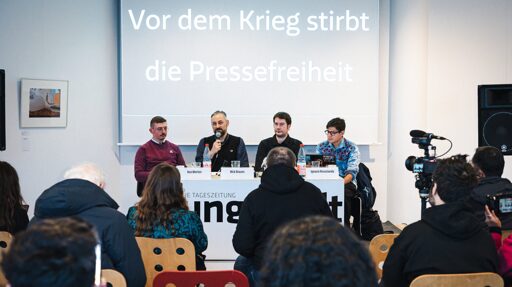

The progressive German newspaper junge Welt, together with its journalists, contributors, and readers, is under increasing pressure from German authorities. The outlet detailed on Friday how that pressure includes threats to deport media workers and de facto work bans for some junge Welt writers.
“junge Welt is to be made an example of,” said editor-in-chief Nick Brauns, “and an opposition voice against massive rearmament, conscription and ‘war-readiness’ is to be silenced.”
Journalists under threat of deportation
Among those under institutional attack is journalist Ignacio Rosaslanda. His passport was recently confiscated, and he is being pushed to leave Germany in less than 70 days or face arrest and deportation.
Rosaslanda and his legal representatives emphasized these attacks represent an assault on press freedom and linked them with his coverage of Germany’s support for the Israeli occupation.
“My journalistic work has always focused on human rights issues,” Rosaslanda said during the press conference. “And it was precisely the quality of my work for which I was originally hired here. It only became a problem when it turned to Palestine and Germany’s complicity in the genocide in Gaza.”
Looming work bans
The Mexican journalist is not the only one facing repercussions for writing critically about Germany’s conduct in international relations. Journalist and founder of the red.media project, Hüseyin Doğru, was placed on an EU sanctions list in 2025. “As a result of the sanctions, the economic existence of Doğru and his family is acutely threatened,” junge Welt emphasized.
The newspaper intended to employ Doğru as an editor, but the sanctions made this impossible. “Since he is also prohibited from taking up paid work, junge Welt may neither employ him nor pay him for any work, on pain of heavy penalties for a sanctions violation.”
Read more: Artists and activists speak out against Germany’s anti-Palestinian censorship
junge Welt authors holding jobs in other sectors have faced a ripple effect, potentially risking their livelihoods. Ken Merten, a regular contributor, faces the threat of being banned from working as a night guard in a refugee shelter. The threat dates back years, Merten pointed out on Friday.
“Already in the first attempt to saddle me with a de facto occupational ban as a security guard, an employee of the regulatory office presented to me in 2024 what the State Office for the so-called Protection of the Constitution holds on me: German Communist Party (DKP) membership, former membership in the Socialist Workers’ Youth (SDAJ), but also my journalistic work for Unsere Zeit and junge Welt.”
Examples described at junge Welt’s press conference signal an expansion of this repressive trend in all sectors. According to the outlet, a former staff sergeant major of the Bundeswehr, the German Armed Forces, said he was pressured by the Military Counterintelligence Service to cancel his junge Welt subscription and leave the cooperative that publishes the newspaper.
“Otherwise, he was told he would have to fear consequences for himself and his family.”
Persecution of “left-wing extremism”
All of this is taking place as junge Welt’s publisher, Verlag 8. Mai, continues to contest a designation of “confirmed left-wing extremism” in court. The label has been used to describe the outlet in German intelligence service reports for years and is now invoked to pressure many of the journalists in these specific cases – despite the judgment upholding it is not yet legally binding. The court case remains delayed, further enabling attacks on the outlet and people connected to it.
Read more: Gen Z protests in Germany met with racial profiling and police harassment
“All of this is an attempt to enforce a quiet ban on an unwelcome newspaper, also so as not to face a public debate about the deplorable state of press freedom in Germany,” concluded Sebastian Carlens of Verlag 8. Mai.
From BT News via This RSS Feed.
You must log in or register to comment.