
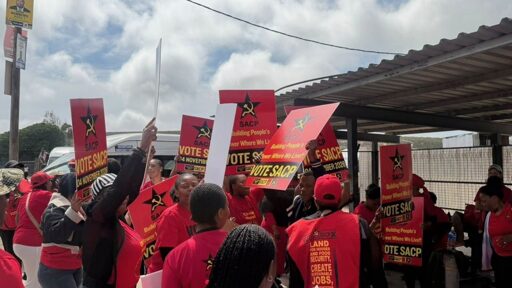

The South African Communist Party (SACP) has secured at least 271 council seats in South Africa’s recently concluded local government elections, marking its first independent electoral contest since the country’s transition to democracy in 1994. The result represents an important milestone, as the Communist Party seeks to establish its own electoral identity after decades of contesting elections alongside the African National Congress (ANC) through the Tripartite Alliance.
The elections, held on November 4, saw the ANC register its weakest electoral performance in the post-apartheid period, securing less than 31% of the national vote. Its share declined from 45.6% in the 2021 local government elections. The deterioration of municipal services, including water supply, electricity, sanitation and waste collection, featured prominently in the political debate.
For the SACP, however, the elections represented more than an opportunity to secure council seats. They marked an attempt to translate its longstanding criticism of the country’s economic direction and the marginalization of working-class interests into independent political representation.
Speaking to BreakThrough News after the elections, Phel Parkies, the SACP’s national head of elections, described the party’s decision to contest independently as a necessary intervention in the country’s political and economic direction.
“Many of the things we frontloaded at the level of the alliance were ignored, more so by the ANC,” Parkies said, referring to the party’s longstanding disagreements with its alliance partner over economic policy.
He explained that the SACP had supported the ANC since before the 1994 elections to secure a majority for the national democratic revolution. However, he argued that the ANC’s political and economic direction had increasingly departed from the expectations of the working class.
“The SACP’s contestation is an act against the domination of imperialism. It is an act against austerity measures in our country. It is an act against policies that fail to deliver for our people,” he said.
Parkies described the independent electoral intervention as an effort to defend what remains of the gains of the liberation struggle and advance the party’s socialist program.
“Our mission is to have a socialist order in South Africa, not a consolidation of neoliberalism in our land,” he added.
Watch: The End of an Era? ANC Suffers Historic Collapse in South Africa
Vying in municipal elections independently
The SACP’s decision to enter electoral competition under its own banner followed years of internal debates over its relationship with the ANC. Although the two parties remain part of the Tripartite Alliance alongside the Congress of South African Trade Unions (COSATU), the Communist Party has increasingly criticized the ANC’s economic policies and its handling of governance.
One of the concerns is the Growth, Employment and Redistribution (GEAR) strategy. The SACP has associated the program with economic liberalization, privatization, retrenchments and widening inequality.
Reflecting on the historical disagreements, Parkies argued that the policy direction failed to deliver the promised improvements in the lives of ordinary South Africans.
“In my own words, I say it was a flood that never came,” he said, referring to the anticipated investment and employment opportunities under GEAR.
He further argued that the restructuring of the economy had resulted in job losses and weakened workers’ conditions, while privatization undermined employment security, workers’ benefits and labour rights.
“For instance, GEAR, in my view, represents what I normally call a self-imposed structural adjustment program in South Africa,” Parks said.
These criticisms were also central to the SACP’s electoral preparations. In his January 31, 2026 address to the party’s National Elections Workshop in Gauteng, titled The Last Trench of the Revolution, Parks outlined the ideological and organizational reasoning behind the decision to contest independently.
He described the electoral intervention as a departure from the party’s previous role of mobilizing support for the ANC.
“This time we are preparing to enter the electoral terrain in our name for the class whilst previously we would be discussing our contribution in mobilizing support for the ANC,” he stated in the address.
The speech also pointed to the party’s concern that its continued participation in the alliance had left it in a position where its criticism of government policy was not translating into meaningful political influence.
Referring to the party’s political report, Parkies put the need to “come out of strategic ambiguity we have been trapped in since 1994,” arguing that the party had remained within an alliance where its economic criticisms were frequently ignored.
The independent electoral campaign was therefore presented as an attempt to establish direct working-class representation in municipal governance rather than continue relying exclusively on its influence within the alliance.
What does the electoral result mean for the SACP?
The over 270 seats secured by the SACP represent its initial electoral foothold under its own political identity. Parkies described the result as a breakthrough for working-class representation.
“We have achieved many seats, which is a breakthrough and a victory for the working class, because those seats will be directly under the banner of the Communist Party,” he said during the interview.
For the SACP, securing representation in municipal councils is also an opportunity to demonstrate that its political programme can translate into practical interventions in people’s daily lives. Parkies identified sanitation, water, land and human settlements as some of the priorities that Communist Party councillors should address.
He added that the party’s elected representatives must be accountable to the communities they serve, with the party’s manifesto providing the basis for evaluating their performance.
Building a broader left movement
Beyond the electoral results, the SACP has also identified the consolidation of left-wing forces as an important part of its political program. The party argues that challenging neoliberal economic policies, austerity, and the influence of capital require a broader working-class movement rather than an isolated electoral intervention.
In May 2026, the SACP convened a Conference of the Left, bringing together working-class organizations, progressive formations, and other left-wing forces to discuss the development of an independent left political pole.
Read more: South Africa’s Conference of the Left issues a bold call for working-class unity
Parkies said the process was necessary to build a political force capable of challenging the prevailing economic direction of the country.
“There is no party that can do that alone,” he said, calling for a popular front that could regain the confidence of ordinary people and challenge policies that reproduce inequality and economic hardship.
The SACP believes it is on course to advance a change in South African politics and strengthen working-class representation. For the party, the recent elections are only the beginning of a longer political struggle to build an independent socialist alternative.
From BT News via This RSS Feed.