


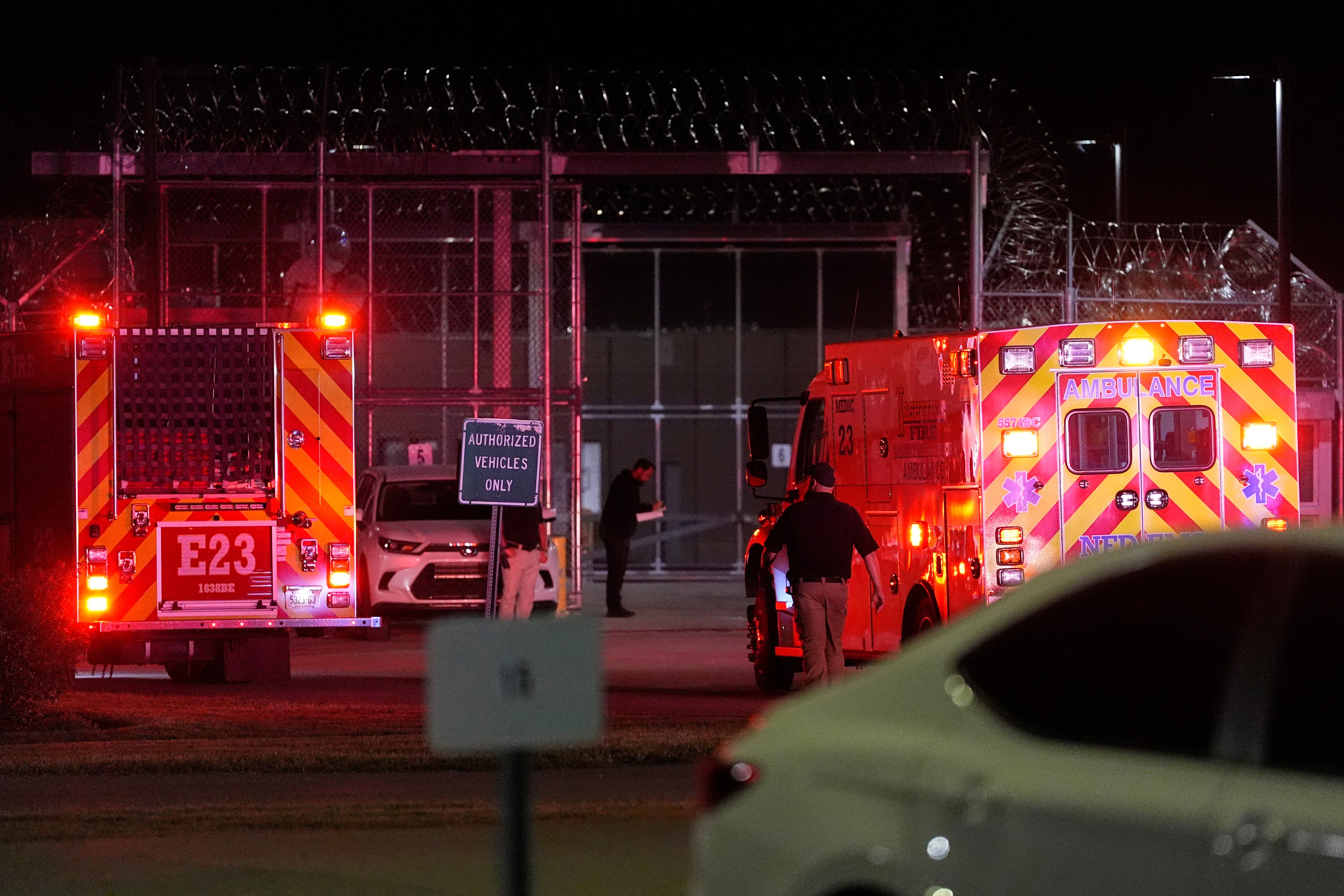
Emergency vehicles arrive at Riverbend Maximum Security Institution after the execution of Christa Pike was halted on Sept. 30, 2026, in Nashville. Photo: George Walker IV/AP
A recent rash of botched executions should eradicate any lingering questions why the press needs more access to our nation’s jails and prisons than ever before.
In the past six months alone, at least three executions have gone drastically wrong, including Tony Carruthers in May, Christa Pike in October, and Reinaldo Dennes last week.
Restrictions on media access in Washington, D.C., from the White House to the Pentagon, have rightfully made headlines this year. But Tennessee’s botched attempt to execute Pike in particular proves that the press needs access to prisons just as much — if not more — than to the White House.
[
Related
The “Satanic Panic” Made Her a True-Crime Obsession. The Truth Is More Haunting.](https://theintercept.com/2026/09/27/christa-pike-execution-women-death-row/)
Condemned to death for a 1995 murder, Pike was the second person to survive a botched execution attempt in Tennessee this year. Journalists who were present described the inhumane debacle. Pike was strapped to the execution table for more than two hours moaning and complaining of pain as prison officials administered the first failed dose of pentobarbital. Determined to carry out the execution, prison officials administered a second unsuccessful dose. She has reportedly been discharged back to prison, where she said she remains “largely isolated,” after receiving treatment at a Nashville hospital.
Similar to Pike, Dennes’s execution was complicated by medical technicians’ inability to locate a suitable vein to insert the needle. Once the injection began to flow into his body, Dennes’s demeanor drastically changed, according to people present in the execution chamber. In between cries, Dennes moaned, grunted, and begged for “the father” to take him.
Shortly before losing consciousness, Dennes complained about pain in his leg and said, “I don’t think this is normal.” (A spokesperson for the Texas Department of Criminal Justice maintained to The Associated Press that the execution “was carried out as planned.”)
That journalists are able to report victims’ screams but have their hands tied in investigating what caused them is a cruel, final irony.
News outlets have long been severely restricted from covering prisons, including those where executions are carried out, and it’s getting worse. A recent ruling from a federal appellate court upheld the state of Indiana’s policy that bans the press from covering executions. But despite all the talk of change following the results of the midterm elections, execution secrecy is hardly being mentioned as a priority, if it’s even on the reform agenda at all.
Tennessee allows journalists to attend executions — hence the firsthand accounts in Pike’s case — but restricts information about the people who carry them out and the companies that supply execution drugs, among other details. This information is vital when those drugs fail; that journalists are able to report victims’ screams but have their hands tied in investigating what caused them is a cruel, final irony. Only reporting on the sordid scenes of botched executions also serves to make them sound like senseless tragedies, rather than the result of policy decisions.
Prison secrecy extends far beyond the death chamber. No one knows this better than the nearly 2 million people who, like myself, are incarcerated in our nation’s jails, prisons, and detention centers. Due to the Supreme Court’s 1974 ruling in Pell v. Procunier, as well as its companion case, Saxbe v. Washington Post Company, widespread malfeasance by prison officials largely goes underreported or unreported.
Those cases held that the First Amendment does not grant the press a special right of access to prisons, and that limiting reporters’ access can be justified by any “legitimate penological objective” prison officials come up with, setting up a system of extreme deference by the judiciary to prison officials.
But coverage of our nation’s prisons was very different 52 years ago. As described in the Pell and Saxbe opinions, the press back then was often permitted to visit prison facilities, take photographs, and speak to the incarcerated people they encountered. If those press interviews demanded confidentiality, guards would often leave the area.
[
Related
Death Row Prisoner: Idaho Officials Ran “Misdirection Campaign” to Withhold Info on Lethal Injection](https://theintercept.com/2025/08/30/lethal-injection-drug-idaho-execution/)
This relative transparency was not compelled by law — and officials sometimes restricted it arbitrarily — but it was relatively common and, in many places, expected, until the Supreme Court gave prisons express permission to disregard these norms.
The Procunier and Saxbe cases arose from restrictions on face-to-face interviews. Prison officials claimed particular constraint was necessary because some individuals allegedly used the media to gain notoriety and promote uprisings. Given the limited scope of the restrictions, it was arguably reasonable for the justices to believe prison officials were acting in good faith, not scheming to avoid transparency.
What the court may not have foreseen was how its ruling would, over the years, allow departments of correction to chip away at media access to prison facilities by manufacturing any kind of “penological objective” to justify secrecy.
The appellate court upholding the Indiana execution ban — which the state justified by contending that secrecy promotes dignity — cited Procunier’s low bar to afford prison officials the benefit of the doubt regarding their absurd excuse. Cases upholding restrictions like Tennessee’s on information about execution drugs and executioners have also cited Pell and its progeny as a get-the-press-out-of-jail-free card.
Had the press been prohibited from witnessing Dennes’s execution, the world would have never known anything even went wrong at all.
AP reporter Michael Graczyk has covered nearly 500 executions — including Dennes’s — over the past four decades. Graczyk wrote he has witnessed condemned people do everything from singing hymns to telling a joke during their final moments. But Dennes’s execution was “like no other,” he said.
“As a reporter, I’d like to find out the truth about the matter,” Graczyk wrote for The AP about Dennes’s execution. “But there’s no way to know for sure.” Texas law restricts, among other things, access to information about, for example, execution drugs, suppliers, and manufacturers.
[
Related
After Democrats’ Midterm Romp, What’s Stopping Governors From Commuting Death Sentences?](https://theintercept.com/2026/11/19/death-penalty-commutations-execution-newsom-dewine/)
Had the press been prohibited from witnessing Dennes’s execution, the world would have never known anything even went wrong at all.
Media reports would be discounted as “fake news.” In Dennes’s case, officials tried to do so, despite witnesses. Texas prison spokesperson Amanda Hernandez discounted Dennes’s reported expression of pain during his final hours and suggested he may have been exaggerating it.
Prisons are supposed to serve the taxpayers who fund them by rehabilitating people who have committed crimes and creating a safer society. Particularly given their deep, ongoing track record of failure in that regard, people have a right and a need to know what transpires inside these government institutions in order to seek redress and change. That becomes impossible when the press is excluded.
Pell has become the slippery slope that has permitted prisons to operate in complete secrecy. As the Columbia Journalism Review observed, in recent decades, “the lower courts rarely find an access restriction they can’t affirm.”
Without access to the press, incarcerated people have had to rely on contraband cellphones to share information with the public. Disturbing video footage captured by people imprisoned in Alabama compelled a 2016 investigation by the U.S. Department of Justice’s Civil Rights Division, which ultimately led to a government report revealing the Alabama prison system fostered an unlawful culture of violence.
The footage also became the focal point of HBO’s Oscar-nominated documentary, “The Alabama Solution.”
The Justice Department found a lack of sanctions by prison administrators for violent conduct by officers led to a belief that staff could act with impunity. According to the department’s report, “Uses of force happen so regularly in Alabama’s prisons that some officers appear accustomed to that level of violence and consider it normal.”
One such incident in 2019 at Alabama’s Ventress Correctional Facility resulted in an incarcerated individual, Michael Smith, being beaten to death by at least two officers, while a third stood by and watched. After intervening in an argument between two incarcerated men, three officers allegedly took Smith out in the hallway where they beat him with their hands and a chair until he was unconscious and bleeding from his head, nose, and ears.
They then dragged the unconscious man into a storage closet and continued their assault. The incarcerated man was then transferred to a local hospital.
Less than a week later, Smith died from his injuries. Had the footage from the cellphones not sparked this investigation, it is likely that no member of the public would have known the type of barbaric behavior patterns their government was perpetuating.
Back at the White House, President Donald Trump uses “national security” as the magic words whenever he wants to justify anything from censorship and secrecy to tariffs and vanity projects. He has deemed foreign films, imported kitchen cabinets, and, in the case of the media ban, his own vice president’s disclosures to the press to be national security threats empowering to act without scrutiny.
Banned news outlets and others challenging Trump’s obvious pretexts can at least cite favorable Supreme Court precedent to make their case: In the Pentagon Papers case, for example, Justice Hugo Black famously proclaimed, “The word ‘security’ is a broad, vague generality whose contours should not be invoked to abrogate the fundamental law embodied in the First Amendment.” But those looking to challenge prison officials — who claim legitimate “penological objectives” just as frequently and just as frivolously as Trump dreams up national security threats — run right into Pell.
[
Related
Private Prison Told ICE Its Jail Was Worth $67 Million. ICE Bought It for Nearly Half a Billion.](https://theintercept.com/2026/11/23/geo-group-private-prison-ice-sale-contract/)
By now, judges and politicians cannot claim ignorance about the abuses behind prison walls. Between botched executions in Tennessee, exposés like “The Alabama Solution,” and the constant news of horrid conditions inside ICE jails operated by the same private profiteers that run the rest of the carceral state, the need to restore press access to prisons is more critical than ever. If this Supreme Court won’t act, legislators across the country must.
The post From an Incarcerated Writer: Botched Executions Show Journalists Need More Access to Prisons appeared first on The Intercept.
From The Intercept via This RSS Feed.