

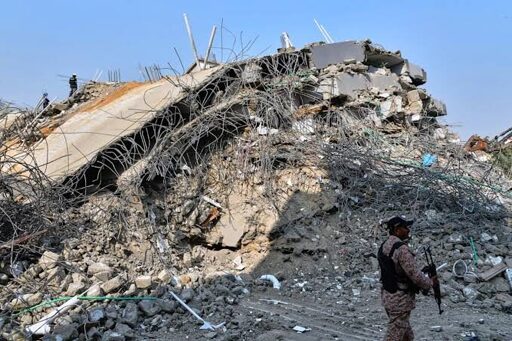
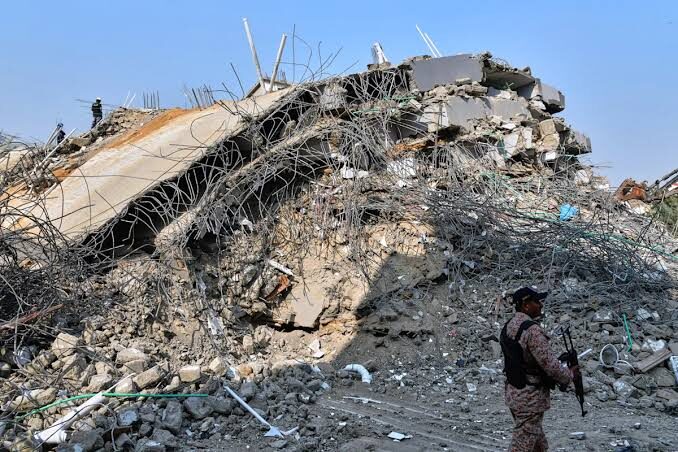
Karachi building collapse kills 11 and injures 13 as rescuers search for eight trapped under rubble at an illegal construction site.
Karachi Building Collapse: 11 Dead as 1 Illegal Site Crumbles
The Karachi building collapse death toll rose to 11 on November 28 after rescue teams recovered three more bodies from the rubble. Thirteen people were injured, and authorities believe eight others remain trapped beneath the debris.[telesurtv]
The building was under construction and, according to officials, was being erected illegally on a residential plot near Baloch Colony. It came down on Wednesday, November 25, without the permits or technical conditions required for such a project.[telesurtv]
Azeem Khan, an official with the Edhi Rescue Service, confirmed the updated figures. “Since last night, three more bodies have been recovered, and there are a total of 13 injured,” he told international agencies.[telesurtv]
Karachi Building Collapse: 11 Dead and 8 Still Trapped
The Karachi building collapse has drawn a large emergency response. Videos released by the rescue service showed workers using high-strength cutters to slice through reinforcing bars and reach victims, while others removed debris with hand tools and heavy equipment.[telesurtv]
The operation has been slow and dangerous. Collapsed structures can shift without warning, and rescuers must balance speed with the safety of their own teams. Families have gathered at the site, waiting for news of missing relatives.[telesurtv]
Police have arrested one of the building’s owners and three contractors, according to the local newspaper Dawn. A complaint filed by a Sindh province official alleged that materials below the required standard had been used in the construction.[telesurtv]
The Karachi Commissioner’s Office reported that, as of November 27, 516 illegal and unauthorized buildings had been sealed as part of an ongoing campaign. The figure suggests that the problem extends well beyond a single site.[telesurtv]
A City Struggling With Unsafe Construction
The Karachi building collapse is not an isolated incident. Building failures are common in Pakistan, a country of more than 240 million people, largely because of weak safety standards and low-quality construction materials.[telesurtv]
Karachi, Pakistan’s largest city and main port, has experienced rapid and often unregulated urban growth. Developers frequently build additional floors without permits, and oversight is limited by staffing shortages and corruption.[telesurtv]
The collapse near Baloch Colony has renewed scrutiny of local authorities. Residents have long complained that illegal construction is tolerated and that inspections are rare or ineffective.[telesurtv]
The sealing of more than 500 buildings is a sign that the government is trying to respond. But critics argue that enforcement after the fact does little to prevent tragedies.[telesurtv]
U.S. Meets with Pakistani Army Chief Amid Tensions with Afghanistan
Sindh Building Control Authority
A Pattern of Deadly Collapses
The Karachi building collapse follows a series of deadly structural failures across Pakistan. In October, the roof of a private school in Peshawar collapsed while classes were in session. At least 34 people died, including 33 children between the ages of six and 14, and one teacher.[telesurtv]
In June, more than a dozen children were killed when the roof of a tutoring center collapsed in Lahore. Those tragedies sparked public outrage and calls for stricter enforcement of building codes.[telesurtv]
The recurrence of such disasters points to systemic problems. Poor materials, inadequate supervision, and a lack of accountability allow unsafe structures to remain in use.[telesurtv]
In many cases, families rent or buy homes without knowing whether they meet safety standards. When buildings fail, the consequences are borne disproportionately by the poor.[telesurtv]
The Human Cost
The Karachi building collapse has left families grieving and communities demanding answers. The injured have been taken to local hospitals, where some remain in critical condition.[telesurtv]
Rescue workers described a difficult scene. The building was reduced to a pile of concrete slabs, twisted metal, and dust. Neighbors helped with the search in the early hours, using their hands and simple tools.[telesurtv]
The tragedy has also highlighted the vulnerability of construction workers. Many laborers in Pakistan work without contracts, insurance, or basic safety equipment.[telesurtv]
For the families of the victims, the arrests and the sealing of illegal buildings offer little consolation. They want accountability and assurances that similar disasters will not happen again.[telesurtv]
Geopolitical Context
The Karachi building collapse reflects a broader challenge facing rapidly urbanizing countries across South Asia. Weak regulation, corruption, and poverty create conditions in which unsafe construction becomes normal.
Pakistan’s population is growing quickly, and cities are expanding faster than planning systems can keep up. That gap creates opportunities for unscrupulous developers and leaves residents exposed to preventable risks.[telesurtv]
The disaster also carries political implications. Public anger over building safety has grown in recent years, and the government faces pressure to demonstrate that it can enforce the law.[telesurtv]
The broader geopolitical meaning is that urban safety is becoming a governance issue with regional consequences. As cities grow, the failure to regulate construction can undermine public trust and stability.[telesurtv]
What Comes Next
The immediate priority is to recover the remaining victims and provide care for the injured. Rescue teams are continuing to search the rubble, though hopes of finding survivors are fading.[telesurtv]
Authorities are also investigating how the building was allowed to rise without permits. The arrests of the owner and contractors are the first step, but critics say deeper accountability is needed.[telesurtv]
The sealing of more than 500 illegal buildings may prevent future tragedies, but it also raises questions about displacement and housing. Many residents of unsafe structures have nowhere else to go.[telesurtv]
For now, the Karachi building collapse stands as a grim reminder of the cost of weak regulation. The next phase will determine whether the disaster leads to meaningful reform or becomes another statistic in a long pattern of neglect.[telesurtv]
#ENVIDEO | En Pakistán 🇵🇰 al menos 31 personas fallecieron y un aproximado de 170 heridos, por explosión en una mezquita ubicada en Tarlai Islamabad pic.twitter.com/jMiv90ikHO
— teleSUR TV (@teleSURtv) February 7, 2026
From teleSUR English via This RSS Feed.