
Iramis Rosique Cárdenas is a Cuban essayist, researcher, and university professor with a master’s degree from the San Luis Potosí Autonomous University (Mexico). He is a member of the digital Marxist magazine La Tizza and has collaborated with multiple international outlets. In this exclusive interview, Rosique offers his views on the present Cuban reality and how the changes in Venezuela are seen by its former closest ally.
How does daily life in Cuba continue today amid the brutal US embargo, and how does the Cuban government operate to prevent a humanitarian collapse?
It’s surprising how daily life continues in Cuba. Nightlife has definitely slowed down, but during the day, people are going about their business. There’s almost no fuel, almost no cars on the streets, and yet people have found a way to keep living without drowning in bitterness.
One of the major changes in the country has been the widespread participation in the energy transition. In transportation, electric vehicles and tricycles have revolutionized how people get around the city and transport goods. Gasoline- and diesel-powered transportation still exists, relying on the small amount of fuel that private actors import from the United States. But I must say that the bulk of the goods moved in Havana are transported by electric vehicles.
We will be the first to make the energy transition. Many people have become experts in solar panel technology, understanding what a home needs and how much energy it consumes. It’s a more expensive technology, but those who can afford it are installing it in their homes.
In a way, there is an energy revolution in Cuba, which is a very interesting phenomenon and a manifestation of resistance. However, it does not stop the damage that this state of emergency is inflicting on the population.
As for the government’s stance, its priority is to maintain stability in the country, because there is a lot of talk about Cuba being a failed state. The country is not collapsing: order, basic services, and security are being maintained.
The main state-run enterprises, where a large number of Cubans are employed, continue to operate and pay wages. This is true even amid inflation, which is running rampant because the country is relying almost exclusively on imports, since industries have come to a standstill and agriculture also requires fuel to function. But the government ensures that the country continues to function.
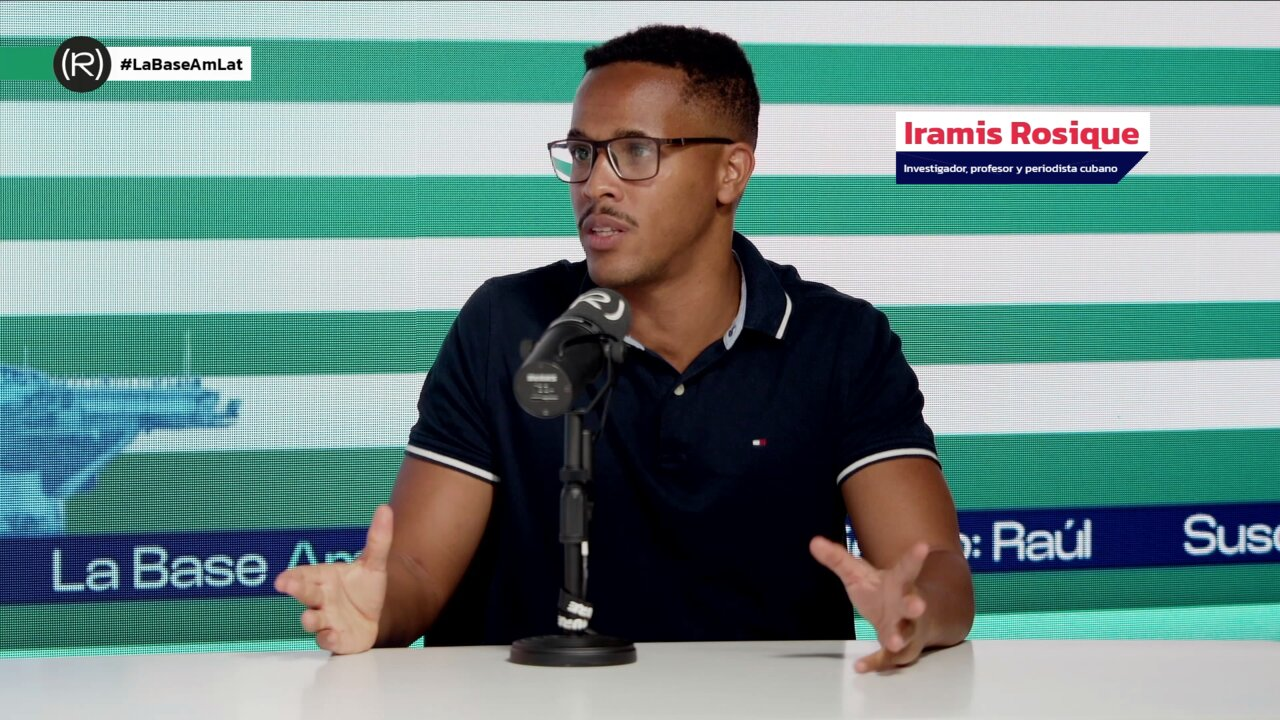
Rosique highlighted the significance of Venezuela not condemning the US embargo against Cuba. (La Base)
With Trump and Secretary of State Marco Rubio pressuring countries to drop support fo Cuba, has the nature of international solidarity changed? Is it still feasible for Cuba to rely on international solidarity amid threats of US retaliation?
I wouldn’t necessarily link changes in international support to pressure from Rubio and US diplomacy. The decline of international support also follows a shift in the political and ideological dynamics of the contemporary world. There is a rightward shift, and the Trump administration is an expression of that trend.
This change was always going to mean isolation and a loss of support for Cuba, regardless of whether there was a US secretary of state who took the Cuban issue personally. If there are far-right governments in Latin America and Europe, it doesn’t take much pressure for them to speak out at the UN against lifting the embargo.
As for solidarity, Cuba does not depend on the solidarity of peoples or on the solidarity of states. After many disappointments, abandonments, and betrayals, we have accepted the idea of emancipating ourselves through our own efforts. That is part of our concept of revolution, as Fidel [Castro] said at the beginning of this century. We cannot depend on anyone.
But I would still draw a distinction between the solidarity of the people and the solidarity of states. Even though many of those Latin American countries, as was the case in the 1960s and ‘70s with the military dictatorships, turn their backs on Cuba, the people and social movements are another matter entirely. In that sense, solidarity among peoples, including moral backing, remains very important for Cuba, as an avenue to expose to the world the crimes committed against Cuba.
As for governments, this is a phase that will pass, just as the military dictatorships passed. It is not so novel. Cuba continues to have good friends around the world; there are still countries that are very grateful to Cuba and on which Cuba has been able to rely, regardless of the fact that the global context is very adverse.
Some analysts have said that Cuba can negotiate economic reforms, but not political changes under pressure. How does that position hold up in practice when the blockade is escalating, with a devastating impact on the population?
I believe that neither economic nor political reforms should be up for negotiation [with the US]. In any case, the United States and Cuba, as two sovereign states, can reach agreements that they deem to be mutually beneficial. Obviously, US capital could reap economic benefits in Cuba were it not for this hostile stance.
I believe that the reforms carried out in Cuba, especially the recent economic reforms, are aimed, among other things, at facilitating the presence of foreign capital, including from the US. And that could be beneficial for the US companies. However, if Washington seeks to dictate economic and domestic policy, it has so far encountered an insurmountable barrier.
Why should Cuba allow the United States to dictate its internal affairs? What they are waging against us is a war, seeking to subjugate another country in order to control its domestic affairs. They are imposing a blockade and a medieval siege against us, trying to suffocate us through hunger and despair, to bring about the collapse of the state so that they can take the reins.
We must never forget that no country today has a law like the Helms-Burton Act, in which the United States explicitly expresses what it believes the political norms in Cuba should be. This is an extremely unusual phenomenon in the contemporary world. And it runs counter to the Cuban government’s long-held position on sovereignty.
Public opinion is varied, as one would expect. Some people believe that the right course of action regarding the United States is to surrender, as in Venezuela, while others disagree.
Sovereignty is a prerequisite for democracy. It would make no sense to destroy sovereignty in the name of democracy. If Cuba is not a state, if it is not an independent republic, it cannot be a democratic state. Take Puerto Rico as an example.
So, people may very well want the United States to rule Cuba, but that doesn’t mean that, in the name of democracy, anyone has to give in to that idea, an idea that is pushed by US pressure and violence. It’s like a confession under torture. In a country under torture, many people say what the torturers want them to.
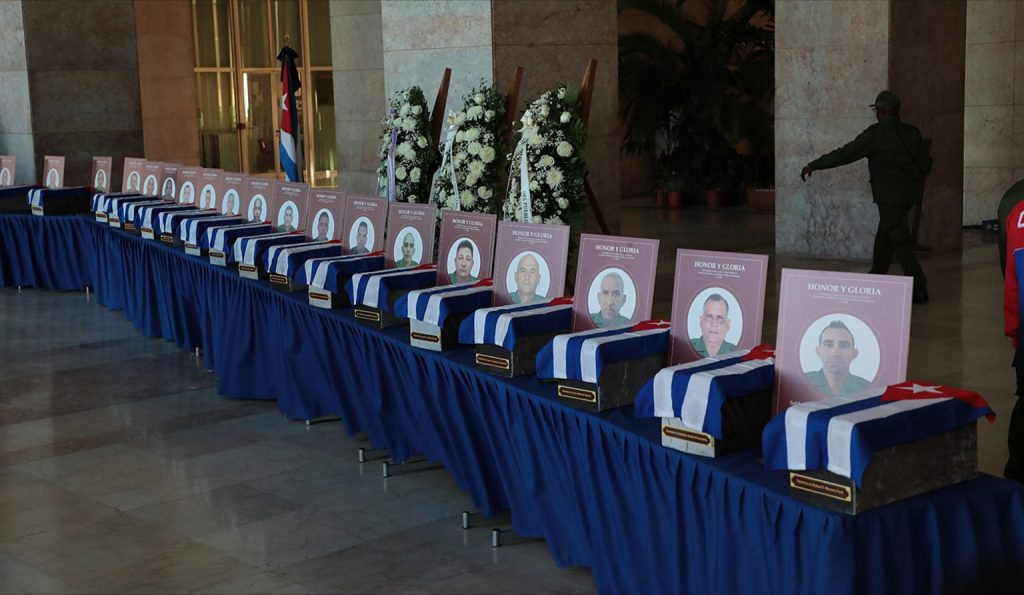
32 Cuban soldiers were killed in Caracas resisting the US attack and Maduro kidnapping on January 3. (Cubadebate)
La Tizza recently published an article titled “Tehran Before Caracas,” analyzing Venezuela and Iran’s respective responses to US imperialist war. How is Venezuela’s (geo)political shift after January 3 viewed from Cuba, not only in terms of its actions, but also in terms of its official rhetoric?
Cuba’s official discourse has been very cautious in commenting on what has happened in Venezuela. Cuba has always been very respectful of the decisions others make, just as we demand respect for the decisions we make ourselves.
We’ve already lived through the 1990s. I remember Fidel saying that, after the fall of the Soviet Union, many important revolutionary movements, including guerrilla groups, asked Cuba what they should do. And Fidel would simply say: “Well, we only know what we’re going to do. Make your own decisions.” That is Cuba’s position: not to tell anyone what to do.
I avoid talking about the situation in Venezuela because I try to hold on to that principle. The Venezuelan government and the Venezuelan people in general are making their own choices, with determination, in accordance with the circumstances that history has placed before them.
At La Tizza, we have emphasized, and the government has done so as well, that in a scenario similar to January 3 [US attack and kidnapping of President Nicolás Maduro], the response would be different from [then-Venezuelan Defense Minister] Vladimir Padrino’s, who refused to give the order to fight in order to save lives. No, no. To take Cuba, to capture the president of Cuba, to capture the leader of the Cuban Revolution, the US will have to fight, and defeat the Cubans who are willing to defend their homeland and the revolution.
That is the spirit we want to convey. There will be fighting if something similar to what happened on January 3 were to occur in Cuba. There will be fighting, just as there was fighting in Iran. I understand that every country is unique, that each has its own circumstances and makes its own decisions, but this is our position.
Chávez’s rise to power solidified an alliance between Cuba and Venezuela on multiple fronts, such as healthcare, security, and energy. A Cuban deputy minister recently stated that Venezuela is no longer considered “an ally.” What is the current status of Cuba-Venezuela cooperation programs?
I cannot speak specifically about the Cuba-Venezuela cooperation programs. We know that there are still Cuban doctors and other workers in Venezuela, and they are gradually returning. However, there has been no official announcement in Cuba regarding the end of the cooperation agreements with Venezuela.
Regardless of what [Deputy Foreign Minister] Fernández de Cossio said, which is also understandable, I find Venezuela’s position in the latest United Nations vote regarding the embargo against Cuba to be significant. It’s not that Venezuela did not vote (*), but that it did not speak out. The choice not to condemn the blockade indicates a change and implies a shift in the level of relations.
This does not mean that Venezuela and Cuba have severed ties, but obviously after January 3, taking into account Delcy Rodríguez’s praise for Trump and Marco Rubio, the close collaboration with the United States and its security apparatus, and the rapprochement with the State of Israel, it is normal for us to go from being the countries with the closest diplomatic ties to having a different, less close relationship. This does not mean breaking off relations, because Cuba has ties with many countries that are allies of the United States and Israel.
These countries are not our closest friends, and it seems that this is the change taking place in the relationship with Venezuela, one that is a response to the developments that have occurred since January 3.
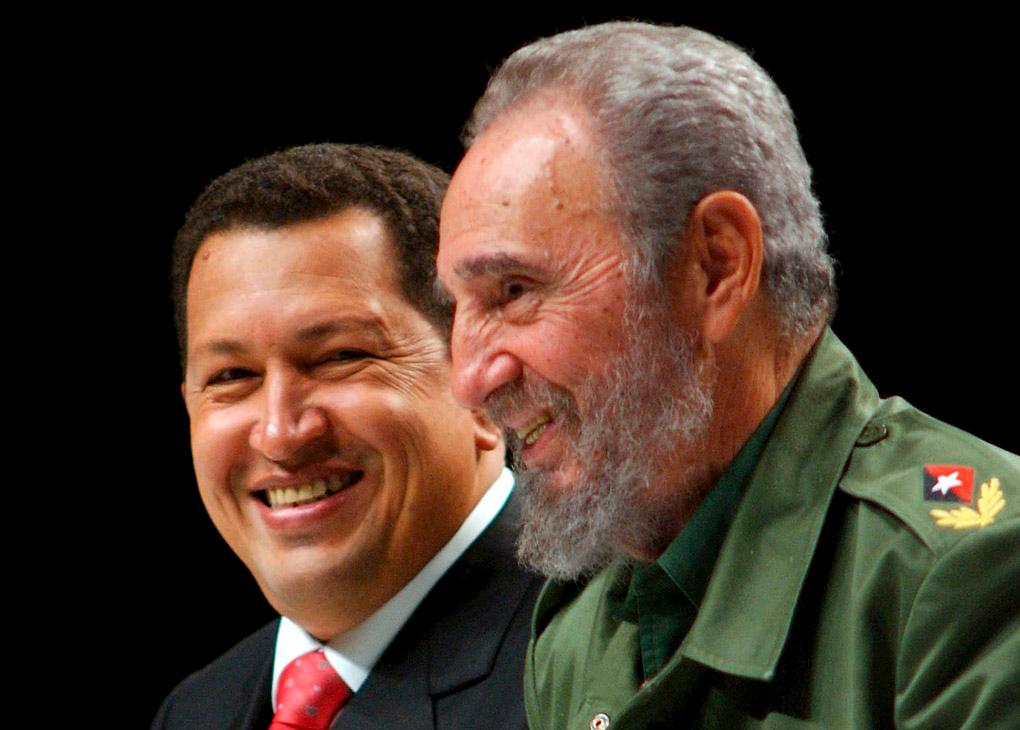
Hugo Chávez and Fidel Castro launched a number of cooperation programs that face an uncertain future. (Archive)
(*) Venezuelan voting rights at the UN are currently suspended over unpaid financial dues.
The post Iramís Rosique: ‘Cuba Would Respond Differently than Venezuela to a US Attack’ appeared first on Venezuelanalysis.
From Venezuelanalysis via This RSS Feed.