

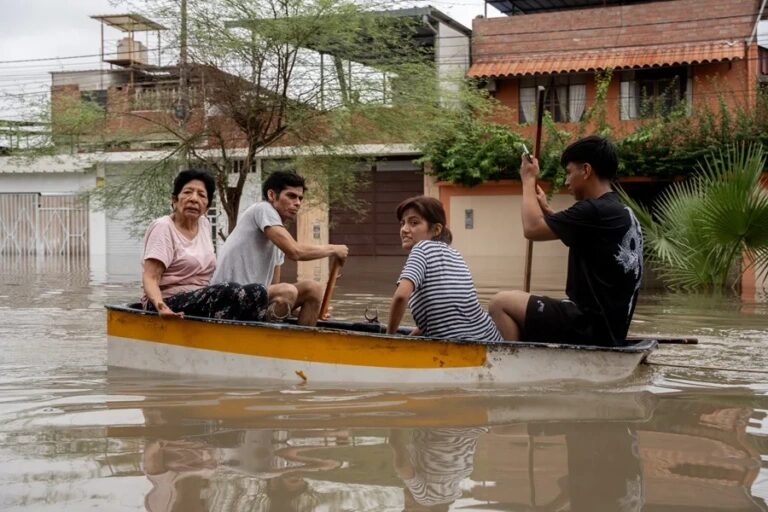
Peru El Niño floods trigger rescue of 400 people in Piura as record rainfall overwhelms the north and Fujimori pledges urgent aid.
Peru El Niño Floods: 400 Rescued as 1 Historic Storm Batters Piura
The Peru El Niño floods have forced emergency teams to rescue about 400 people in flooded areas of Piura after torrential rains dumped the equivalent of two years’ worth of water in a single day. President Keiko Fujimori traveled to the affected zones on the night of November 27 to assess the response.[telesurtv]
Rescue teams were still working to evacuate about a dozen residents isolated by rising water. The government has warned that the rains are expected to continue at least through Sunday.[telesurtv]
Fujimori urged regional governors and mayors to prioritize citizen assistance over political disputes. “This is not the time to look for culprits or blame each other. It is time to help the people who need it,” she said after walking through flooded streets.[telesurtv]
Peru Proposes Life Imprisonment for Police, Military Linked to Criminal Groups
Peru El Niño Floods: 400 Rescued in Piura
The Peru El Niño floods have hit the northern coast especially hard. In Piura, monitoring stations in Miraflores and Mallares recorded 143 and 109 liters per square meter, respectively, between the morning of November 26 and the same time on November 27.[telesurtv]
In Cajamarca, the Andean district of Tocmoche set a historic one-day record with 134.3 liters per square meter. The storm front later moved toward southern Piura, the border department of Tumbes, and high areas of Áncash.[telesurtv]
The rainfall has overwhelmed drainage systems and flooded roads, homes, and farmland. In some neighborhoods, residents used inflatable boats to reach their houses and placed sandbags at their doors to keep water out.[telesurtv]
The Defense Ministry deployed about 250 personnel to help drain water in affected areas, while the Housing Ministry activated its emergency response teams.[telesurtv]
Peru’s National Meteorology and Hydrology Service
A Storm That Arrived Early
Fujimori noted that the current emergency began unusually early. She compared it with the severe 1997 event, when the first major storms did not arrive until January rather than the final week of November.[telesurtv]
That timing is significant. An early onset gives authorities less time to prepare and leaves communities exposed for a longer period. It also increases the risk that successive storms will compound the damage.[telesurtv]
The president said she would speak with Economy and Finance Minister Elmer Cuba about the possibility of bringing forward support payments for victims that were originally scheduled for 2027.[telesurtv]
The measure would provide direct relief to families who have lost homes, crops, or income. It also signals that the government expects the emergency to have lasting economic consequences.[telesurtv]
An Extraordinary El Niño Event
Scientists attribute the torrential rains to an extraordinary El Niño episode. The surface of the eastern tropical Pacific is about 5 degrees Celsius above its historical average for late November.[telesurtv]
That level of warming is exceptional. Technical agencies warn that the current event could surpass the impact of the most destructive episodes on record, including those of 1982-1983, 1997-1998, and 2016-2017.[telesurtv]
El Niño alters atmospheric circulation patterns, bringing heavy rainfall to normally arid coastal regions of Peru and Ecuador. The phenomenon can also cause droughts in other parts of the region, creating a dual crisis of floods and water shortages.[telesurtv]
The current event is developing against the backdrop of climate change, which scientists say is intensifying extreme weather. Warmer oceans hold more moisture, increasing the potential for intense rainfall events.[telesurtv]
[Peru Proposes Life Imprisonment for Police, Military Linked to Criminal Groups: Peru El Niño Floods: 400 Rescued as 1 Historic Storm Batters Piura](https://www.telesurenglish.net/peru-el-nino-floods/)
The Human and Economic Toll
The Peru El Niño floods have displaced families, damaged infrastructure, and disrupted transport. In Piura, public transport was paralyzed, and several districts were cut off by flooded roads.[telesurtv]
Agriculture is particularly vulnerable. The northern coast is a major producer of bananas, rice, and other crops, and flooding can destroy entire harvests. That threatens both local food supplies and export revenues.[telesurtv]
Health risks also rise during floods. Contaminated water, stagnant pools, and crowded shelters create conditions for disease outbreaks. Authorities have warned about dengue, leptospirosis, and gastrointestinal infections.[telesurtv]
The economic cost will depend on how long the rains continue and how quickly the government can restore services. Early estimates suggest that rebuilding damaged infrastructure will require significant investment.[telesurtv]
A Test of Governance
The emergency is also a political test for Fujimori’s government. The president has faced criticism over the lack of investment in climate adaptation and disaster preparedness in northern Peru.[telesurtv]
Her response has focused on direct assistance and coordination with local authorities. By visiting the affected areas and promising to accelerate aid, she is trying to project control and empathy.[telesurtv]
But the scale of the emergency may overwhelm existing resources. Regional governments and municipalities have limited capacity, and the central government faces fiscal constraints.[telesurtv]
The coming weeks will show whether the response can meet the needs of affected communities. The outcome will shape public perceptions of the government’s competence and its commitment to climate resilience.[telesurtv]
Geopolitical Context
The Peru El Niño floods reflect a broader pattern of climate-related emergencies across Latin America. From droughts in the Amazon to floods in Brazil and Ecuador, extreme weather is testing the region’s ability to adapt.
The phenomenon also has regional economic implications. Peru is a major exporter of minerals, agricultural products, and fishmeal. Disruptions to production and transport can affect global supply chains and prices.[telesurtv]
At the international level, the emergency highlights the need for climate finance and cooperation. Developing countries are disproportionately affected by extreme weather but often lack the resources to invest in resilience.[telesurtv]
The broader geopolitical meaning is that the floods are not just a local disaster. They are a reminder of how climate change is reshaping security, economies, and governance across the region.[telesurtv]
What Comes Next
The immediate priority is to continue rescue operations and provide shelter, food, and medical care to those affected. Authorities are also monitoring rivers and reservoirs for further flooding.[telesurtv]
The government is expected to announce additional emergency funding and to accelerate the delivery of support payments. International organizations may also provide assistance if the situation worsens.[telesurtv]
In the longer term, the emergency will renew debate over climate adaptation. Experts argue that Peru needs stronger early warning systems, better drainage infrastructure, and more resilient housing in flood-prone areas.[telesurtv]
For now, the Peru El Niño floods represent one of the most serious climate emergencies in the country in recent years. The next phase will determine how quickly communities can recover and whether the government can prevent a repeat of past disasters.[telesurtv]
From teleSUR English via This RSS Feed.