

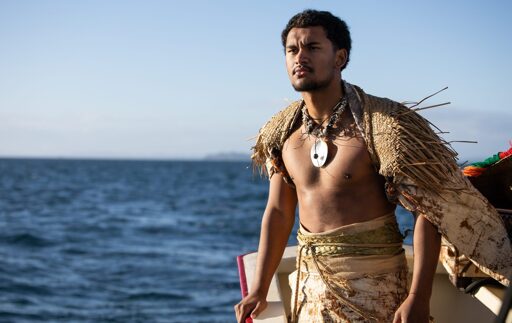

Julian Wilcox, writer and presenter of Ngā Kupe o Aotearoa, a five-part documentary based on his doctoral research. Pictured on Haunui, a double-hulled voyaging waka. (Photo: Te Rawhitiroa Bosch)
The story of Kupe that most of us know is the story of a navigator, an octopus, and an extraordinary journey from Hawaiki to Aotearoa.
But as broadcaster and journalist Julian Wilcox discovered during his doctoral research, that wasn’t the whole story. In fact, there was more than one story, and more than one Kupe, as his new documentary Ngā Kupe o Aotearoa reveals.
I’ll be honest. As a child, I didn’t know that much about Kupe.
As a Ngāpuhi, that’s poor. As a descendant of Te Māhurehure, that’s koretake. And as someone with connections to the Hokianga, it’s almost unforgivable!
Because Kupe is everywhere in the Hokianga. The name, the journeys, and the deeds of Kupe are embedded in the landscape. And not just in the Hokianga. By my last count, there are more than 300 places in Aotearoa associated with Kupe.
That’s quite a footprint for someone I knew so little about.
What I did know was probably what most New Zealanders know. Kupe was a great navigator who left Hawaiki in pursuit of a giant octopus that had been helping itself to Kupe’s fish. Kupe chased it across the Pacific Ocean, stumbled upon Aotearoa, and the rest, as they say, is history.
One man. One voyage. One rather troublesome octopus.
It’s a great story. But is it the whole story?
I first started wondering about that in 1998.
My uncle, the late Tā Patu Hohepa, was chair of Te Taura Whiri i te Reo Māori, the Māori Language Commission. He summoned me to his office at the top of the PSIS Building in Wellington, handed me a pile of papers, and said two words.
“Learn this.”
The papers were full of Ngāpuhi whakapapa. One name kept appearing. Kupe.
I knew the importance of our ancestor, Rāhiri, to Ngāpuhi, but here was Kupe, appearing time and again, almost as though his significance to our whakapapa was just as profound.
I was curious. Why didn’t I know more about Kupe?
Over the years, as I worked in journalism, radio and television, Kupe’s name kept appearing in conversations. Different people had different accounts. There were stories I recognised, and others I’d never heard before.
I didn’t know it then, but Uncle Patu had started something.
In 2018, he and another of our Te Māhurehure kaumātua, Matua Rereata Makiha, decided they wanted to establish a whare wānanga at our marae in Point Chevalier, Tāmaki Makaurau. They wanted to call it Taumata o Kupe, meaning the pinnacle or achievements of Kupe.
Uncle Patu also wanted a book written about Kupe. A very good idea, I thought.
Then he told me that I’d be writing it.
And there was another catch. Before I could write the book, Uncle Patu decided I needed a licence — much like learning to drive a car, apparently. Except my licence was going to be a doctorate.
So off I went to Te Whare Wānanga o Awanuiārangi to begin full-time doctoral studies.
Fortunately, I had plenty of help. My supervisors, Dr Reuben Collier and Distinguished Professor Linda Tuhiwai Smith, guided me through the academic side. My doctoral cohort, Turumakina Duley, Thomas Clark and Te Anga Nathan, helped me navigate the highs and lows.
And then there were my unofficial supervisors, Uncle Patu and Matua Rereata.
Their knowledge was entrenched in whakapapa, in our marae in Waimā, in the Hokianga, and in the kōrero handed down by our tūpuna.
They were central to everything that followed. And they helped me recognise something that seems obvious now. Why would I begin researching Kupe by asking what others had written, when the people who’d inherited the stories of Kupe were still here?
That’s not to say the historical books and manuscripts aren’t important. Some contain extraordinary records of our ancestors’ knowledge. But they aren’t the only places that knowledge lives. And they shouldn’t automatically be the places we turn to first.
For generations, many of us have learned a version of Kupe’s story popularised in historical publications, particularly the work of ethnologist Percy Smith.
It’s the story of a navigator, an octopus, and an extraordinary journey from Hawaiki to Aotearoa.
But throughout Aotearoa and Te Moana-nui-a-Kiwa, other accounts have survived.
Accounts of where Kupe travelled, why Kupe travelled, who travelled with Kupe, and what happened along the way. These accounts question our understanding of Kupe — not as a person named Kupe, but of what Kupe means. A title. A master navigator. An intergenerational transmitter of knowledge.
And if Kupe is a title, why do we all assume Kupe could only be male?
Those stories led me to five Kupe — five legendary navigators who guided our tūpuna to Aotearoa — one of them a woman.
Even the famous wheke has more to its story than many of us realise.
These aren’t simply variations invented by people who’ve forgotten what happened. They are kōrero tuku iho, oral history, passed down and maintained through generations, often tied to particular whakapapa, places and communities.
But why had one version become so familiar, while others remained largely unknown outside the communities that held them? Who decided which story was the right one? And why were we so comfortable with the idea that there could only be one?

Kupe isn’t one man, but a title — master navigator. Pictured, Whaiurangi Maxwell, who plays one of the Kupe in the documentary Ngā Kupe o Aotearoa, which starts on RNZ platforms on November 30. (Photo: Te Rawhitiroa Bosch)
The more I researched, the more I realised that the questions we ask are just as important as the answers we find.
If we begin by assuming there’s only one account, we’ll probably spend our time trying to make everything focused on that account. And anything that doesn’t fit becomes a problem.
But what if we begin somewhere else? What if we ask the people who’ve carried these histories what they know? What if we listen before we interpret? And what if different accounts aren’t necessarily mistakes or contradictions, but important parts of a much bigger picture?
For me, that’s been one of the greatest lessons of this journey.
Our histories don’t always need to be squeezed into one tidy narrative. Different communities have different whakapapa, different relationships with places, and different responsibilities for the knowledge they’ve inherited.
Understanding those differences may tell us far more than ignoring them, or trying to fit them into a western academic construct.
This approach became central to my doctorate and, eventually, the documentary, Ngā Kupe o Aotearoa, which launches on RNZ on Monday.
With my whanaunga, Jade Maipi, and the team at Mahi Tahi, we’ve taken the research beyond the pages of a thesis and into the communities that have maintained these traditions.
We’ve travelled across Te Moana-nui-a-Kiwa, the Pacific Ocean, listening to people whose knowledge of Kupe comes not simply from books, but from their ancestors.
We sat down with people like Papa Maraehau Kaina Tavaeari’i at his house in Ra‘iātea, Tahiti. Papa Maraehau was the man who welcomed Sir Hekenukumaingaiwi Busby to Taputapuātea marae in Ra‘iātea in 1993.
He was staunch in his conviction about who Kupe was, where Kupe came from, when Kupe left Tahiti, and why Kupe left Tahiti (because of internecine conflict in Ra‘iātea, he told us). It was clear that he took seriously the responsibility of holding on to the Kupe kōrero and passing that knowledge on.

Julian Wilcox’s doctoral research led him to five Kupe — five legendary navigators who guided the tūpuna of Māori to Aotearoa — one of whom was a woman. Pictured: Te Ātanga-o-Āionuku Hill, in the documentary Ngā Kupe of Aotearoa. (Photo: Te Rawhitiroa Bosch)
Papa Maraehau, like others we talked to, wasn’t waiting for us to discover their history. They already knew it. They’d inherited it, protected it, and they had continued to pass it on.
That changed the way I thought about doing the doctorate and making a documentary.
As journalists, we’re accustomed to finding people, asking questions, gathering information, and then putting a story together.
But when we’re dealing with oral history, with kōrero tuku iho, there’s another responsibility.
The people sharing their knowledge aren’t simply interview subjects. They’re the holders of histories that have survived for generations. They have their own relationships with that knowledge, and their own responsibilities for how it’s shared.
Our job isn’t to take their stories away and make them ours. It’s to recognise their authority and help create space for those stories to be heard.
This doesn’t apply only to stories about Kupe. Think about Māui, Mahuika, Hine-nui-te-pō and the many other ancestors whose names and stories are familiar to us.
How much do we really know about them? How much of what we’ve been taught has been shaped by people interpreting those traditions from outside the communities that maintained them? And what else might we learn if we began with our own people’s knowledge?
So that’s where our work is headed next: Māui. And yes, there’s a connection between Māui and Kupe, but you’ll have to watch the documentary to find out.
What I will say is that this journey has left me with a much greater appreciation of the extraordinary knowledge our tūpuna possessed, and the responsibility we have to those who continue to carry it. It has also convinced me that we need to think differently about how we protect that knowledge.
We spend a great deal of time collecting, recording and archiving our histories, and that’s important work. But preserving a story in a book or an archive isn’t quite the same as ensuring the people who know that story can keep telling it.
Knowledge needs people, language, and relationships. And it needs communities willing and able to pass it on.

Julian Wilcox and master navigator Hoturoa Barclay Kerr, who captains the oceangoing waka Haunui. (Photo: Te Rawhitiroa Bosch)
We lost Uncle Patu in 2023.
I hope the doctorate and the documentary have justified the faith that both my Waimā uncles placed in me. They entrusted me with something important, and I hope I’ve done right by them.
And I hope my whānau might be a little chuffed that my mama and papa’s spoilt progeny has finally managed to do some work!
Of course, I still have plenty of aunties, uncles and cousins around to tell me what to do next. Mainly my straight-talking northern relations, although my Tūwharetoa and Te Arawa whānau aren’t exactly shy about offering instructions either!
I’ve learned that it’s generally easier to do what you’re told, especially when it comes from your kaumātua.
Sometimes the people who know us best can see things in us that we haven’t yet recognised. And sometimes, what feels like another job being handed to you turns out to be one of the most important journeys you’ll ever take.
I certainly didn’t know that when Uncle Patu handed me those papers in 1998 and told me to learn them.
Nearly three decades later, I’m still learning.
Mā Kupeariki tātou katoa e ārahi.
May Kupe guide us all on our own extraordinary journeys of discovery and learning.
Ngā Kupe o Aotearoa will be released on rnz.co.nz/video, YouTube and Facebook from tomorrow, November 30, with an accompanying series of in-depth interviews with experts on navigation and whakapapa released on rnz.co.nz/podcasts and podcast apps. The five-part documentary will be in te reo with English captions.
Dr Julian Wilcox (Ngāpuhi, Ngāti Tūwharetoa, Te Arawa) was one of the founding members of Whakaata Māori and has also been chief officer of operations for Te Rūnanga o Ngāi Tahu. He presents Māpuna on RNZ National every Saturday. In 2025, Julian completed his PhD in Indigenous Studies at Te Whare Wānanga o Awanuiārangi, focusing his research on Kupe and the ancestral histories that connect Māori to the wider Pacific.
The post Julian Wilcox: Many stories, many Kupe appeared first on E-Tangata.
From E-Tangata via This RSS Feed.
You got a Maori dictionary lying around somewhere? I got half a page down and gave up.