

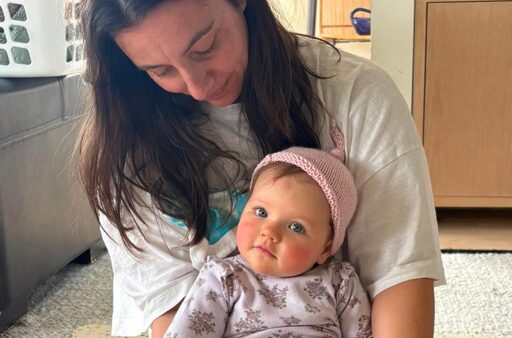

“As soon as I fell hapū, friends told me to enrol my little embryo with a kōhanga. I didn’t. And that was my first major mistake,” writes Lizzie Dunn, pictured here with her pēpi Moana. (Photo: Supplied)
Lizzie Dunn has been trying to get her first pēpi into a kōhanga reo. It’s been harder than she imagined, as she writes here.
Before I was even sure I wanted children, I was sure I wanted them to attend kōhanga reo.
I wanted them to grow up speaking te reo Māori and to understand tikanga, their whakapapa Māori, and the way of the Māori world. And I felt, quite palpably, that my tūpuna did too.
By the time my baby girl Moana arrived in January this year, I’d already spent countless hours imagining her getting her schoolbag ready, swinging poi at kapa haka, and making mother-tongue demands for aihikirīmi — ice cream — at summer pick-ups.
What I hadn’t imagined was just how difficult, both practically and emotionally, getting her on a kōhanga reo roll would be, and how the process of trying would entirely reframe my own sense of cultural belonging.
Kōhanga reo, or “language nests”, are an early childhood education option where tamariki are fully immersed in Māori language, customs, and values. Activist groups like Ngā Tamatoa fought hard for them in the 1970s, and in 1982, the first centre opened in Wainuiomata.
Since then, more than 400 kōhanga reo have been launched across the motu, and more than 50,000 tamariki guided through their Māori-centric curriculum. Graduates have gone on to be known as the “kōhanga generation” — exceedingly capable young men and women who are stunningly confident in their culture. Māori Party MP Hana-Rāwhiti Maipi-Clarke, pop sensation Maisey Rika, and social media star Te Aorere Pēwhairangi are prime examples.

The kōhanga generation includes Hana-Rāwhiti Maipi-Clarke, Maisey Rika, and Te Aorere Pēwhairangi.
As a young, mixed-heritage kid who grew up far from my tūrangawaewae, I always wanted to be one of those kōhanga kids. I wanted to walk, talk and look like them — and most of all, I wanted to belong like them.
My parents, however, opted for the mainstream education system. Mum says she didn’t think much about it. She didn’t speak Māori, and she hadn’t heard of any kōhanga around where we lived, so mainstream just seemed like the practical option.
My childhood was great, surely one of the best, but I struggled with my cultural identity. A longing to know more about my taha Māori ate away at me, and I felt incomplete, ashamed, and confused.
Cue an adult cultural redress involving more than 10 years of reo Māori study, the casting aside of steady career opportunities to dream up non-steady but exciting Māori media initiatives, and hours upon hours of questions for long-suffering whānau and kaiako.
I’m making progress, and it’s been an amazing trip, but I want my baby to have it easier.
When she was nine months old, I started making enquiries at kōhanga reo. E tama, boy, was I in for a wake-up call.
As soon as I fell hapū, friends told me to enrol my little embryo with a kōhanga. I didn’t. And that was my first major mistake.
As I started to call kōhanga, it became very clear very quickly just how oversubscribed kōhanga reo are in Tāmaki Makaurau (and, I hear, all over the motu).
I was furious with myself for not acting sooner. I think the overwhelm of being a first-time parent had taken over my brain. All information not vital to my child’s survival in the next five minutes was relegated to some back chamber to form a terrifying pile-up.
I thought it would just work out, which now sounds wholly arrogant. I guess the real problem is, I just didn’t really think.
Panicked, I messaged a couple of friends whose kids are at the local kōhanga. “Any tips on getting in, e hoa?”
Their advice was good.
“Don’t just phone. Go visit so they can put a face to the name and make sure they know you’re present in te ao Māori.”
“Go in person. Offer some volunteer hours if you can. Tell them what you’re up to. They’ve got to see you’re fully committed to the kaupapa.”
I secretly wish they’d said: “Oh, don’t worry, e hoa. I know X and can get you in there, no problems.” I know that’s selfish and that I don’t deserve a spot above anyone else.
I called the Kōhanga Reo National Trust for some extra advice to relay in this article. A spokesperson confirmed — with a lot of empathy, perhaps because he could hear my baby crying in the background — that it’s hard for new whānau to secure a spot. Waitlists are heaving, and it’s indeed normal practice to apply for pēpi before they’re born.
Each kōhanga has its own rangatiratanga to set specific enrolment requirements. The main thing, he advised, is commitment to the kaupapa. It isn’t just about creating reo-speaking stars. The movement is about whānau transformation well beyond kōhanga years, and everyone has to be on board.
I could do that, I thought. Now I just had to show it.

Lizzie and Moana. (Photo: Supplied)
On the way to my first kōhanga visit, I practised what I wanted to say over and over again.
“Tēnā koe, ko Lizzie ahau. E hiahia ana kia pātai ai mō tō koutou rāranga tatari. Kei a koutou ētahi tūranga wātea mō tāku tamāhine pea?” “Hi, my name is Lizzie. I want to ask about your waiting list. Do you possibly have any spaces for my daughter?”
My reo definitely isn’t perfect or very naturally flowing, but I needed to show I was already speaking with my bub at home and committed to getting better.
The building and grounds were beautiful. I felt nervous. A busy staff member welcomed me into the office, and I awkwardly took my shoes off even though she said not to.
We got chatting, and I tried to work my commitment into our kōrero without sounding like a complete twat. Five minutes of reo Māori later, she gently suggested we switch to reo Pākehā, which I accepted with a laugh while dying of embarrassment inside.
They were full for two years, and at that point, they’d prioritise babies younger than my kōtiro. Also, I’d need to think about primary-school options as the local kura kaupapa (Māori primary school) would prioritise kōhanga graduates.
I must have looked glum, because she added: “Hey, there’s still a chance for your girl — and if you’re thinking of conceiving again, come and see me at that point!”
My daughter had woken six times that night. I was not thinking of conceiving again.
I left with a bunch of phone numbers and addresses for other kōhanga in my area, or within a 40-minute drive.
At the second kōhanga I visited, my anxiety only got louder. A kaimahi shrugged: “No room till 2028.” There was no offer of a waitlist place. Did she look me up and down? I tried my best to stop thinking that it was because I’m not brown enough.
At the third visit, a kaimahi offered similar dates while apologising profusely and then recommended I try kōhanga number two, because they normally had a few more spots.
“I’ve just been there, and unfortunately they’re full up too,” I replied.
“Huh? Reeeally?” she asked.
It was getting harder to shrug off the not-brown-enough thing.
Running low on energy, I called a fourth kōhanga where a kaiako said, miraculously, that a spot was free for a pēpi and to text through my daughter’s details to jack up a visit. I did. No reply. I texted two days later, then the week after, and again the week after that, the last two messages starting with “I’m so sorry to be a hōhā, but . . .”
Still no reply.
I rang again, was greeted enthusiastically but not remembered, and was told to text again and they’d reply ASAP. I cringed as I added another message to my trail and got a very short reply to confirm I was on the waitlist. That spot must have gone. Perhaps I’d annoyed them.
I had a long conversation with a fifth option, a little further away this time, where the manager explained that with limited funds and a shortage of kaiako, every kōhanga reo is under immense pressure.
We talked about whānau responsibilities. Monthly hui, regular working bees, wānanga and trips away with strict attendance expectations. She kindly added us to the waitlist but prepped me emotionally to not hear back.
I felt my dream for my baby slipping away.

Lizzie and Moana. (Photo: Supplied)
I wasn’t just feeling like an awful mum. I was feeling like an awful mum who’d taken 50 million steps backwards in my own cultural connection journey.
The practical barriers I could handle. As a first-timer in this parenting gig, I realised I wasn’t quite ready for my daughter to leave my side for full-time care (which is another requirement of kōhanga reo), so a long waitlist would actually be okay.
The reo Māori and other whānau commitments people kept warning me about felt like advantages. I’ve been looking for a Māori community to ask me to show up and do stuff my whole life.
The barrier I didn’t see coming was the niggly return of those “not Māori enough” feelings I thought I’d left in my early 20s.
Over the last 10 years, I’ve been stoked to make real progress in building my cultural confidence. With the help of some fantastic kaiako and quite a few deep conversations with whānau, I’d finally landed in a place where I no longer felt the need to prove to anyone that I was Māori. I believed it for myself.
That was, until I had to stand before a kōhanga reo tutor and be sized up for their community.
Suddenly, I found myself picking up on every little detail that could possibly insinuate I didn’t belong. The kaiako switching to English became an all-out rejection instead of a practical decision. The kaimahi adjusting her sunglasses became a judgment about my skin colour. And the late replies weren’t a sign of busyness but a reflection that they somehow knew I haven’t yet stood on the grounds of my own marae.
How did this happen? I racked my brain for what had changed and realised she was staring me in the face, with orange juice running down her cheeks. My baby was reaching for me from her highchair, proudly practising her first word: “Māmā.”
It clicked. I didn’t mind anyone rejecting me, but I was terrified they’d reject my daughter.
I’m not sure there’s an easy way around this one, e te whānau. The kōhanga I visited had kids of all shades and whakapapa combos running around, and impeccable reputations for caring — like really caring — about their moko.
At every visit, my daughter was cooed over and welcomed with open arms. At one kōhanga, a kui I had at first found rather intimidating called her a “pīwari (cute) fruit salad”.
When I look at our experience objectively, it’s clear the fear came from my own experiences growing up awkwardly between worlds.
Auē.
I’d like to offer a quick and easy insight to skip past this, but I’m a little stumped. It’s a lesson I didn’t expect from this process — that this slight cultural shakiness remains part of me.
The fairytale of kōhanga reo being a U-turn in our whānau disconnection story remains. But getting on a staunchly and unapologetically Māori education track is going to be a more uncomfortable ride than I had imagined.
The silver lining? As I think of how happy my daughter was at our visits — crawling around, immediately connecting with the kaimahi sitting with her, dancing to the waiata playing, and soaking up the reo around her — I can see that my discomfort was a solo experience. My fears haven’t been tuku iho (passed down), and I remain adamant they won’t be.
Our names are on multiple waiting lists. I’ll find an interim option that leans as heavily as possible on te ao Māori, and continue to make Māori our main language at home. And I’ll hold on to the faith that our call will come.
I imagine I’ll still have nerves when that day comes. But, just like I do now as she wobbles around the house, and just like I’ll do in the future as she learns to ride a bike, surf, and climb trees, I’ll harbour those nerves quietly while telling her: “Karawhiua! Go for it!” And I’m sure she will.
I send aroha and waitlist hope to other parents planning to do the same. May we find our way through chock-a-block waitlists and swing open that door to te ao Māori for our babies. No matter what.
Lizzie Dunn is Māori (Te Whānau-ā-Apanui), English, Irish, Cook Island Māori, and Jewish-Austrian. She writes Te Arawhata, an email newsletter about Māori arts, media, and events.
The post The trials of finding a kōhanga reo appeared first on E-Tangata.
From E-Tangata via This RSS Feed.
You must log in or register to comment.