

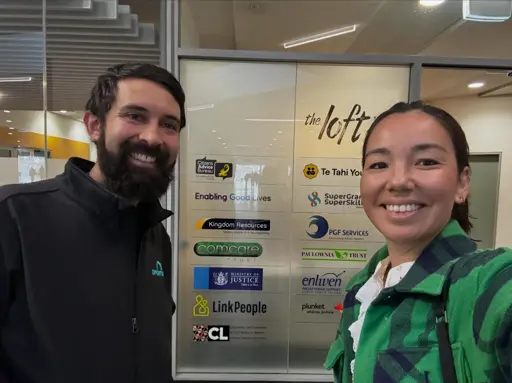

Eden Skipper, the only Māori MP in the Opportunity Party, with leader Qiulae Wong. Post-election negotiations will test their mettle and commitment to Te Tiriti, writes Jamie Tahana. (Photo: Facebook)
Turnout in the Māori seats this election was the highest in 30 years — and there is no doubt the vast majority voted for a change of government. But with the final election results now in, writes Jamie Tahana, the signs suggest there’ll be no let-up in the relentless debate on the future of Indigenous rights.
In the TVNZ kaupapa Māori debate a month ago, Eden Skipper, of Ngāi Tahu, was making the case for why Māori should back Opportunity, the centrist party that was hoping to make it into parliament for the first time.
Wedged between Tama Potaka and Willie Jackson, and berated by Shane Jones as a Hoani-come-lately, the bright-eyed and bearded 28-year-old was asked why Te Tiriti o Waitangi wasn’t one of his party’s bottom lines.
But he wouldn’t say, even when pressed. Eyebrows rose when he didn’t raise his hand to the question of whether the health system was racist, instead challenging the parties to commit to a bipartisan 10-year plan. Still, he said: “We wouldn’t have supported many of the policies from this current government.” In subsequent interviews, he said he was worried Māori culture had been feared, misunderstood and weaponised. “What the government has done over the last three years has been incredibly harmful to the Māori iwi-Crown relationship,” he told Newsroom in October.
The rise of Opportunity has been one of the defining moments of this year’s bizarre and unprecedented election. On election night, the party’s leader, Qiulae Wong, told screaming fans at Eden Park that “the nation has been waiting for this moment.” On Friday, after a three-week wait, the final results made clear the repudiation of the two major parties. A Labour-led left bloc had no path to power, while the incumbent coalition of National, ACT, and New Zealand First were one seat short. They need Opportunity to govern again — otherwise we have a hung parliament. Qiulae Wong is now the kingmaker.
Skipper is the only Māori in the Opportunity Party caucus of seven as it confronts what will likely be lengthy and difficult negotiations. That will certainly test his, and the party’s, mettle and commitment to Te Tiriti. Two of the coalition parties, ACT and NZ First, have both committed to abolishing the Waitangi Tribunal, a move that Skipper, in that same TVNZ debate, said he wouldn’t support.
Wong, in an interview with Mihingarangi Forbes before the election, said the Crown-Māori relationship needed a reset, promising to restore changes to marine and coastal area law and repeal legislation that has stripped references to Te Tiriti o Waitangi.
“I see the obligation of the Crown as both honouring Te Tiriti itself but also educating the public and raising awareness about the benefits of what a positive Crown-Māori relationship can mean for all citizens,” she said.
Now is the time when the depth of that commitment will be put to the test.
The negotiations, Christopher Luxon has warned, will be difficult. David Seymour and Winston Peters are both seasoned negotiators who’ve made policies around the future of Māori central to their campaigns. Just last week, Seymour called for the abolition of the Māori seats — which NZ First also supports — telling RNZ “we may well” push for a referendum on their future in coalition negotiations.
For Māori exhausted by the relentless debate around the future of Indigenous rights, the signs so far suggest there will be no let-up. The Crown-Māori relationship is at its lowest point in generations, but there may still be further to go before it hits rock bottom.
In a poll by Whakaata Māori before the election, 72 percent of Māori voters said the Treaty partnership had been weakened by the previous term. Iwi leaders, who gathered in Wellington this week, had their eye on the result, even if politicians weren’t invited. The Ngāti Kahungunu leader Bayden Barber told me: “We need to be formulating a plan for the next little while.”
Our people are clearly not taking this lying down, with Māori voters bucking the nationwide trend of record-low turnout. According to figures released by the Electoral Commission, the turnout in the seven Māori electorates was 72.9 percent, up 4.9 percent from the last election and the highest since 1996. More Māori also enrolled to vote in both general and Māori electorates, following sustained mobilisation among our people.
That adds to the weight of expectations for those who now find themselves tasked with Māori interests in the coming negotiations, and the weight of Opportunity’s commitment to Te Tiriti and a reset in Crown-Māori relations.
Whatever coalition forms, the margins of power will be bare. Dame Marilyn Waring, the former National MP who, in 1984, crossed the floor over nuclear legislation, ultimately triggering a snap election, recently told The Post that being “one heart attack from a general election” should force Christopher Luxon to listen closely to his caucus. Because the National Party faces pressure, too. In private, several MPs have expressed frustration over how the past three years panned out, and what the Treaty Principles Bill did to its now shattered reputation among Māori.
Tama Potaka, who is now one of National’s most senior figures, could face some difficult decisions. In that same TVNZ debate, he wouldn’t be drawn on whether he would commit to keeping the Waitangi Tribunal. “That’s a matter for discussion in the event that we reach a coalition opportunity,” he said. Didn’t whānau have a right to know where he stood? “That is actually a matter for the leadership of the National Party,” he replied.
But if a contentious vote that triggers a mass hīkoi comes to the House again, and it came down to one vote, would he walk? If it came to deciding between people or party, which would he pick?
A lot now weighs on a few shoulders.
Jamie Tahana (Ngāti Pikiao/Ngāti Makino/Tapuika) is a journalist and broadcaster who has worked in both Aotearoa and the Pacific. He grew up between his Dutch mother in the Hutt Valley, Wellington, and his Te Arawa dad in Rotorua. He has a master’s degree from Te Herenga Waka Victoria University and was the Māori news editor at RNZ until May 2023.
The post A lot now weighs on a few shoulders appeared first on E-Tangata.
From E-Tangata via This RSS Feed.