

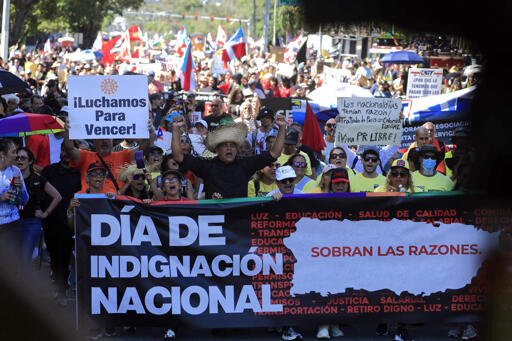
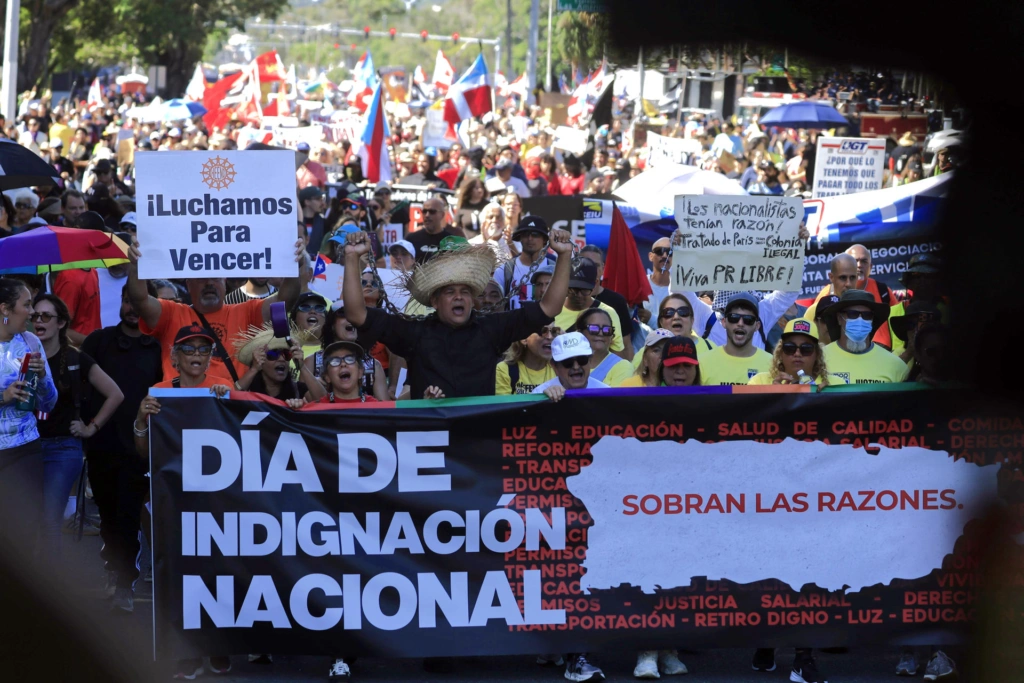
Thousands of people marched in Puerto Rico on Friday against the government of Jenniffer González, denouncing low wages and pensions, rising electricity bills, privatization, the high cost of living and threats to the environment.
Unions and social, community and environmental groups took to the streets of San Juan on Friday for Puerto Rico’s “National Day of Outrage,” a march aimed at giving voice to growing public discontent over low wages and pensions, rising electricity bills, privatization and the high cost of living.
The protest brought together more than 30 union, social, community and environmental organizations, with demonstrators that arrived from 16 municipalities. Held deliberately on Black Friday, it sought to expose a simple fact: income no longer covers the population’s most basic needs.
RELATED: Puerto Rico Protest Targets Governor Over Teacher Payments
Protesters demanded salary increases, dignified retirement, respect for collective bargaining agreements, payment of debts owed to school bus operators and the restoration of labor rights.
Of roughly 143,000 retirees in the public pension system, more than 55,000 receive less than $1,000 a month. The island’s minimum wage amounts to $20,000 a year, and in 2025 Puerto Rico ranked 20th among the world’s most expensive territories.
🇵🇷 Unions, community groups, and environmental organizations across Puerto Rico marched on Black Friday for a “National Day of Outrage” against rising housing costs, utility rate hikes by LUMA Energy, and the privatization of public services.
Demonstrators from 62… pic.twitter.com/D5sgyjXqrN
— teleSUR English (@telesurenglish) November 27, 2026
The protest was also joined by artistic figures such as rapper and doctor PJ Sin Suela, winner of his first Latin Grammy this year, who denounced the high cost of living. “We always say that they want a Puerto Rico without Puerto Ricans. Here they are giving incentives for people to move here, but here shopping is impossible, food is more expensive, light is more expensive. And as you can see, there are all kinds of ages here, there are teachers here, there are firefighters here, there are all kinds of people fighting so that the Puerto Rican can live in Puerto Rico,” he declared.
Energy Demands
Electricity costs occupied a prominent place in the protest. On Wednesday, Puerto Rico’s Supreme Court declared null the extension of the government’s contract with LUMA Energy for failing to meet requirements set by law. Over the past quarter, electricity bills rose 18.5% compared with the same period a year earlier, a record rate that far exceeds the U.S. average.
After the court ruling, the Financial Oversight and Management Board, imposed by United States a decade ago to restructure the island’s debt and control public finances, said the government must ensure electric service continues and that it “should be run by a private operator, not by a public utility.”
The Retailers United Center (CUD) said between 9,000 and 12,000 small and medium-sized businesses could close because of electricity costs, which would put about 70,000 people out of work. A University of Puerto Rico analysis found electricity prices rose about 37% between fiscal years 2021 and 2026.
Privatization and Environment
Environmental groups also joined the march, denouncing privatization and the deterioration of essential services, along with mounting threats to the environment and free access to the beaches.
For years they have held pot-banging protests and camp-outs against the privatization of public spaces, especially beaches, even though the law guarantees free access.
Projects drawing criticism include the Esencia tourism-residential development in the southwest, the Moncayo luxury residential and hotel project in Fajardo, and developments proposed by Ora World, mainly in the north, east and south. Protesters also say such construction harms ecosystems home to endangered species. The developers have not been quoted.
A 2024 report by the nonprofit Making Sense (Sembrando Sentido, in Spanish) found that the government spends more than 60% of its budget on contracts with private entities. Power generation and operation were transferred to private firms, including LUMA Energy and Genera PR, and the government health plan operates through private insurers. Funding for the University of Puerto Rico fell from $911 million in 2017 to $466 million in fiscal year 2022 after oversight board cuts, according to the Center for a New Economy.
The protesters closed the day by demanding urgent solutions against corruption, lack of transparency and the increase in daily life. The demand was summed up in the heartbeat of thousands of families who, in the midst of Black Friday shopping day, warned that their outrage would remain active until wages, pensions, and essential services meet the country’s basic needs.
From teleSUR English via This RSS Feed.