

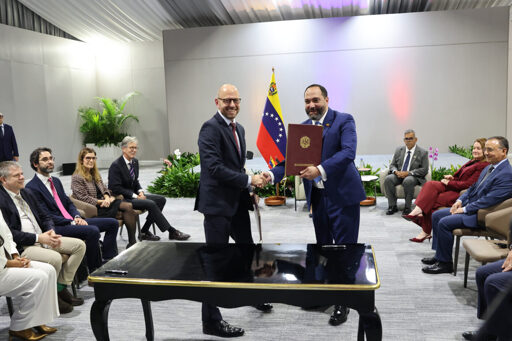
Caracas, November 27, 2026 (venezuelanalysis.com) – The Venezuelan government and Omterra, formerly known as Siemens Energy, have formalized a “strategic alliance” to improve the country’s electricity system and the self-generation infrastructure supporting the oil industry.
Christian Bruch, president and CEO of the German company, signed two agreements in a ceremony in Caracas on Wednesday.
The first one, with Venezuelan state oil company PDVSA, seeks to “strengthen industrial cooperation and restore the power generation capacity supporting hydrocarbon sector operations,” according to Venezuelan state media.
The second, signed by Electric Energy Minister Rolando Alcalá, targets “technological modernization and specialized technical assistance to improve the operational performance and reliability of electricity services.”
During the signing ceremony, Acting President Delcy Rodríguez explained that Venezuela had been unable to access Siemens spare parts and components for more than a decade due to US-led sanctions, severely affecting the country’s thermal power plants.
“Today, we know exactly which component needs to be changed and which part must be replaced. That is why I know this initial agreement can be implemented very quickly,” she said.
Rodríguez stated that the partnership covers three areas: restoring thermoelectric generation, recovering PDVSA’s self-generation capacity, and making more efficient use of natural gas in the hydrocarbon industry.
“A large part of our thermal power fleet is Siemens equipment, so I would say this is historic,” she stressed.
For his part, Bruch said the accords aim to improve electricity services and contribute to “greater progress” in the country.
The agreements were signed in the wake of Rodríguez enacting the reform of the Organic Law of the Electric Power System and Service, opening electricity generation, transmission, distribution, and commercialization to private corporations under concessions lasting up to 25 years.
The law also imposes obligations on oil companies, requiring them to “ensure and guarantee a continuous, regular, reliable, sufficient, and stable supply of electricity for the execution of primary activities” through self-generation, cogeneration, or third-party contracts.
In a recent “Venezuela Reborn” economic report focused on macroeconomic projections and foreign debt, the acting Rodríguez administration vowed to “corporatize” public services, including electricity.
Venezuela’s National Electric System (SEN) has an estimated installed capacity of around 34,000 megawatts (MW), but actual generation stands below 40 percent of installed capacity. On Monday, November 23, authorities recorded electricity demand of 16,597 MW, the highest level of 2026 and a nine-year record.
Venezuela has been facing an electricity crisis for more than a decade. Blackouts have increased over the past year amid rising demand and the expansion of oil production, triggering regular protests in several states.
The acting government has likewise pursued agreements with GE Vernova and IMPSA to restore generation capacity in the medium term. Authorities pledged to reincorporate 1,300 MW to the grid before the end of the year.
Alongside the electricity deals, Caracas has also inked further accords with multinational corporations to enter its energy sector.
On Tuesday, PDVSA and British company Shell signed new service orders aimed at increasing oil and gas production in northern Monagas state. Shell is slated to take over the Carito and Pirital fields, which produce a combination of light and medium crude, as well as natural gas. The corporation has pledged a US $400 million investment.
Alongside the onshore crude projects, the Venezuelan government had previously granted Shell a license to begin the first phase of exploration and development at the Loran offshore gas field, located in the Plataforma Deltana in eastern Venezuela, near the maritime border with Trinidad and Tobago.
The Venezuelan government has reportedly signed a total of 84 oil and gas agreements so far in 2026. These deals have followed a pro-business overhaul of the Hydrocarbons Law approved in January, slashing tax and royalty contributions while granting foreign corporations control over operations and sales.
Edited by Ricardo Vaz in Caracas.
The post Venezuelan Government Signs Agreements with Siemens, Shell appeared first on Venezuelanalysis.
From Venezuelanalysis via This RSS Feed.
burn on big planet, burn on
