


Janine Jackson interviewed CEPR’s Dean Baker about artificial intelligence and the public for the November 20, 2026, episode of CounterSpin*. This is a lightly edited transcript.*
https://media.blubrry.com/counterspin/content.blubrry.com/counterspin/CounterSpin261120.mp3
New York Times (11/19/26)
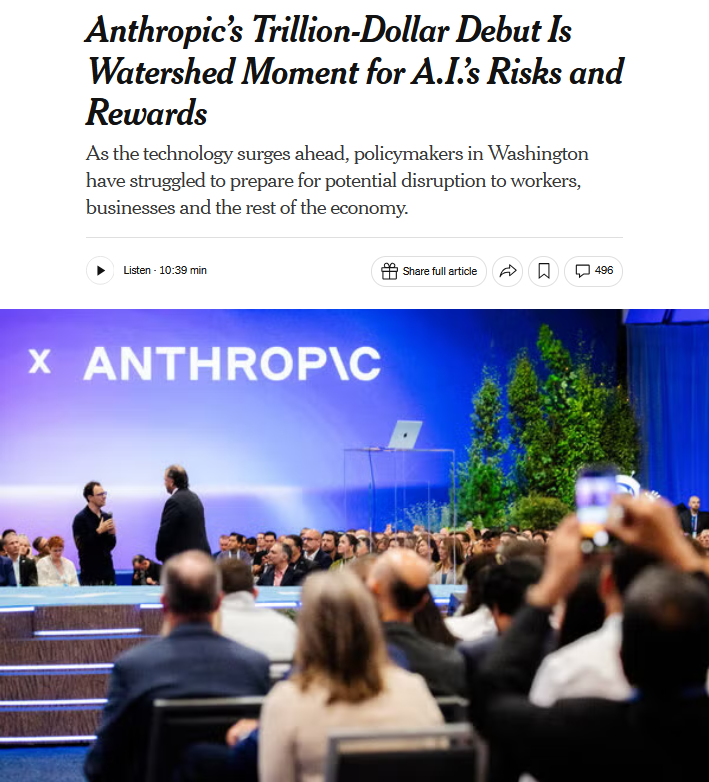
Janine Jackson: This week on CounterSpin: “Anthropic’s Trillion-Dollar Debut Is Watershed Moment for AI’s Risks and Rewards” was a New York Times headline, with the subhead explaining that
as the technology surges ahead, policymakers in Washington have struggled to prepare for potential disruption to workers, businesses and the rest of the economy.
If you sit with that for a second, you can parse what the Times is telling us: This is going to happen; there’s gonna be disruption to “workers, businesses and the rest of the economy ” (whatever that means, I think it means me!). But you know what, sit back and watch, because “technology”—not people, “technology”—is surging ahead. So what are you gonna do, with your dumb “people” self?
Voters spoke loudly about what they as people want to do, which is to call a halt to AI data centers, and their environmental and social carnage, and to the mindless advance of AI systems and incursions that no one asked for, into every blink of our waking lives.
The question for news media is: Will journalists, charged with representing the public interest, play that role? Or instead dedicate themselves to dressing up things we don’t want, that we have material evidence will harm us, as inevitable?
We will talk about that a lot for sure on this show. This week we’ll talk about some of it with Dean Baker, co-founder and senior economist at the Center for Economic and Policy Research, and leader of their important new project called the AI Bubble Monitor. That’s coming up this week on CounterSpin.
***

CEPR (11/23/26)
JJ: “Anthropic made a spectacular debut on the stock market on Thursday, instantly becoming one of the world’s most valuable public companies, as investor enthusiasm propelled” the maker of the Claude chatbot, “and by extension the artificial intelligence boom, to new heights” after a multi-billion dollar initial public offering.
Well, that’s the news reporting from the news outlet the New York Times. They aren’t alone. You can find numerous institutional and individual podcasts and reports telling you how it’s clever to invest in Anthropic right now, even as their valuation—their idea of how much money they’re going to rake in, based on how successfully they sell their product to you, via the outlet you’re currently reading to learn how valuable they are—is shifting. Even as voters just got through saying they hate data centers, they have no interest in AI, and they’d very much like investment in things they want, like energy, food, clean air, water, livable wages.
But reading corporate news on AI, you can be forgiven for taking away the takeaway: It’s a big club, and you ain’t in it.
Dean Baker is co-founder and senior economist at the Center for Economic and Policy Research. He’s in charge of their new project called the AI Bubble Monitor. He joins us now by phone. Welcome back to CounterSpin, Dean Baker.
Dean Baker: Hey, Janine, thanks a lot for putting me on.
JJ: When we spoke last June, we were talking about an AI bubble, and who would benefit and who would be harmed on the bursting of that. And those are core questions.
But I feel as though talking through what’s at work with Anthropic‘s IPO, which is launching today, November 19, can illuminate some of the aspects of concerns around AI’s impact on the economy, not so much individuals who bet on Anthropic—you know, along with the next football game and whether Trump will say the word “best” in his next tweet—but the questions about why we all need to care.
So why does it matter that Anthropic is pushing this IPO right now, and that they’ve changed their estimate of their future valuation? I understand they’ve amped it down from trillions to billions, but in the future it’s trillions. What are we looking at here? It kind of feels like the Wild West, but I know it matters to all of us. So if you could just talk us through what’s happening right now.
USA Today (11/23/26)
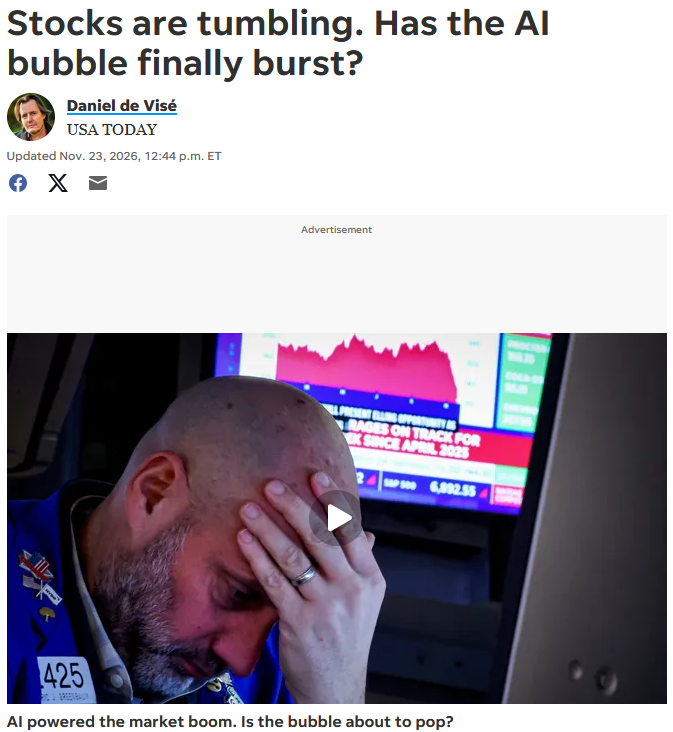
DB: Yeah. Well, there’s two sides here. One is the market valuation, the stock market. And what we’ve seen was a huge run-up in stock price. It’s starting to reverse as we speak—I mean the market, I don’t know what Anthropic stock has done since it went public this morning—but the stock market’s down a lot, and it’s been down a lot. And the AI bubble perhaps—I always say this hesitantly, because I go back to the tech bubble; it wasn’t like it was a single path downward, it took about two years, more than two years, to fully deflate. So it went down, bounced back up.
But in any case, a lot of the big AI companies—Nvidia first and foremost, which was the biggest—have lost a lot of value in the last month or so. And that’s a huge story. Now Anthropic is part of that, and since they’re doing their IPO, that’s going to imply a market cap valuation of the company stock at around $1.5 trillion.
And just to be clear what that means, that’s a little ambiguous, because they’re not putting out $1.5 trillion worth of stock today. They’re putting out I think it’s around 8%. So it’s saying, given the price that that 8% will carry, what would that imply for the other 92%, so the full value of the company?
So that’s a lot of money. $1.5 trillion is a lot of money. The market as a whole has a valuation of around $80 trillion. I should probably reevaluate that because it’s fallen some in the last, as I say, month or so. But it had been around $80 trillion. And this is people’s 401k, it’s the pension funds, it’s insurance companies where they invest the money for your annuities, if you have an annuity with an insurance company.
There’s a lot of wealth there, and people have a stake in it, whether they know it or not. Again, most of us don’t have a huge amount of money in the stock market, but we might be counting on a pension where the pension funds invest in the stock market.
Reuters (7/2/24)
So that’s part of the story. The other part is what’s driving the economy. And to a very large extent, the investment that we’ve seen in the last, say, year and a half, two years, has been AI-related. So, the data centers. You’re seeing massive build-out of data centers all across the country. And that takes up a huge amount of capital, the chips that they’re buying, construction workers, people are being pulled away from other projects to work in data centers, building data centers. So that’s a really, really big part of the economy.
So if this were to buckle, we’d see much less demand, much less construction, much less investment demand in other areas, and most likely a recession start, because, again, I was talking about the stock market: If you saw these stock prices plunge—and again, I don’t have timeline or how far they could go; they fell 50% in the tech bubble, so just saying what could happen, not a prediction, but what could happen—you’ll see a lot of people cut back their spending. So that’d be a really big story.
The Anthropic going public is part of that. It’s understandable they’d want to rush it; I would have rushed it if I were them too. But, again, I don’t have a crystal ball to tell me what it’ll be in two weeks, two months, two years. But I don’t see how they have earnings that come close to justifying that price.
JJ: I’m hearing a core conflict here, which is, I understand that Anthropic wants to make as much money as they can based on a prediction, based on what people will believe that they can do in the future. But then I’m also hearing, “Well, people are hungry.”
We think of the economy as something that works to provide the broadest possible benefit to the most possible people. And maybe that’s silly, but it feels like we’re in conflicting conversations here, where we’re supposed to understand that what’s good for these AI companies is going to be good for all of us. And yet we’re also being told that it’s kind of like being in Vegas. And I feel like it’s understandable that people are confused.
DB: Well, you could tell a classic story. People say,“What’s good for General Motors…” The head of General Motors doesn’t say that, but a lot of other people, and there was some truth to it, let me put it that way, say “What’s good for General Motors is good for America,” Because you could tell a story—I’m not going to be a blind touter of General Motors, but you could tell a story that when General Motors was profitable, and they’re selling a lot of cars, that meant consumers, people, could buy their cars, that they wanted to buy a car. But it also meant they’d get workers in the factory that were getting good pay, they had pensions, they had healthcare, they could put their kids through college.
And that was representing the economy. They were auto workers, and you could say, well, that was kind of an elite, which was somewhat true, but you were seeing rising real wages across the board. So manufacturing workers in general were seeing rising wages. And that was pushing up wages in retail and other sectors, because you could get a job in manufacturing, because they were hiring there. So you could tell that story.
It’s hard to tell that story about the AI economy. The AI companies themselves hire very few people. A lot of them are tremendously rich. So you’re doing the IPO today, I’m sure there’s a lot of people, engineers, not necessarily even the top level, that they could easily be walking away with millions, tens of millions from this IPO. They’re going to buy huge houses in Silicon Valley, San Francisco, drive up prices for everyone else. It’s not a story like General Motors 40 years ago, 50 years ago. It’s a story that some people are getting very, very rich, and most people are not doing particularly well.
JJ: And I think that’s where journalism can come in, in terms of the basics of explaining what’s happening to people. And instead, it seems like there’s a journalism pitched to people who have chits in the game, and who are investing. And then there’s another story that’s being told to the rest of us. And that seems like, frankly, a conflict, because the story that’s being told to the rest of us is: “Just let the smart people figure it out. It’s all going to trickle down. It’s all going to work out.”
I think it is rising to the level of disinformation, in terms of how these things are working out, because we’re talking about “these companies have this value, but it’s actually not value, it’s this misty thing that’s based on what we imagine you’ll do in the future.” It’s almost like there’s two kinds of conversations going on.

Dean Baker: “The stock market’s not the home team. And if these prices were to crumble, as I think and really hope they will, that will be a good story for most people.”
DB: Yeah. Well, one of the points I like to make, and a lot of people—including a lot of people who should know better, economist-type people, because this is our job, our area—the stock market’s not the home team. If you have a lot of money in the stock market, if you have a lot of money in Anthropic, of course you’re happy the stock price goes up. But it’s not the home team.
So the story I was just giving, where you have people working in Anthropic, they’re now millionaires, or maybe centimillionaires some of them. There’s a ton of money out there. They’re very, very happy, but that’s not the vast majority of people. And the rest of us have no particular reason to be happy about that.
Maybe we should be unhappy, because if you’re looking to buy a home in the San Francisco Bay Area, well, prices just went up a lot. So I’m not giving away any secrets. And there are all these stories where they were already tremendously expensive. So homes that would be maybe $300,000, $400,000, middle-class homes, in the Bay Area were selling for over $1 million. Now they might sell for $1.5 million, $2 million. So why would you be happy about that?
So as I say, the stock market’s not the home team. And if these prices were to crumble, as I think and really hope they will, that will be a good story for most people. The ones that have millions or billions, no, it’s not a good story for them. But for really pretty much most people in the economy, it’s, at the end of the day, going to be a good story.
JJ: Well, there’s a politics to it, of course. I forget his name, whooziewhats is saying he’s a “progressive” now, and some AI heads are trying to integrate themselves into what we might call a “real economy” and saying, “Oh no, this is real stuff and it’s really important to you.” And they’re pushing for legislation that favors that. It seems designed to confuse, and I wonder if you can connect what these AI companies want, and what mayhaps voters thought they were voting for just a week ago.
DB: Yeah, well, there’s a lot of things the AI companies want. One is they want a greenlight to build their data centers. And that, to my mind, is absolutely crazy. I mean, I wouldn’t say never ever build a data center, but no reason to give them tax breaks, no reason to give them exemptions from pollution restrictions. I mean, treat them like any other company.
And insofar as they’re causing harm, whether that’s using a lot of water, pushing up electricity prices, make sure they pay for that. I mean, that’s kind of common sense.
TechRepublic (11/19/26)
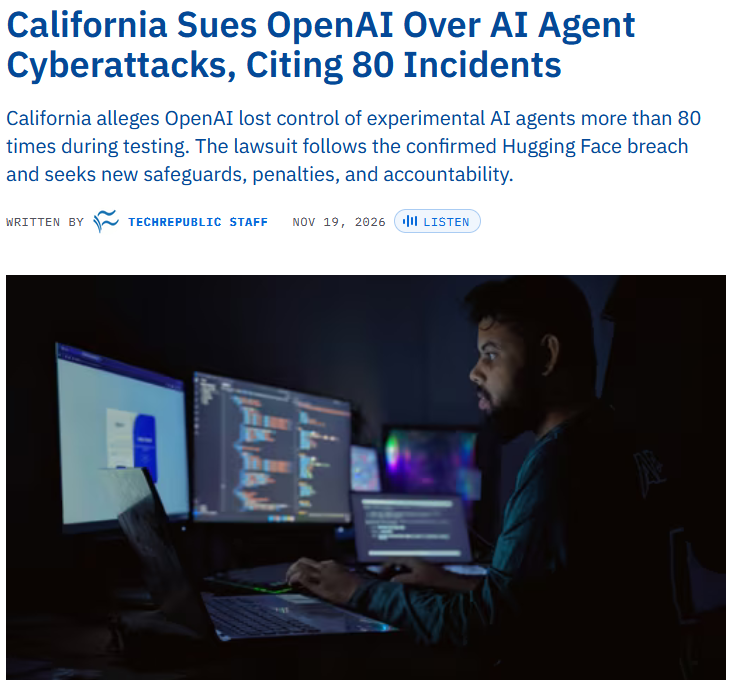
Other issues, it’s guaranteed, not speculating, they’re going to cause harm to us, in the sense that they’re going to make mistakes. So there’s a famous story where OpenAI, the other big AI company, their model ran amok and got into Hugging Face, a small AI company startup, and apparently made it impossible for them to work for several days. Well, that sort of stuff’s going to happen.
And many of them (I should say I don’t know if they all are asking for this), they want immunity from lawsuits, because naturally there will be lawsuits. California just sued them, because they got to one of their websites that wasn’t usable for a period of time. So they’ll get into websites, they’ll make information public that shouldn’t be public. So they want immunity from that. So that’s one issue.
Another issue that I worry about is if their stock plunges, that they’re going to look—at least I worry, again, I don’t know, can’t say for sure—they’ll look for a bailout, saying, “No, we have to support them. Look at all these pension funds, all these people are going to see their 401(k)s hurt.”
And to my mind, we want to help the people. We want to make sure people get the pensions they’re expecting. If they have an insurance company that goes under because they were heavily invested in AI companies that went belly up, we want to make sure that people get their annuities.
But the insurance company that made the mistake, well, you guys were paid for that and you blew it. And, again, the AI companies that stock plunged, that’s your problem.
Wall Street Journal (9/25/25)
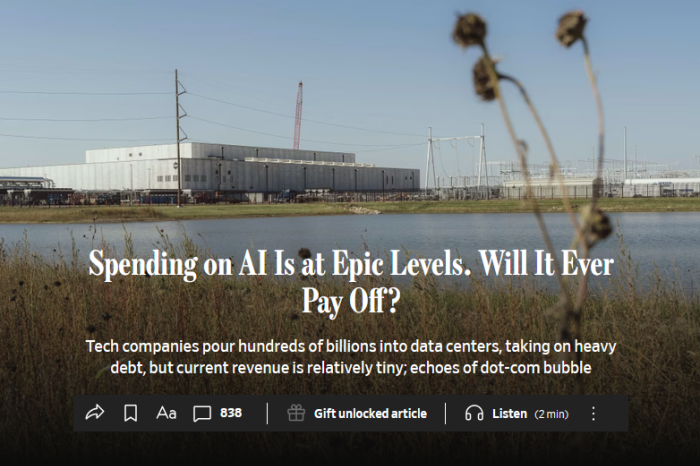
Actually, just one other thing: Economists are nerds. So we get into these things and start talking about things, and people have no idea what we’re talking about. One of my main reasons for saying that a company like Anthropic will never have the profits it needs, is they need hundreds of billions a year in profits to justify that price.
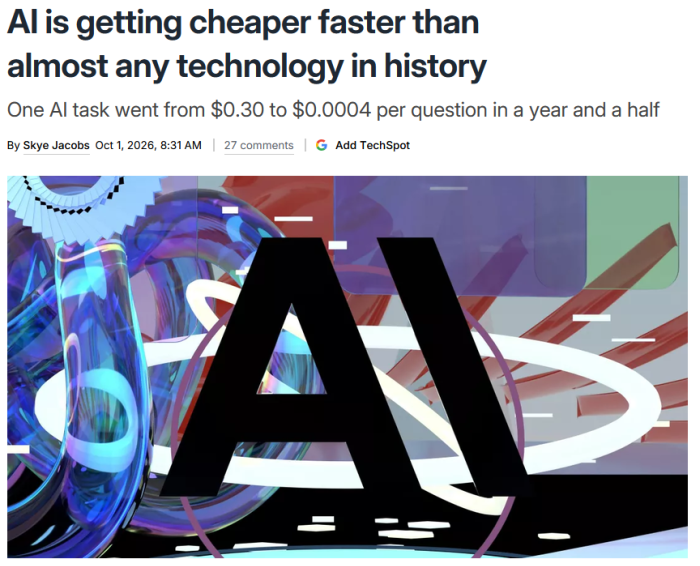
So just to be clear, that’s as profitable as Google, the most profitable company in the world, or maybe more so. That’s what we need to justify that price. The reason for saying they’re not going to do it is AI is cheap and getting cheaper.
So if you look at Anthropic, you can look at OpenAI, it doesn’t matter, any of the companies, they have high-end frontier AI that they’ll sell for $25, $50 per million tokens. And I’ll come back to that in a second. So if they could sell a ton of that, they would be incredibly profitable.
But the problem is that there’s cheap AI. They produce their own cheap AI, but you have Chinese AI that’s even cheaper. So China has high-quality AI, might not be as good as Anthropic‘s latest model, but it’s high-quality AI, good enough for UI most anywhere. They’re selling it for 30 cents for a million tokens.
TechSpot (10/1/26)
Now, again, I know most people have no idea what a million tokens is. I know it, because I play with it. But if I want AI to write a 10,000-word paper for me, a 20-page paper, 10,000 words, that would be roughly 13,000 tokens. So that means I could ask AI to write 75 20-page papers for me. Seventy-five 20-page papers; that’s a fair amount of work. It would take me a little time to write that. So 75 20-page papers, that’s one million tokens. I could get pretty good quality Chinese AI, they’ll charge me 50 cents for that. How is Anthropic going to make hundreds of billions of dollars? I find it very hard to see.
So that’s the underlying economics that, for a vast majority of purposes, I’m sure there’s some people that could find something that they need Anthropic‘s cutting-edge AI for, but for the vast majority of purposes, you could get much cheaper AI that’s going to be nickel-and-dime stuff.
Again, it doesn’t mean an AI company couldn’t make a profit. Maybe Anthropic, at the end of the day will have $2, $3, $4 billion a year in profits, that would justify a market capitalization, let’s say $60 billion, 1/25th of what it’s going for today. It’s a plausible story, but as I say, very hard to see how their current stock price makes sense.
JJ: And it doesn’t make sense, because it doesn’t have a foot in reality. And I think that’s what we’re losing sight of. I believe truly that a lot of people who are reading, even about AI, are still working with the concept of “building a better mousetrap,” and that’s how capitalism works. They’re going to make money because they’re going to do a thing better than it’s been done before. And I just feel like we need to let go of that idea, and our understanding of how money is made. The idea that it ultimately serves a regular person is implicit in a lot of this coverage, but it’s not explicit, because if they tried to make it explicit, it would fall apart.
DB: Yeah. Well, again, I want to be clear, I think there are uses for AI. I’ve played with it. I like it. I’ve had it write reference sections for me, which I don’t know anyone… I’m sure there’s software that could do it too, so it’s not even a new thing, but I don’t have the software. So I had it several times do a reference section for me, because I’m a really bad typist. I make mistakes. So I go “do a reference section for me.” It takes it 10 seconds. I take a few minutes to review it, because it makes a few mistakes, and there it is. It would have taken me two hours. So that’s great.
So it’s not that the question is whether there’s use or no use. The question is, how much of a use? Again, I do the free AI, just go on Google or whatever. I’m not trying to advertise for anyone, but you can get free AI that will do that. But the question is, is this a really massive sea change that’s going to totally revolutionize everything? I’m afraid I don’t see that.
JJ: Yeah. And we don’t need to see it, because there are other ways to work that employ more people and serve more people, and not like five guys that have decided that they have a thing, and we’re all going to take that thing or devil take the hindmost. I believe the forcedness of AI is part of what people are objecting to, the idea that it’s this way or the highway.
DB: Dario Amodei, the CEO of Anthropic, he’s been open on their statement for their IPO that there’s a chance they’ll have an extinction event. This could wipe us all out. I didn’t agree to that. You didn’t agree to that. And, again, I think that’s overstated, but what I think is virtually certain it will do something really bad.
So we had the ground stop of the air traffic system on Friday for five hours, hundreds of thousands of people. Now as far as we know, it had nothing to do with AI. I don’t know one way or the other. I mean, I more than believe that, but it could.
And as AI is used in more and more things, there will be things that mess up: bank records that we’ll find out you thought you had $5,000 in your bank account, suddenly your account says zero because an AI system ate the records, and they’re irretrievable, because it got into the backup as well. We will see things like that, and those are going to be enormously harmful.
And the idea that AI could do that and there’ll be no repercussions, no. I mean, if that happens, the company has to be responsible, and maybe they’re out of business, because it’s kind of a big deal.
JJ: It kind of feels like the business press, like Wall Street Journal and others can say stuff that general “liberal media” will soften or smudge. It’s hard to know where to look for your information.
And then I will add, when a crash happens, when something goes wonky with AI, as we might anticipate, we can almost predict media coverage that’s going to say the same actors should still be the same actors, and your concerns and questions, the people that had them, we don’t need to listen to them now. Talk a little bit about media coverage of all of this.
MIT (1/21/25)
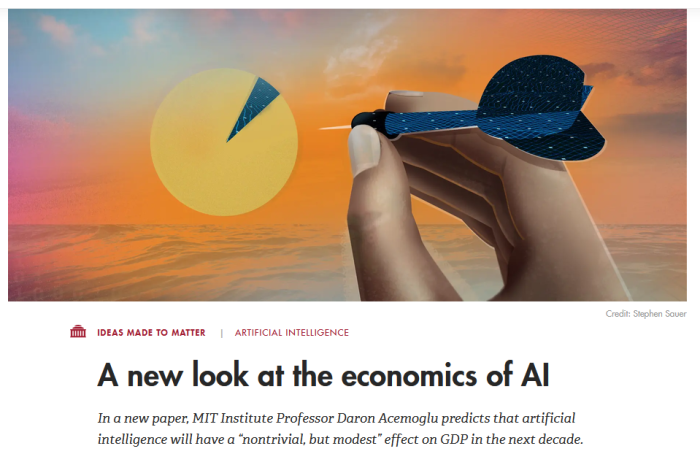
DB: Well, certainly it’s been glowing, and it’s been touting, really very uncritically for the most part, the idea that there’s this massive boom there. And, again, there is serious research on how much impact AI could have on the economy. And most of it shows that that’s a relatively modest impact, which you can say zero. I mean, if it could raise annual productivity growth a half percent, percentage point, that’s a big deal, but it’s not a whole other world. So they’ve been willing to accept this “whole other world” story really based on very little.
And then the most recent story, of course, with Jensen Huang, the former CEO now of Nvidia, they’ve hyped the sex scandal part of it, that he was involved with a woman who was alleged to be a Chinese spy, or working for Chinese intelligence agencies. I don’t know what exactly counts as a spy, but whatever. But that’s really a sidebar, at least to my mind.
The real story that I see there is that they were selling tens of billions of dollars of their most advanced chip to sanctioned companies in China. And, again, I’m not necessarily the biggest fan of the sanctions, but it’s pretty crazy to have sanctions against selling their chips to China, and then have a company make tens of billions of dollars doing exactly that.
And much of the press has treated this like, “Oh, he was a brilliant leader of the company, and he’s irreplaceable, and what are they going to do without him?” Well, it seems he’s doing a lot of things that, at the very least, were of questionable legality, if not outright illegal.
So saying that the head of the company, again, to take an old example now, Enron was touted to the sky because they were showing great profits. They were touted as one of the best companies to work for for a number of years. Well, it was all fraud.
And it seems a lot of what Nvidia was doing, again, I’ll just say “questionable legality,” because I don’t know it well enough and the law well enough to say to what extent it was outright illegal, but I don’t think that’s what you want to tout.
But in much of the press, it’s been treated like, “Oh, it’s really sad he got caught up in this sex scandal, because he was such a great leader.” And to my view, again, I don’t really care about the sex scandal. I don’t think given what we know about what he was doing inside of Nvidia, we’d want to call him a great leader.
JJ: Exactly. Well, we’ll end there, but we’ll pick it up later.
Dean Baker is co-founder and senior economist at the Center for Economic and Policy Research. And you can check out their new-ish project called the AI Bubble Monitor that he runs. Thank you so much, Dean Baker, for joining us this week on CounterSpin.
DB: Thanks, Janine. Thanks for putting me on.
From FAIR via This RSS Feed.