

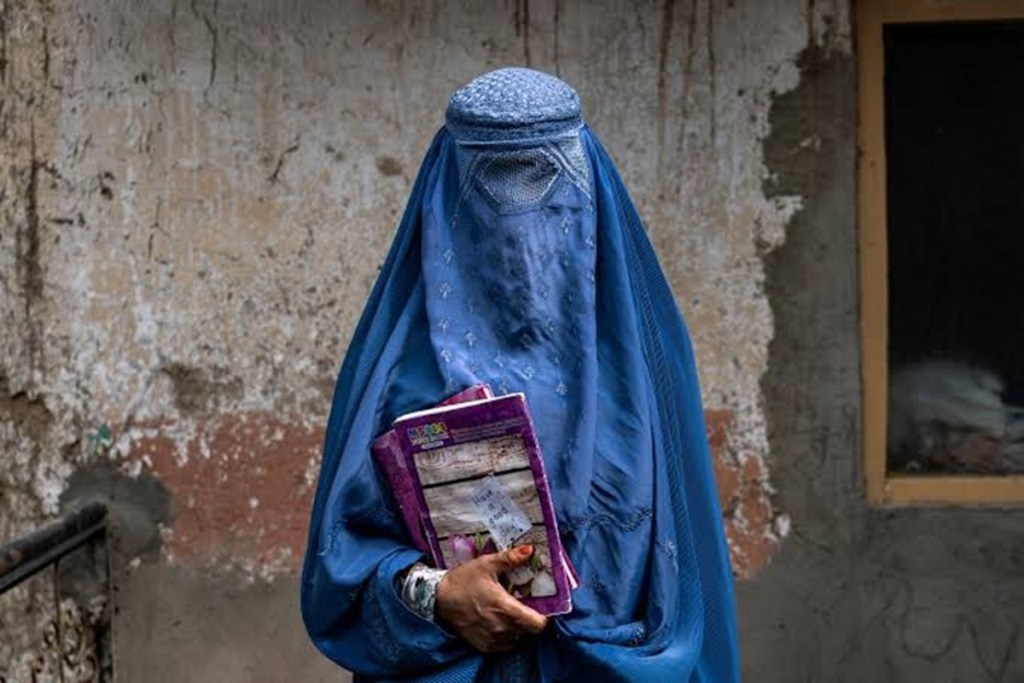
The directive mandates that women’s names be replaced with a common appellation.
In Afghanistan, Taliban authorities in Balkh province have ordered that women’s and girls’ given names no longer be used in documents and public spaces, which has drawn strong criticism from activists and human rights organizations.
RELATED: UN Denounces Arrests of Women for Not Wearing the Veil in Afghanistan
The directive mandates that women’s names be replaced with a common appellation, eliminating their individual identification in official and administrative records. Afghan activists denounce the measure, arguing that it further invisibilizes women in public life.
Several international organizations consider the measure a violation of the right to identity and part of a pattern of systematic discrimination against women since the Taliban regained power in August 2021.
According to reports, officials and public employees were instructed to address all women using the term “Bibi,” a word that can be interpreted as “grandmother” or “elderly woman.”
Members of the Free Women Network raised slogans calling for an end to gender apartheid in Afghanistan. They demanded education, work, freedom, justice and equality for Afghan women and girls as part of the 16 Days of Activism campaign.#EndGenderApartheid #16DaysOfActivism2026 pic.twitter.com/aD264ROhw8
— Jahanzeb Wesa (@jahanzebwesa) November 26, 2026
Afghan activist Lalah Osmany, exiled in Germany, denounced the practice as going beyond a conservative tradition and representing a process of dehumanization. She also pointed out that in some contexts, women are identified by derogatory terms associated with animals.
Osmany also warned of the practical consequences of the measure, especially within the healthcare system. She explained that using the same name or designation for numerous patients could lead to confusion in prescriptions, medical records, and healthcare processes.
The activist noted that the restrictions imposed on Afghan women include prohibitions on accessing certain levels of education, limitations on working and moving about in public spaces, obstacles to filing for divorce, and other measures that have progressively reduced their participation in social life.
Furthermore, she expressed concern that this legislation could be extended to the rest of the country, further solidifying the exclusion of women and girls from the Afghan public sphere.
#FromTheSouth News Bits | Russian Foreign Minister Sergei Lavrov said that the presence of NATO infrastructure in Afghanistan was ‘categorically unacceptable’. pic.twitter.com/hYSMNZgVXY
— teleSUR English (@telesurenglish) October 8, 2026
teleSUR: JP
Source: EFE
From teleSUR English via This RSS Feed.