

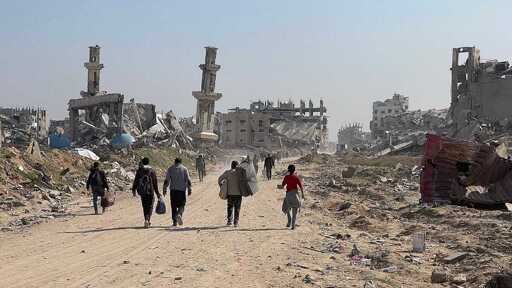
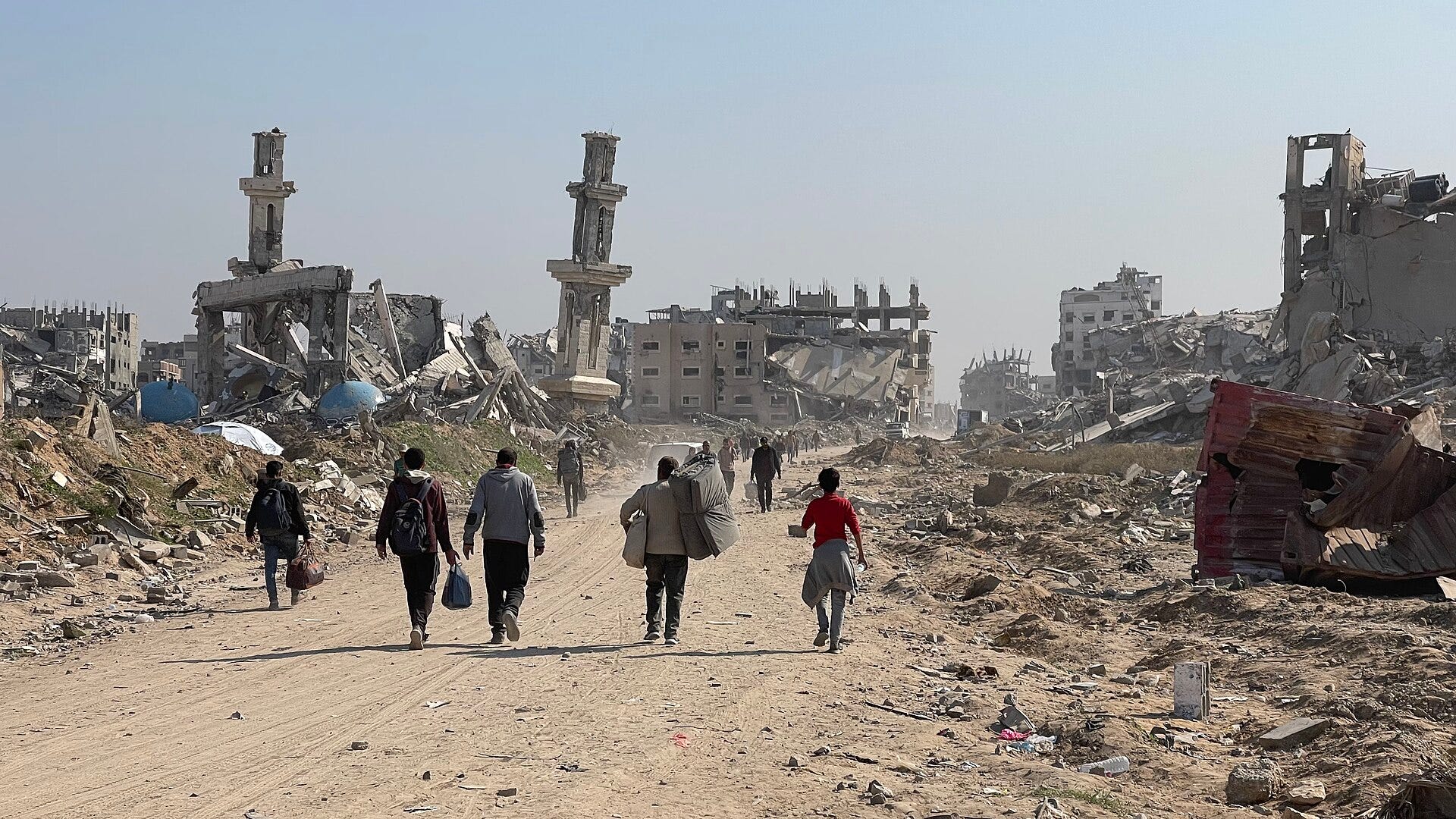
Credit: Jaber Jehad Badwan, CC BY-SA 4.0, via Wikimedia Commons

In the gut-wrenching book Requiem for Gaza, a collaboration between journalist Chris Hedges and cartoonist Joe Sacco, the reader bears witness to US-backed Israeli genocide through the eyes of 29 survivors living as refugees in Egypt. In the spring of 2025, Hedges, a former New York Times war correspondent, and Sacco, a comics journalist, spent three weeks in Cairo interviewing men and women–doctors, journalists, teachers, mental health workers–who, one way or another – through medical approval, foreign citizenship, GoFundMe accounts—escaped from Gaza through the Rafah Crossing before Israel shut the gates, once again, to declare no exit.
The gripping 120-page book sets a grim stage with a preface by Hedges, who reported from Gaza for seven years, during which time the Arabic-speaking Middle East NYT bureau chief made dear friends, only to lose some to Israel’s post-October 7th saturation bombing of the densely-packed coastal strip, populated by refugees and their descendants from Israel’s 1948 ethnic cleansing of Palestine. For Hedges, the “requiem’–or act of remembrance–embodies a Gaza that, at least in one’s heart and mind, can never be erased despite Israel’s mission of erasure through slaughter, occupation, and colonization. “The razing of Gaza is not only a crime against the Palestinian people, but it is also a crime against our cultural and historical heritage, an assault on memory,” writes Hedges, a graduate of Harvard Divinity School and former seminarian who once ran a small church in Boston’s Roxbury neighborhood.
With chapters that cover First Day, Exodus, Assassinations, Ceasefire, Exile and Resistance, Requiem for Gaza introduces us to Osama, a clinical psychologist who specializes in trauma. The former resident of Gaza City recalls how, in the days that followed October 7th, he and his family huddled at home in a safe room while Israel pummeled his neighborhood with warplanes, artillery, naval guns and tanks. Osama, his wife, three children, and a Persian cat loaded up the car to get the hell out but were stricken with fear –unable to think clearly–before landing in a place long enough to set up a GoFundMe page to raise $30,000 for exit visas to Egypt.
Hedges points out the cost of a visa doubled, tripled, quadrupled, and more after Israel launched its AI-assisted genocide that, in the crime of scholasticide, destroyed every university in Gaza, where the literacy rate–among the highest in the world–had reached 98 percent.
Life is not easy for Osama in Egypt, where 150-thousand exiles from Gaza–100,000 since Oct. 7th– cannot obtain work permits, forcing them to survive in an underground economy or on donations sent from abroad. Hedges quotes Osama, “We have no status in Egypt … We are nothing … It is another level of war and struggle.”
Sandwiched between Hedge’s text, Sacco–an award-winning artist– draws Osama’s story of hardship and survival in gritty black-and-white captioned storyboards that capture close-ups of Gaza’s victims amid the terror of bombardment and the weariness of constant forced displacement. In bold strokes–more realistic than cartoonish–Sacco illustrates the frightful and panicked expressions of Osama and his wife as they sit frozen in their car, unsure of how to escape Israel’s assault; the smoke, rubble, and tanks they pass en route to a humanitarian organization, where Osama worked in mental health. “There was bombing everywhere,” ‘but Osama assumed the Israelis knew the location of international aid groups and wouldn’t target their facilities,’ reads the paneled caption. Sacco illustrates the violence and chaos that results when a bomb falls in front of the building, killing two people. Head-bandaged children, anguished men carrying victims into the ground floor of the office, adults covering as many windows as they can with filing cabinets, cupboards …” Sacco breaks up the brutal images with drawings of Osama’s daughters joyfully petting and tickling the belly of their cat, Semsen–which means sesame seed in Arabic.
Pleasure juxtaposed with pain reminds us that even in the bleakest of times, life can hold humor in small moments. In this way, Requiem for Gaza recalls the diverse stories told in the 2025 Gaza film “From Ground Zero”–an anthology of 22 mini-docs and animated videos, in which the short film “Everything is Fine’ chronicles a stand-up comedian’s preparation and performance for the children–some wounded and orphaned– of Gaza. Whereas other films–American Doctor, NAZA–present the point of view of caring outsiders inside Gaza or IDF soldiers in Tel Aviv coldly recounting their obliteration of Gaza neighborhoods, Requiem for Gaza presents the intimate stories of Palestinian survivors in exile who remind us of the broad spectrum of human emotion that traverses love, guilt, fear, empathy, longing and pride.
We meet Anna, a Palestinian from Gaza who waited four months to cross into Egypt so her paralyzed daughter Layan could receive medical treatment. “We have to continue physical therapy so she can walk again. I keep reminding her that she is very strong and one day she will walk.” Back in Gaza, Anna’s husband and two other children shelter in the ruins of a school. When she speaks to them on her cell phone–every day or every two days, depending on internet service–she tells a harmless lie–one we all might tell- that she, like them, eats only canned food. “I can’t tell them what I actually ate.” Anna picks up her phone to show Hedges and Sacco her “painfully thin” son who “is constantly complaining of headaches because of his malnutrition. I tell my sisters to get him some peanut butter.”
We also meet journalist Sanna Kamal, who tells Hedges and Sacco she lost 150 family members in Gaza. After selling her car and jewelry–and asking friends for money, she crossed the Rafah border, leaving behind four brothers and their families. The pain of what she witnessed and reported from Gaza haunts her days in Cairo. “I may be in a safer place, but my soul is not … I worry about my friends and my brothers inside Gaza … Now I have nightmares … one of my brothers comes to me in my dream to tell me my other brothers have been killed.”
What makes Requiem for Gaza such a compelling read is not just the voices of the exiled, but the essential background information, context and analysis Hedges offers in each chapter. “The backdrop of war is as familiar to the inhabitants of Gaza as the cadences of the surf that beats against the 25-mile shoreline ….The obliteration of memory, the goal of all genocidal killers, severs a dispossessed people from their roots …” Hedges exposes a fraudulent Holocaust industry. “Holocaust scholars, with a handful of exceptions, have exposed their true purpose, which is not to examine the dark side of human nature and the frightening propensity we all have to commit evil, but to sanctify Jews as eternal victims and absolve the ethnonationalist state of Israel of its crimes of settler colonialism, apartheid and genocide.”
In the chapters Assassinations and Resistance, Hedges rebukes Israel’s deliberate assassination of medical workers and journalists in Gaza; the sanctions the US has imposed on Francesca Albanese, the UN special rapporteur for Palestine, after she exposed 1,000 companies’ corporate complicity in genocide; Israel’s arrests, torture and solitary confinement of flotilla activists who since 2010 have tried to break Israel’s siege on Gaza. “They are reminding the world of its moral and legal duty to intervene. They are shaming not only Israel, but the Western governments whose complicity sustains the genocide,” writes Hedges.
Requiem for Gaza is the journalists’ second collaboration. Their first–Days of Destruction, Days of Revolt–was a journey to America’s heartland, where the health and land of Native Americans were sacrificed at the altar of capitalist exploitation. When Simon and Schuster wouldn’t even entertain a “Requiem” proposal–and other publishers also passed, Hedges and Sacco published their book in 2026 through Fantagraphics, publisher of Sacco’s many graphic novels, including Palestine, winner of the 1996 American Book Award.
Requiem for Gaza has been reviewed by the Financial Times and the
Columbia Journalism Review, but legacy news outlets, such as the New York Times, Washington Post, and even the Guardian– have failed to review a book that should be classroom reading at every high school and college campus to teach students the imperative of resistance to genocide lest ascendant global fascism swallow us in fire and fury.
On a blue-sky-sunny day, during his KPFK-sponsored “Requiem for Gaza” book talk in Santa Barbara, Hedges–both solemn and surprisingly funny–urges fans to buy his book because he promised his wife they wouldn’t lose their savings on it. Inside the church, an anti-war audience of Vietnam-war era activists, as well as Generation Z smarties, pepper him with questions. The Q and A goes something like this:
”How did you win the trust of the exiled?”
“Through word of mouth”–a custody chain of trust.
“How do you convince a Christian fundamentalist to reject Zionism?”
“It may not be possible, but they wouldn’t dare quote scripture to me. I know the Bible.”
“What do you make of the Congressional Progressive Caucus supporting AIPAC’s Hakeem Jeffries as House Speaker? How do we convince progressives in Congress to reconsider?”
“I am not much on lobbying Congress. The answer is civil disobedience.”
Far from the sunlit pews, across the world in Gaza, torrential rains flood scores of tents while Israel blocks relief: mobile homes, construction and sanitation equipment, more tents. Hedges tells people who have traveled over 50 miles–from Los Angeles to Lompoc-- to hear him talk that we have two choices: either surrender to totalitarianism or obstruct the oligarchs bent on bringing the Palestine laboratory–AI drone warfare, ubiquitous checkpoints, mass expulsion–home in all its horrors.
The words in Requiem for Gaza resonate long after Hedges leaves Santa Barbara.
“Our book is an effort to combat erasure, to preserve memory, to defy an indifferent world,” write the authors, “to set down the stories of butchery, carnage and loss, as well as resilience, courage and self-sacrifice.”
You can purchase Requiem for Gaza here!
Marcy Winograd hosts the CODEPINK Radio podcast broadcast on Pacifica radio stations and organizes in teacher union spaces to challenge censorship of US-Israel genocide in Gaza.
CODEPINK Substack is a reader-supported publication. To receive new posts and support our work, consider becoming a free or paid subscriber.
From CODEPINK Substack via This RSS Feed.