

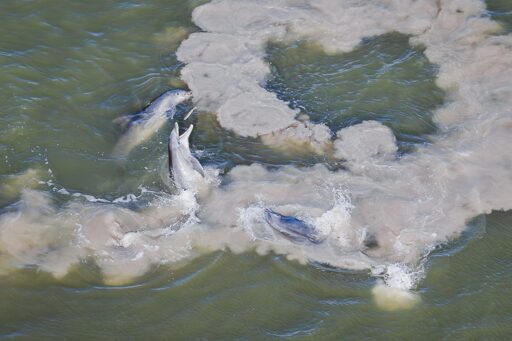
Freshwater flows into Florida Bay, significantly reduced by decades of Everglades drainage, are slowly increasing under the Comprehensive Everglades Restoration Plan. Helicopter surveys by avian ecologist Mark Ian Cook document returning wading birds, wintering waterfowl, American flamingos and threatened American crocodiles. Wading bird nesting reached a record high in 2018 but has since declined, while a severe 2025–2026 drought underscored the birds’ sensitivity to water fluctuations. From a low-flying helicopter above the coastal Everglades in southern Florida, U.S., Mark Ian Cook looks down at dense mangrove forests and silty shallows rarely seen by others. Below him, bottlenose dolphins trap mullet in rings of mud, nurse sharks mate in sheltered waters and flamingos forage on remote mudflats. Mating Nurse Sharks. Two nurse sharks (Ginglymostoma cirratum) mate off Shark Point in Everglades National Park. Unlike bony fish, sharks must make physical contact to reproduce: The male grips the female’s pectoral fin in his mouth to hold position. Image by Mark Ian Cook. Cook, an avian ecologist who heads the South Florida Water Management District’s Everglades Research Group, tracks how wading birds respond to the Comprehensive Everglades Restoration Plan (CERP), a decades-long federal-state effort to return freshwater to the southern Everglades and Florida Bay. He conducts a flying survey about every two weeks during the birds’ breeding season, photographing nesting colonies through a small flap in the helicopter door. Some colonies hold tens of thousands of nests, too many to count by eye, so photos are the most reliable way to tally them,…This article was originally published on Mongabay
From Conservation news via This RSS Feed.