

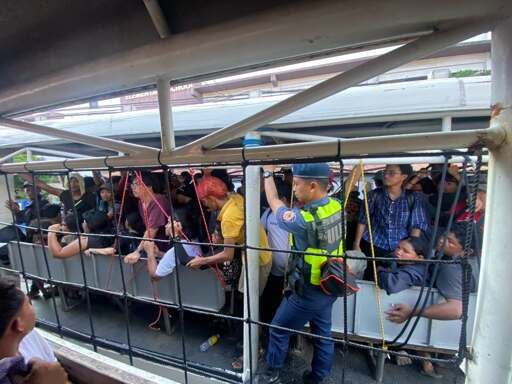
The right to assemble and express dissent is constitutionally guaranteed and should not be treated as a privilege granted by authorities.
By Reachelyn Esona
Bulatlat.com
It was past 2 p.m on November 15 when hundreds of protesters were arrested in what was described as the largest single-day mass arrest under the administration of Ferdinand Marcos Jr.
Before progressive groups from Southern Tagalog could join the anti Pax-Silica and Trump Out protest at Liwasang Bonifacio in Manila, the Southern Police District blocked and arrested nearly 300 protesters at Sucat People’s Park in Muntinlupa City. Among those who were arrested were 19 student journalists and alternative reporters.
Read: Police violently disperse, arrest hundreds in Muntinlupa protest
The arrested protesters faced inquest proceedings over alleged violations of Batas Pambansa Blg. 880, or the Public Assembly Act of 1985, as well as alarms and scandals, and resistance and disobedience to a person in authority. They were eventually released after prosecutors granted the motion filed by their lawyers.
The arrests, however, renewed a long-standing concern among human rights defenders: instead of protecting the people’s right to peaceful assembly, B.P Blg. 880 has been used to restrict and penalize the exercise of that right.
At a public forum on the human rights legislative agenda organized by Karapatan on November 20, Kabataan Party-list Representative Atty. Renee Co discussed House Bill No. 4574, or the proposed New Public Assembly Act. The bill seeks to repeal the Marcosian decree Batas Pambansa 880 and establish a new legal framework that strengthens the protection of the people’s right to freedom of assembly.
Read: Repressive decrees, issuances, legacies of Marcos dictatorship, remain in force
Co cited a series of arrests and restrictions involving protesters in Muntinlupa, Bulacan, Liwasang Bonifacio, Cebu, and other areas, as well as students who participated in university walkouts. She said authorities have invoked BP 880 to justify restricting assemblies, particularly those held outside designated freedom parks without permits.
Under the existing law, organizers are generally required to secure a permit for public assemblies, except in designated freedom parks and certain other circumstances.
The proposed HB 4574 seeks to change this framework.
According to the bill’s explanatory note, it removes the “no permit, no rally” policy and replaces it with a notice system. Rather than requiring organizers to obtain permission from authorities, the proposed system would require them to notify the appropriate authorities of their planned assembly, with the presumption that assemblies are peaceful.
The bill also provides for the automatic designation of public parks, halls, and plazas as freedom parks in cities and municipalities that fail to designate such spaces. This provision aims to ensure that people have accessible venues where they can exercise their right to peaceful assembly.
These proposed changes are rooted in a broader argument raised by the National Union of Peoples’ Lawyers (NUPL): the right to assemble and express dissent is constitutionally guaranteed and should not be treated as a privilege granted by authorities.
“Our rights do not require permits,” NUPL said.
The Commission on Human Rights (CHR) likewise emphasized that freedom of expression and peaceful assembly must be respected, as guaranteed under Article III, Section 4 of the 1987 Constitution.
During the same forum, Karapatan Secretary General Cristina Palabay called for the passage of a new law to replace B.P Blg. 880, arguing that the existing legislation is a remnant of the Marcos dictatorship and no longer responds to the realities faced by protesters today.
Despite these calls, HB 4574 has yet to advance beyond the committee level. Co said the bill was filed last year but has seen little progress, as it is not among the administration’s legislative priorities. She stressed the need to broaden public awareness on the right to peaceful assembly and build public support for the bill to help move it forward in Congress.
The debate over the proposed law comes as protesters continue to face complaints under B.P Blg. 880. The preliminary investigation into the case of the Southern Tagalog protesters, who are still facing allegations of violating the said law, began on November 25.
As the cases move forward, human rights defenders continue to press for the passage of HB 4574, arguing that a law should truly honor the people’s right to peaceful assembly. (RVO)
The post ASEAN mass arrests fuel renewed push for New Public Assembly Act appeared first on Bulatlat.
From Bulatlat via This RSS Feed.