

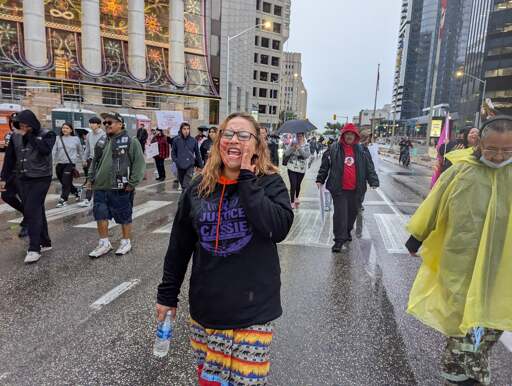

Crystal Delvenne takes to Winnipeg’s streets to draw attention to her daughter Cassie’s arrest and death nine days later, after she was left with unanswered questions by police and investigators. She has kept a sacred fire burning by the provincial legislature for nearly 90 days. Photo by Crystal Greene
Content warning: This story details violence towards an Indigenous woman. Please read with care and look after your spirit.
Outside the Manitoba Legislative Building — under the direct view of the premier Wab Kinew’s second-floor window — Crystal Delvenne tended a sacred fire for 86 days.
On Friday – day 87 – the fire’s last log is set to slowly burn down to ashes, after a private pipe ceremony, followed by a press conference inside the legislative building, according to Firekeeper Patrick Neilan.
As the seasons shifted from summer to autumn, and the year’s first snowfall blanketed the grounds, supporters have brought firewood, warm meals, and condolences for Delvenne’s late daughter, Cassity (Cassie) Marie Delvenne.
The 24-year-old died on June 21 — nine days after her violent arrest by the Brandon Police Service, which her mother alleges left her with injuries that she describes as severe.
But even as the sacred fire winds down, Delvenne vows that her months-long fight will continue.
Further investigations have commenced into several complaints against police, related to her arrest by Brandon police officers just over a week earlier. Ever since, her mother has pushed for answers about the chain of events leading to Cassie’s death.
“For as long as it takes, I’m not going anywhere,” Delvenne told IndigiNews.
Now, as the fire burns out, it signals a new phase in her fight for answers — and she hopes towards justice for her daughter.
Cassie was a member of Shoal Lake 40 First Nation, with ties to Wuskwi Sipihk First Nation and “Barrows,” Manitoba.
After Brandon Police Service (BPS) received the medical examiner’s report and toxicology results, the force issued a Nov. 6 press release that her death was “non-suspicious in nature with no evidence of foul play.”
But they did not publicly disclose its details, citing “respect for the family” and privacy provisions of the province’s Personal Health Information Act.
The BPS said its “investigation into this matter is now concluded.”
“They’re not investigating properly, they’re covering it up,” Delvenne alleged. In an interview with IndigiNews, she spoke of what she perceives as a lack of willingness for the province’s police watchdog and the BPS to investigate further.

While live-streaming video, Crystal Delvenne (left) meets with senior leaders of Brandon Police Service in September, including Insp. Dana McCallum (centre left), Insp. Jason Dupuis (centre right), and police chief Tyler Bates (right). Photo by Barb Guimond
‘No mom should have to investigate her own daughter’s death’
In a video she recorded with the police department’s chief and senior leaders, Delvenne asked officials why she had been forced to interview witnesses, gather footage and seek medical evidence herself.
“No mom should have to investigate her own daughter’s death,” she told BPS top brass on Sept. 2.
“This is your guys’ job. I shouldn’t have had to do this. I shouldn’t have interviewed people, I shouldn’t have had to do any of this, and I want to know why.”
The latest development comes after months of waiting for autopsy and toxicology reports, and live-streaming meetings with the police and government officials, which were shared on social media.
At an August protest outside the BPS headquarters, Delvenne spoke passionately into a megaphone — criticizing investigators for ruling out foul play.
“The apartment was not protected like a possible crime scene,” she told supporters.
“Assumptions were made — her death was treated as an overdose.”
The day BPS announced it had closed the case, Delvenne posted to Facebook that Kinew had sat with her by her sacred fire.
According to her, he committed to asking the medical examiner for a further probe into Cassie’s death.
“I’m grateful for that commitment, and it gives me hope that our family will get some answers,” she said.
IndigiNews asked the province to confirm details of what Kinew said.
“The premier met with [Cassie’s] mother to offer his condolences,” Seeon Smith, spokesperson for Kinew, wrote in an email.
“During that meeting, he also committed to following up with the Chief Medical Examiner regarding the matter.”
The spokesperson did not respond to a specific question about whether the premier supported an inquest or inquiry, however.
But Delvenne said she received a letter from Justice Minister Matt Wiebe on Monday, but has not revealed details publicly yet.
What caused Cassie’s death remains uncertain. Delvenne alleged BPS deputy chief Greg Hebert told her Cassie died after she “injected her boyfriend with fentanyl, then injected herself,” she wrote in a Nov. 6 Facebook post.
Asked to verify what Hebert told her, a force spokesperson said it could not provide “further commentary” due to an “ongoing investigative process.”
In an email, the force said there have been “a myriad of concerns” raised in the matter, “complaints that have been initiated with outside investigative agencies.
“These matters are the subject of ongoing investigation.”
But Delvenne asserted that “Cassie’s toxicology testing did not detect any illegal drugs. As her mom, I want to know what evidence deputy chief Hebert based that account on.” IndigiNews was not able to independently verify the toxicology results.

A Facebook profile photo of Cassity (Cassie) Marie Delvenne, 24, was posted only a few weeks before her June 21 death. She was a member of Shoal Lake 40 First Nation, with ties to Wuskwi Sipihk First Nation. Photo courtesy Cassie Delvenne/Facebook
A life cut short: who was Cassie?
Cassie, who was nicknamed Sunshine, was set to enter her final year of nursing studies at Brandon University. She was a mother of a young girl, Zoelille.
“She was an amazing mom,” Delvenne said. “She loved her little girl, and she just cared about everybody around her. She was full of life and full of love.”
Delvenne said Zoelille “misses her lots,” and “knows her mom’s in heaven.”
“She’s a hard worker; she cared about people so much,” she added, pausing as a tear ran down her cheek.
“She was an amazing writer ever since she was little. She just loved to write and read — she was so smart.”
Delvenne said the loss has been felt widely, including at her university — where one of her instructors emailed to say they’d donated to the school to support a bursary in her memory. Cassie had written a winning essay on truth and reconciliation, Delvenne said.
Her daughter also made an impression throughout her education, according to her friend Hailey Flett.
“She was the first person that came up to me to be my friend,” said Flett, who recalled the day she met Cassie at Assiniboine Community College. Flett spoke at the protest outside the BPS building.
“She would have done so many great things,” she said. “She wanted to help people with addictions — people that are struggling.
“Now her little girl will never see her mom ever again.”

“She would have done so many great things … Now her little girl will never see her mom ever again.”
— Hailey Flett, friend of Cassie
Cassie’s June 12 arrest and injuries
Just over a week before Cassie died, Brandon Police received a call at 1:30 a.m. about a vehicle speeding “into oncoming traffic,” and that its driver may have been “impaired as it was swerving,” according to a June 12 media release.
Police found the vehicle parked on the 1900 block of Patricia Avenue, and charged the female driver, 24, with impaired driving, resisting arrest, and failing to provide a breath sample; her male passenger, 23, was charged with assaulting and obstructing a police officer.
The release said both occupants left the vehicle and “tried to walk away” after police told them “multiple times” to stay inside.
The officer at the scene tried to “gain physical control of both subjects,” BPS stated, and “one of the occupants began pushing the officer interfering with the apprehension of the other occupant.”
Although police at the time did not identify the two accused, on Sept.11 the force confirmed the driver charged was Cassie.
A witness — who Delvenne said recorded a 45-second video of the incident — posted footage online that appears to show part of the arrest. Delvenne said the video was filmed from inside a nearby apartment.
The low-resolution, poorly-lit video clip appears to show a barefooted woman being pinned to the ground by two officers in a dark parking lot. An officer’s arm appears to repeatedly strike down on the woman, and loud cracking sounds can be heard several times as well as screams from the woman.
Her family believes the cracking sounds on that video were an officer’s taser, which police have denied using during the incident.
IndigiNews reviewed the short video closely, but cannot confirm what happened before or after what was filmed, nor could we independently verify the video’s authenticity or circumstances.
Brandon’s police chief disputed that officers used a taser, and refuted that and other allegations swirling around the case online.
“The information circulating publicly has generated a false, misleading narrative to the June 12 incident and arrest of Cassie Delvenne,” said chief Tyler Bates on Sept. 11.
He added that while Brandon officers do carry tasers, pepper spray and batons,“none of these were ever used in this interaction” leading up to Cassie’s detention.
Delvenne does not accept that version of events, continuing to allege officers did used a taser — and continues to demand a further investigation.
She also alleged her daughter had pleaded for medical attention after she was detained, describing several injuries including bruised ribs, bleeding ears, hearing loss, a chipped tooth, scrapes, and missing toenail.
“She went to emergency right after,” she said.
Hebert, the deputy chief, took a complaint from Cassie and first made a phone call to the acting civilian director of Manitoba’s police watchdog, the Independent Investigation Unit (IIU).
Delvenne said her daughter filed a complaint before being released from custody.
Under the Police Services Act, the IIU “must be immediately notified by the police service” if there is evidence or a complaint that “a police officer may have caused the death of a person” or “ a serious injury.”
Delvenne alleges Cassie’s original complaint was not investigated until after the 45-second video “was already all over” social media.
In a September meeting with the BPS police chief and the force’s executive team — except for Hebert — Delvenne brought up the injuries she said Cassie had filed her complaint about.
She shared a Facebook video of the meeting, at which she asked questions about how the BPS conducted Cassie’s arrest.
“She was 112 pounds,” she said in the video, “a little person.
“Even if she was resisting, that shouldn’t have happened to her.”
In a video recording of the meeting — which Delvenne shared to Facebook — BPS Insp. Jason Dupuis said Cassie’s injuries “could have happened prior, we don’t know that.”
In another, later meeting she recorded with the IIU’s civilian director, viewed by IndigiNews, he confirmed that BPS sent him photos taken during Cassie’s detention “soon after the incident.”
“I reviewed the photos,” he said. “I was advised of the situation at that point in time. There was nothing of concern.
“Once I reviewed those I said, based on what you’ve provided me so far, there’s no serious injury to this individual.”
Content warning: This 45-second video features a violent police interaction and swearing. It was filmed by a civilian witness of Cassie Delvenne’s arrest by the Brandon Police Service on June 12. IndigiNews has not been able to verify what happened before or after the clip, nor its authenticity. Video courtesy of Crystal Delvenne
Complaint to police watchdog hits a wall
Under the province’s Police Services Act, police chiefs have a duty to report serious injuries or death of civilians involving their officers — or if officers may have committed a crime — to the Independent Investigation Unit of Manitoba (IIU).
The threshold of serious injuries that fall under the IIU’s mandate include fractured bones, the loss of a body part; vision or hearing loss; injuries that require a hospital stay; any wounds from a gunshot, not including an impact munition or other non-lethal munition.
Police chief Bates said in the Sept. 2 recording that once BPS notified the IIU, the watchdog then “declined it and said that it didn’t meet their mandate.”
Delvenne, along with supporter Barb Guimond and Cassie’s grandmother Donna Delvenne, livestreamed a meeting with the IIU’s acting civilian director, Bruce Sychuk, an experienced Crown attorney.
He told the women that he originally reviewed photos related to the incident, and later received police paperwork with additional material, including the 45-second witness video, as well as witnesses’ audio tapes, and footage from the police vehicle’s WatchGuard camera.
Delvenne said BPS deputy police chief Hebert told her that the dashcam wasn’t working the night of Cassie’s arrest.
Sychuk emphasized his legal mandate only allowed him to investigate based on what police provided him, but if there was documentation about broken ribs it would meet his “serious injury” threshold.
“How do you know she didn’t have broken ribs? She went to an X-ray,” Donna replied, asking Sychuk if he would review Cassie’s medical records or later autopsy.
“I’m not reviewing the autopsy,” he said. “It’s not come to me; it’s not foul play, it wouldn’t come to me.”
The IIU was never given her medical records, only what the BPS submitted.
Delvenne told him that Cassie “was crying for medical attention in her cell … because her ears were ringing,” saying she “couldn’t hear out of one ear” and “blood was coming from her ears, draining out.”
“If you provide me with that medical information, [that] there was total hearing loss, it would meet my mandatory investigation,” Sychuk said.
Her grandmother also accused police of not giving her requested medical attention in custody, even though Cassie said “she could not breathe.” Delvenne alleged her daughter’s lungs were “a pound heavier than they should have been” — and when she was released she “went straight to the hospital.”
“They sent her for an X-ray on her ribs and her ribs were quite bruised,” Donna said, stating the family would try to obtain those records themselves.
“If there is medical evidence that suggests she had a fractured rib, it would meet my mandatory investigation, it would,” Sychuk said.
“I would strongly suggest you wait until the autopsy report and the toxicology reports come back. If the situation after the autopsy report comes back suggests foul play, clearly it has to be investigated.”
Delvenne complained that police “get to pick and choose” what evidence they submit to the IIU.
He explained that if the police were to not provide him “a fulsome disclosure on purpose, that would be extremely concerning and it would definitely cause some ramifications.”
In Delvenne’s recording of the meeting, Sychuk promised he would be “happy to take this matter on” were he given new evidence that meets the IIU mandate.
Donna said she thought it was “pretty darn serious” BPS did not send the IIU information about officers’ alleged use of a taser on Cassie, which she said the video shows, despite police denials.
“If there is actual evidence of a taser, that would be a concern,” Sychuk said. “I don’t have anything from them.
“We’ve declined jurisdiction on this matter. So, we have no duty to investigate anything. Based on the information I have been provided it would not meet the public interest to investigate this matter any further.”
Delvenne said she wants officers involved to be held accountable — and to learn the full truth of what happened to her daughter between her violent arrest and her death nine days later.
“I want transparency,” she said. “I want them to quit lying … they shouldn’t be allowed to get away with this.”
“The IIU should be helping, but they only have a two per cent rate” of recommending charges for officers involved in civilians’ deaths, she added, citing a recent Investigative Journalism Foundation report.
Her concerns echo the conclusions of a 2021 report by Legal Aid Manitoba’s Public Interest Law Centre.
“There is currently no way for the IIU to know how often a police service fails to notify the agency of an incident within its mandate,” the report stated.
“This ‘good faith’ procedural standard for notification has proven insufficient and a major loophole obfuscating reporting between the police service and chief to notify the IIU as required.”

Crystal Delvenne (centre) displays a ‘Justice for Cassie’ banner at Manito Ahbee powwow in October, alongside supporters Patrick Ritchot (left) and Patrick Neilan (right). Photo courtesy Barb Guimond
Mom asks why apartment not secured as potential crime scene
Nine days after Cassie’s arrest on June 21 at 9:11 p.m., emergency responders were called to Cassie’s Patricia Avenue apartment, where they found her “unconscious and not breathing,” according to a BPS media release.
“Neither police nor the Chief Medical Examiner’s office have identified any indicators of foul play,” the release noted.
Delvenne raised concerns that police never secured the apartment as a potential crime scene.
When she later entered the home after Cassie’s death, she said she found “blood all over the bathroom, there’s holes in the walls” — and believes the 24-year-old had been frightened for her safety before she died.
In a publicly shared Facebook video of Delvenne’s Sept. 2 meeting with BPS’ leaders, Delvenne questioned his force’s investigative methods.
During the recorded meeting, police chief Tyler Bates told her he could “not even fathom” the family’s grief after their loss.
“I can’t imagine how difficult it is to not have answers, to not know what contributed to your loved one’s death,” he said in the video.
“If I were in your situation, I would want answers too. We should be providing those answers, but we don’t have them yet … I wish we didn’t have so many unknowns.”
Delvenne asked why officers did not secure the scene of her death as a potential crime scene — and claimed a camera was filming inside the apartment, which she alleged showed officers leaving after less than seven minutes.
“Six-and-a-half minutes and you’re ruling it an overdose?” she asked Bates. (IndigiNews could not independently verify the video or duration officers were present).
“Far be it from me to question the investigator that specifically attended the scene,” he replied. “But you better be confident that there is no foul play — no suspicious element to the death — if you’re not holding the scene.
“Because at the end of the day, you only get one chance to hold a scene. They were convinced that there was no foul play involved. Rightly or wrongly, that’s the determination that they made, and that’s why the scene wasn’t held.”
He added that the cause of death remained “unexplained,” and that the Chief Medical Examiner had “found no bodily injury contributed to her death.”
“We don’t know why your daughter died,” Bates said. “In this case, we were provided very little other than to say it’s unexplained and further toxicology examinations are required to establish what caused her death.”
But the police chief confirmed officers had previously responded to calls related to “conflict” at the apartment where she died.
“It’s clear from the calls and whatnot that relate to conflict at that address … certainly there was conflict and arguments taking place,” Bates said. “There had been calls for service to that location, calls that were attended.
“There was just not evidence of assaultive behaviour that took place that night.”

Supporters of Camp Cassie protest in ‘Winnipeg’ for justice in the later 24-year-old Shoal Lake 40 First Nation member’s death. Photo by Crystal Greene
A quest for justice continues — like many before in province
Cassie’s story — and her mom’s months-long quest for justice — has resonated with a growing number of supporters in the province, many of whom have regularly attended marches in both Brandon and Winnipeg, and supplied her with firewood, food and tobacco offerings for her sacred fire outside the provincial legislature.
Manitoba’s justice system has come under fire for decades for its treatment of Indigenous people. In 1988, the province held an Aboriginal Justice Inquiry (AJI) after the high-profile deaths of Helen Betty Osborne and J.J. Harper.
It issued numerous recommendations, including creating a “special investigations unit, or … a special investigations team for a particular incident, able to take control of the investigation immediately,” and that “police forces in the province be required to provide all available assistance and co-operation.”
The province states on its website that ultimately drove “changes to address systemic racism in Manitoba’s criminal justice system.” Yet there would be no such investigative unit until after a 2008 provincial inquiry into an off-duty cop’s killing of mother-of-three Crystal Taman in a hit-and-run.
That inquiry called for “a provincial special investigation union independent of all police enforcement agencies” — finally resulting in the IIU’s formation seven years later, and disbanding the East St. Paul, Man., police department.
Since then, the National Inquiry into Missing and Murdered Indigenous Women and Girls echoed many of the same grievances and recommendations from the previous decades’ inquiries.
It called for a new dedicated investigation unit to examine “incidents of failures to investigate, police misconduct, and all forms of discriminatory practices and mistreatment of Indigenous Peoples” — and provide reports to Indigenous communities directly.
Since Delvenne set up camp outside the provincial legislature, she has sought meetings with officials such as justice minister Wiebe.
Now, she continues her fight to get the IIU to take another look at Cassie’s arrest prior to her death.
Under the Police Services Act, Wiebe has the power to determine if a “police service has failed to provide adequate and effective” policing, and ultimately to “suspend” a department entirely, as happened in the Taman case.
As she fights for answers, Delvenne fundraised more than $3,100 for legal representation, eventually retaining the same law firm involved in a public inquest into the 2020 police shooting of 16-year-old Eishia Hudson.
”Having a lawyer can help with making an impact at an inquest,” explained Bronwyn Dobchuk-Land, a University of Winnipeg criminal justice associate professor, in an email.
“At an inquest, Crown counsel is supposed to neutrally represent the interests of the public, and that is often legally assumed to include the interests of the family, however that is not always the case in practice.”
A lawyer can also help victims’ families file civil lawsuits against police, she added, but she is unaware of any such suits against the IIU.
“Officials work to pin the blame for a death in custody on the person who died,” she said. “This is devastating and dehumanizing.”
Now, as the weather gets colder with each passing day, Delvenne still waits for answers — now with the support of lawyers and hopes raised by the premier he or Wiebe might step in.
“We don’t trust the Brandon police,” Delvenne told IndigiNews by her sacred fire. “That’s what we’re trying to get — is for them to be held accountable.”

Cassity (Cassie) Marie Delvenne, age 24. Photo courtesy Cassie Delvenne/Facebook
She previously told IndigiNews that she was hoping to winterize Camp Cassie, to keep the fire burning, during what she is aware will be a slow, bureaucratic process.
But after months of waiting, meeting officials, and praying, she decided to wind down the sacred fire.
But that in no way means she or her supporters are abandoning their fight for justice — and for all other families who believe justice was not done.
“This is for everyone, I’m sure we’re not ones that this is happening to,” Barbara Guimond, who’s been at Delvenne’s side since summer, agreed.
“This affects all races — not only our people, but predominantly us though, in Manitoba.”
Delvenne said she relies on the growing public backing she’s finding in her quest.
“It helps me,” she said, “being surrounded by support.”
The post Grieving her daughter, a Manitoba mother’s fight for answers from police continues: ‘I want transparency’ appeared first on Indiginews.
From Indiginews via This RSS Feed.