

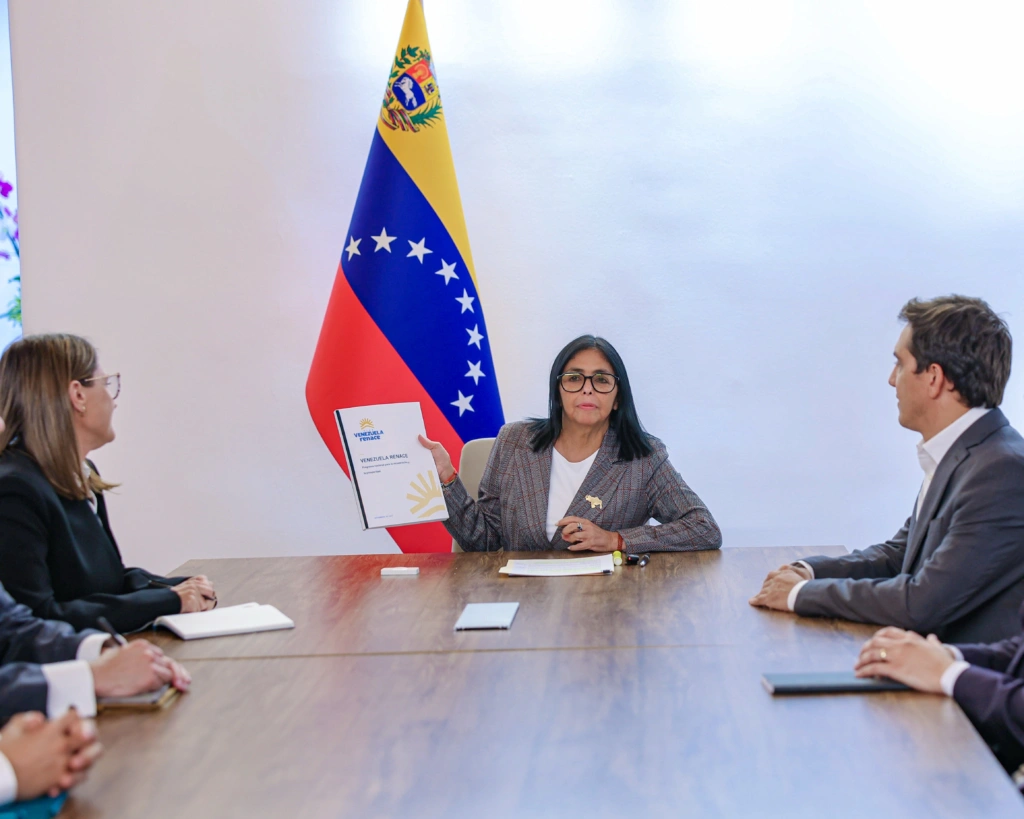
The Venezuela’s program links price stabilization, earthquake reconstruction, oil production, and electricity repairs with public oversight and state coordination.
On November 24, the Venezuelan government announced the Venezuela Rises macroeconomic plan, a ten-year program (2026–2036) designed for the country’s recovery and reconstruction.
Venezuela Rises is structured in three phases: Normalization (2026–2027), Recovery (2027–2029), and Diversification (beginning in late 2029).
RELATED: Venezuela Unveils 10-Year Plan to Rebuild Economy
The plan aims to stabilize prices, rebuild housing and public infrastructure, strengthen electricity and water services, expand formal employment, and provide support to households, workers, and communities through coordinated state action.
In this in-depth article, we will explore the details addressed by Acting President Delcy Rodriguez with an extensive team of vice presidents and ministers.
#Venezuela | 🇻🇪 Calixto Ortega Sánchez emphasizes that improving the living conditions of Venezuelans remains the central objective of the country’s economic recovery program.#EconomicRecovery #SocialWelfare #NationalDevelopment #teleSUREnglish pic.twitter.com/GpXER2vFuZ
— teleSUR English (@telesurenglish) November 26, 2026
Launch and Leadership of the Venezuela Rise Plan
The Venezuela Rises Plan presented by the Acting President Delcy Rodriguez is a multi-year economic recovery and reconstruction program designed to guide the country through 2026–2036.
Venezuelan government documents and public presentations outline the program in three main stages. The first stage, “Normalization,” spans 2026 to 2027 and focuses on stabilizing prices and addressing urgent reconstruction needs.
The second stage, “Recovery”, covers 2027 to 2029 and centers on reactivating production, investing in public services, and rebuilding housing. A third stage, “Diversification,” begins in late 2029 with projections extending to 2036 and aims to expand production and formal employment beyond oil and gas.
Acting President Delcy Rodriguez launched the initial housing and reconstruction phase of Venezuela Rises on July 7, 2026, from Bolivar Avenue in Caracas. The program emerged in response to two earthquakes of magnitudes 7.2 and 7.5 that struck parts of Venezuela on June 24, 2026.
In late November 2026, Rodriguez presented the broader macroeconomic plan alongside senior officials, including Sectoral Vice-president of Economy Calixto Ortega, PDVSA President Héctor Obregón, Hydrocarbons Minister Paula Henao, Electric Energy Minister Rolando Alcalá, and Public Works Minister Juan José Ramírez.
Rather than concentrating all authority in a single agency, the Venezuela Rises Plan runs through existing ministries such as the Ministry of Economy and Finance, the Ministry of Habitat and Housing, the Ministry of Electric Energy, the Central Bank of Venezuela, PDVSA, Corpoelec, and some missions.
Housing credit programs under the plan also operate through banks such as Bank of Venezuela and BBVA Provincial, while local councils and community consultations are designated to monitor neighborhood works.
#Venezuela | Acting President Delcy Rodriguez met in Caracas with an International Monetary Fund delegation to advance bilateral dialogue and analyze strategic financing for the national development plan, Venezuela Rises.
The meeting focused on a comprehensive exchange of… pic.twitter.com/sFfEDMvIuV
— teleSUR English (@telesurenglish) July 30, 2026
Financing Architecture and Multilateral Engagement
The Venezuela Rises Plan outlines several funding sources to support public works, social protection, and productive recovery. According to official information from the Venezuelan government, the resources are expected to come from higher oil and gas revenues, new financing mechanisms, increased tax collection linked to economic activity, and a restructuring of public debt.
A dedicated initial reconstruction, on july, fund of $200 million was activated from global financial resources at the start of the housing phase, alongside mortgage support mechanisms and fee exemptions for property registries, leases, and sales.
Public disclosures on the economic part of Venezuela Rises also address external debt and multilateral relations. Venezuelan published figures note roughly $237.544 billion in public debt subject to restructuring considerations, alongside $17.097 billion in non-financial debt owed by PDVSA to suppliers that requires reconciliation and audits.
In parallel, reports on the rebuilt plan’s financing framework, including potential multilateral funding, with figures up to $10 billion discussed, as Venezuela engages international financial institutions such as the World Bank, the International Monetary Fund, and the Inter-American Development Bank.
Venezuelan official communications present Venezuela Risesas an effort to sustain growth, lower inflation over time, and restore household purchasing power while navigating external sanctions and financial constraints.
At the same time, economic reporting notes that the plan’s targets depend on turning projected oil revenues, debt negotiations, and credit programs into steady budget execution and verified results.
#Venezuela | 🇻🇪 Deputy Minister of Finance and Public Budget Christiam Hernández highlights a ten-year economic recovery roadmap aimed at strengthening investment and promoting sustained growth.#EconomicRecovery #Investment #NationalDevelopment #teleSUREnglish pic.twitter.com/NwvGFjQsh9
— teleSUR English (@telesurenglish) November 26, 2026
Social Services, Productive Economy and Communities
The Venezuela Rises Plan links macroeconomic goals with practical changes in daily life across households, neighborhoods, and productive sectors. On prices, the program aims to stabilize the local currency (bolívar), widen access to foreign currency, and slow price increases so families can plan weekly food purchases with fewer sudden jumps.
On incomes, the plan proposes recovering wages and pensions and protecting lower-income households. For water and electricity, the plan schedules grid investments and power generation inside oil fields to reduce outages.
Housing, health, education, and local production form another core pillar of the program. Following the June earthquakes, Venezuela Rises rebuilt damaged homes along with nearby schools, clinics, and public infrastructure, subject to project funding, completion, and service delivery in each area.
The program also seeks to expand formal jobs through contracts with domestic suppliers and create pathways for young people and Venezuelans abroad to find work and housing if they stay or return, provided job openings and return rules are clearly published.
Community participation and public reporting are included to track local results. The plan calls for consultations with local communities and regular publication of economic data so residents can request repairs, such as fixing a school pipe, and follow construction progress, which depends on active consultation channels, named officials, and accessible project records.
Political and Economic Thesis on Sovereignty
Acting President Delcy Rodriguez presents Venezuela Rises as a path designed to protect national sovereignty while addressing economic pressures. In a public address briefing on the plan, Rodriguez links economic stabilization with social protection and public investment, arguing that recovery must rebuild living standards and public services without surrendering national decision-making.
Rodriguez government frames the program around restoring institutional order, expanding productive capacity, and managing external constraints through diplomacy and selective international cooperation.
Following the June seismic events, official reporting highlighted international solidarity and technical engagement alongside domestic state coordination to support reconstruction and infrastructure repair.
In public presentations of Venezuela Rises, Rodriguez and her economic team emphasize measurable milestones in output, prices, and public works while noting that lasting results require consistent execution across ministries, state companies, and local communities.
#Venezuela | 🇻🇪 Sectoral Vice President for the Economy Calixto Ortega Sánchez highlights fiscal reforms and public debt resolution as key elements of the country’s economic recovery plan.#EconomicRecovery #PublicDebt #NationalDevelopment #teleSUREnglish pic.twitter.com/vLB6CanrWO
— teleSUR English (@telesurenglish) November 26, 2026
Oil, Gas, and the National Electric System
Oil and gas sit at the center of the Venezuela Rises Plan’s production and revenue strategy. Venezuela’s official plan documents link higher oil and gas output to greater foreign exchange availability, stronger public revenues, and new contracts for domestic suppliers and technical workers.
The program’s design, expanding oil and gas activity, is intended to support formal employment across engineering, maintenance, and logistics while feeding resources into broader economic recovery and later diversification beyond hydrocarbons.
The National Electric System (SEN, in Spanish) and related utilities are addressed through grid rehabilitation and local power generation. The Venezuela Rises Plan provides for investing in electrical networks and generating electricity directly inside oil fields to reduce strain on the wider system.
According to the Plan’s citizen guide, easing demand and repairing distribution networks is meant to reduce power cuts for homes and businesses and help households receive water more regularly, depending on the physical rehabilitation of local lines and pumps.
Rollout Timeline, State-Level Progress
The recovery plan is structured across timelines starting in November 2026, following the July 7, 2026 launch of the initial housing and reconstruction phase after the June earthquakes.
In practice, progress of the rebuilt plan depends on funding allocation, timely completion of construction and utility repairs, clear rules for programs such as diaspora return and housing, and active local monitoring.
Venezuela Rises Plan sets out a ten-year sequence from 2026 to 2036 that connects price stabilization, reconstruction, utility repair, and eventual economic diversification.
The plan presented by the Vice-President for the Economy, Calixto Ortega, underscores that outcomes for families, workers, small businesses, and local communities depend on sustained monetary and price stability, on incomes growing at a faster rate than the cost of living, on the existence of reliable electricity and water networks, on the completion of local infrastructure projects, and on public and transparent accountability.
Sources: Ultimas Noticias – La Radio del Sur – teleSUR – El Mazo Dando – El Nacional – Presidential Press – Despacho de la Presidencia – Delcy Rodríguez – Diosdado Cabello – El Universal – Agencia Venezolana de Noticias – El Diario Venezuela – Venezuelanalysis – La Iguana Tv – Presidential Press
From teleSUR English via This RSS Feed.