

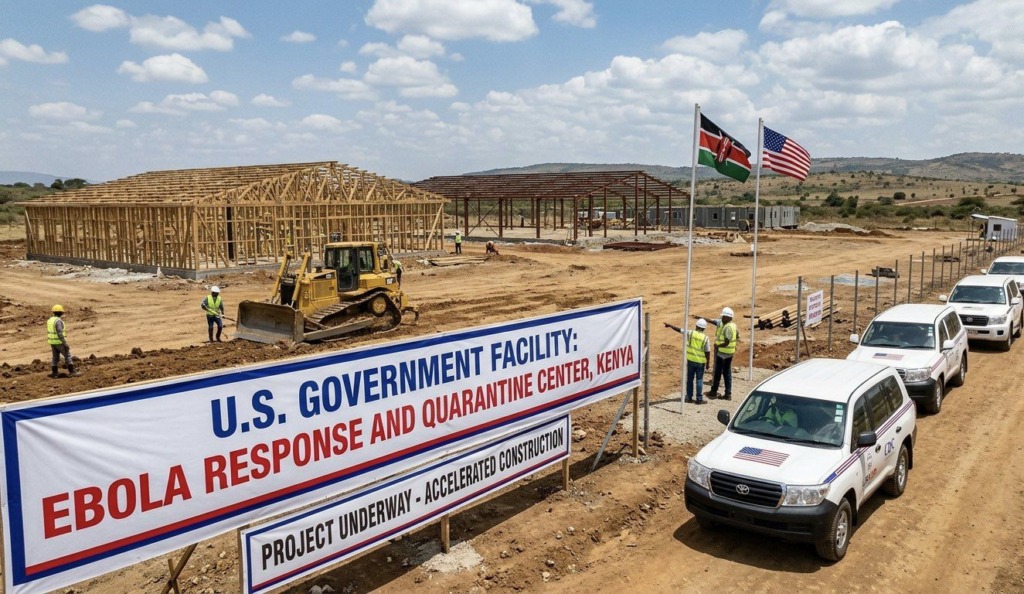
Kenya’s High Court ruled Thursday that the government breached the Constitution by authorizing a U.S.-funded Ebola quarantine facility at the Laikipia air base near Nanyuki, and ordered all construction halted until the bilateral agreement is disclosed.
Justice Patricia Nyaundi found on November 26, that the executive should have disclosed the details of the pact with Washington and put the project to public consultation before signing it.
The ruling bars work on the 50-bed facility, designed to isolate people exposed to the virus, including U.S. citizens, until authorities meet transparency and public participation requirements.
RELATED: DR Congo Ebola Outbreak Tops 12,000 Cases and 5,900 Deaths
“Put differently, the petitioners, the people of Kenya and, most significantly, the residents of Laikipia County have been left in the position of persons standing outside a sealed wooden window, straining to discern what is happening on the other side,” Nyaundi said in her ruling.
She added that residents are aware that decisions affecting their community are being made and implemented, but have been denied any meaningful opportunity to learn about them, question them or take part in them.
The military complex was already used in July to quarantine seven U.S. humanitarian workers arriving from the Democratic Republic of the Congo (DRC).
HIGH COURT declares the Kenya-US Ebola quarantine facility at Laikipia Air Base unconstitutional, gives the government 45 days to disclose the agreement and related documents pic.twitter.com/FG4s9CQf5I
— The Kenya Times (@thekenyatimes) November 26, 2026
Legal Fight and Contempt
The dispute began in May 2026, when the Supreme Court issued its first suspensions against an initiative defended by President William Ruto under the argument of historic health cooperation with United States.
Before Thursday’s constitutional ruling, Health Minister Aden Duale ordered the project stopped after being held in contempt by the High Court for ignoring earlier orders. The official apologized, citing unintentional non-compliance. Satellite images and flight records told a different story. U.S. equipment and specialists kept arriving at Laikipia despite the judicial prohibitions.
The case was driven by organizations including the Katiba Institute, which warned that Kenya lacks sufficient health capacity to contain the virus, and the Law Society of Kenya (LSK). LSK President Charles Kanjama said that “public health demands that facilities be located near the epicenters of the outbreak” and called for stricter border controls.
Through social network X, the legal body had announced it would appear before the court “to challenge the proposed establishment of a quarantine, surveillance or treatment center for Ebola in Kenya, and to demand clarity, accountability and constitutional compliance in the process that led to that decision.”
Kenyan President William Ruto said hosting a US-backed Ebola quarantine facility at Laikipia Air Base is the right decision, citing Kenya’s health preparedness and cooperation with Washington. pic.twitter.com/s60AKfEv7l
— Radar Africa (@radarafricacom) November 26, 2026
The facility triggered mass protests in Nanyuki and neighboring towns, where residents accuse Washington of shifting its health risks onto Kenyan territory and violating national sovereignty. In June, police repression of protesters left at least one person dead.
The ruling leaves the government with a narrow path forward. It must disclose the agreement and open genuine public consultation, or abandon the project altogether. For now, construction at Laikipia remains frozen.
That outcome matters far beyond a single building. It tests whether the Ruto administration will treat constitutional requirements as binding, and whether U.S.-funded health infrastructure can be imposed on communities that never consented to it. The court has spoken and now the next move belongs to the executive.
The dispute comes as Africa faces its 17th Ebola epidemic since 1976, which began on May 15 in eastern DRC and which the World Health Organization (W.H.O.) has classed as critical. According to the latest DRC government data, the outbreak, caused by the Bundibugyo strain, has reached 12,021 confirmed cases and 5,904 deaths across 69 health zones in eight of the country’s 26 provinces, with Ituri accounting for 67.7% of cumulative infections.
Africa CDC warned that only 15% of new infections are linked to previously identified contacts. W.H.O. declared an end to transmission in Uganda on August 26 after 20 cases and two deaths. The virus has also spread to Kenya, with nine cases and two deaths, and to Nigeria, with one imported case.
From teleSUR English via This RSS Feed.