

China on Thursday firmly rejected a U.S. proposal to impose new tariffs of up to 20 percent on 14 economies following a trade investigation into alleged industrial overcapacity, calling the move unilateral and warning that it would raise global inflation and disrupt supply chains.
Chinese authorities voiced their opposition on November 26, denouncing the initiative violates World Trade Organization (WTO) rules and harms the international economic order. Beijing’s rejection arrived one day after Washington unveiled the plan, which grew out of a trade investigation into alleged excess industrial capacity.
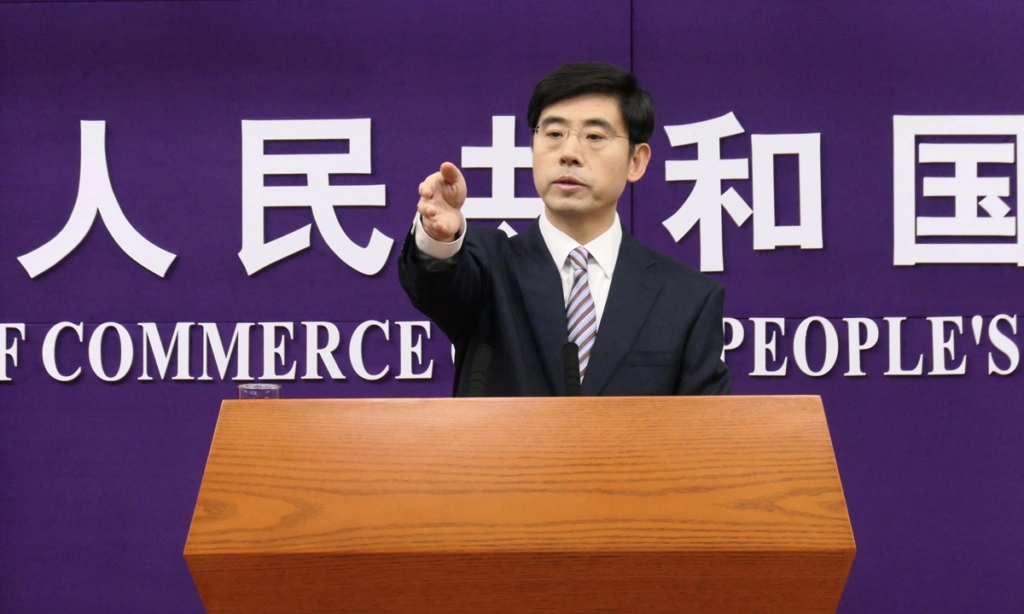
At a press conference, Commerce Ministry spokesman He Yadong described the investigation, carried out under Section 301 of the Trade Act of 1974, as a typical act of unilateralism that politicizes normal market competition. He warned that the tariffs would push up global inflation, hurt businesses and consumers, and create long-term systemic risks for global economic growth.
RELATED: China at APEC: ‘Peace, Not War, Is Humanity’s Destiny’ – A Direct Challenge to US Unilateralism
The proposal comes from the Office of the U.S. Trade Representative (USTR) after an eight-month investigation. Under the measure announced by Washington, certain duties on Chinese products now set at 12.5% would rise to 20%, and could climb to 40% if trade negotiations fail.
Besides China, the investigation covers the European Union, Japan, South Korea, India, Singapore, Switzerland, Indonesia, Malaysia, Cambodia, Thailand, Vietnam, Taiwan and Bangladesh.
Chinese Foreign Ministry spokesman Guo Jiakun said tariff and trade wars benefit no one and called the alleged overcapacity a pretext for political manipulation. He urged both sides to resolve differences through consultations based on mutual respect and to honor the consensus reached by Chinese President Xi Jinping and U.S. President Donald Trump at their recent meeting in Shenzhen, arguing that tariff and trade wars benefit no one.
The sectors affected read like the backbone of the modern economy. Semiconductors, batteries, steel, automotive and renewable energy would all face new barriers. A disruption in those industries would ripple through global supply chains that depend on Asian manufacturing.
Ver esta publicación en Instagram
Una publicación compartida de teleSUR English (@telesurenglish)
Trade Truce on the Table
Despite the heated language, communication between the two governments continues. China’s Ministry of Commerce said the economic teams of both countries remain in close contact to evaluate a new extension of the bilateral trade truce, which remains in force until January 10.
The Ministry also noted that the new tariffs exclude goods covered by the reciprocal reductions agreement, valued at roughly 30 billion dollars for each side. Beijing asked Washington to speed up the implementation of that accord.
The Chinese government said it will follow the dispute closely and reserves the right to adopt all necessary measures to safeguard its legitimate rights and interests.
This latest round of friction lands days before the next scheduled meeting between Xi and Trump in December, on the sidelines of the G20 summit in Miami. Both leaders now approach that gathering with a fresh tariff confrontation unresolved, testing whether the detente announced in Shenzhen can survive the pressure of new trade measures.
For China, the dispute is about more than a single tariff. Beijing frames the Section 301 investigation as a challenge to the multilateral trading system itself, one that rewrites the rules by which global commerce has operated for decades.
Washington, by contrast, has spent months arguing that excess industrial capacity distorts markets and requires a correction. The 20% rate proposed for Chinese goods stands at the top of the list, a signal of where the administration places its priority.
What happens next will depend on the negotiations. The 40% ceiling hangs over the talks, a pressure point that Beijing is unlikely to accept without a response. The two sides have until January 10 to decide whether the truce holds.
From teleSUR English via This RSS Feed.