

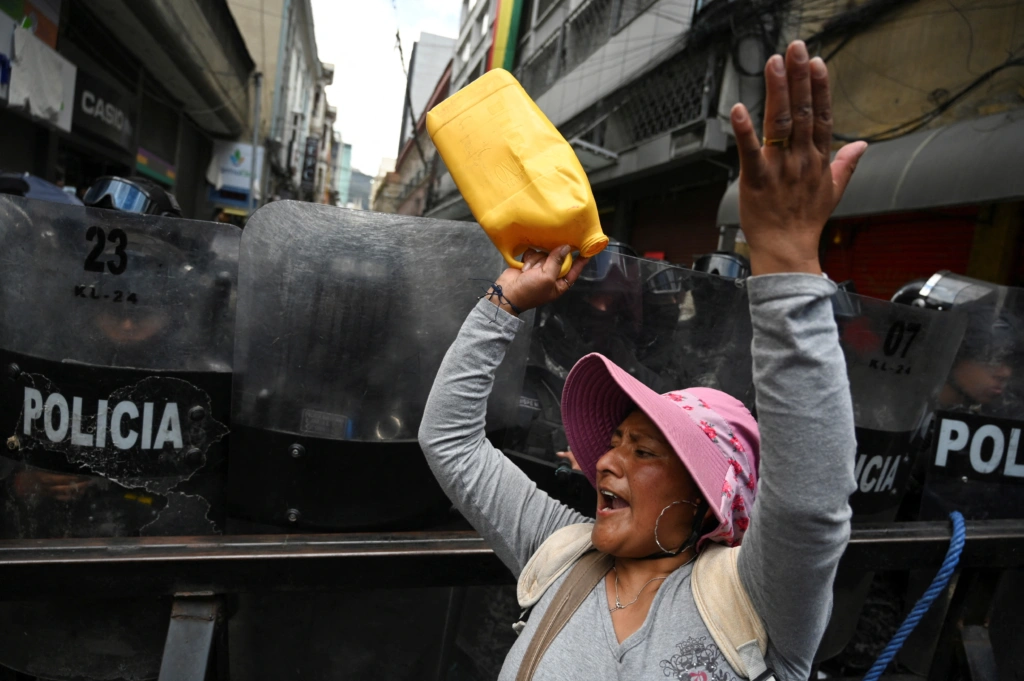
Bolivia’s national drivers union will begin an indefinite nationwide strike on November 30, in protest against a diesel price increase that pushed the fuel to 20.57 bolivian pesos (1.74 dollars) per liter.
The Bolivian Confederation of Drivers’ Trade Unions dopted the decision on Thursday during an assembly in La Paz. The measure responds to a resolution issued Tuesday by the National Hydrocarbons Agency, which set the new fuel price under Supreme Decree 5716.
Lucio Gómez, the union’s top leader, insisted the protest has no political side and answers only to a social demand in defense of workers.
RELATED: Bolivian Sectors Reject Diesel Price Hike and Announce Protests
The union has two immediate demands. It wants the abrogation of Decree 5716 and the withdrawal of the official notice that updated the diesel tariff. Gómez argued that the measure harms both transporters and the population at large.
🚨 #VideoNoticias | Transporte federado y libre anuncian #paro nacional indefinido desde el lunes contra el DS 5716https://t.co/A3lL73EwKR pic.twitter.com/90CkFseYHR
— T Informas Bolivia (@TinformasBo) November 26, 2026
Text reads: “Federated and free transport announce national indefinite strike since Monday against the Decree 5716.”
A 400 Percent Surge
The price of diesel now moves in line with international quotations. President Rodrigo Paz eliminated the state subsidy on September 18, ending a protection that had kept the fuel affordable for years.
What followed was a cascade. In barely ten months, the government applied three successive increases that carried the price of a liter of diesel from almost 4 bolivian pesos (0,34 dollars) to the current 20.57. The accumulated rise exceeds 400 percent, a burden the union says falls directly on working families.
The transport sector has added a list of structural grievances to the wage dispute. Drivers point to the deteriorating road network and the mechanical damage it inflicts on their vehicles. They also denounce delays in converting vehicles to natural gas, the lack of a zero tariff, rising interest rates on productive loans, and failures tied to the credit guarantee fund known as Fongat.
#Bolivia | Transport unions and social organizations announce protests and consider a nationwide strike following a nearly 15% diesel price increase, demanding the repeal of Supreme Decree 5716.#DieselPriceHike #SocialProtests #CostOfLiving #teleSUREnglish pic.twitter.com/fMORBOPQ8I
— teleSUR English (@telesurenglish) November 25, 2026
IMF Conditions in Play
The new tariff places Bolivian diesel as the second most expensive in the region, behind only Peru. The adjustment follows the conditions set by the International Monetary Fund (IMF) to eliminate state subsidies and fix international prices in the domestic market. That link has sharpened the dispute. What the government frames as a technical adjustment, the drivers read as the direct cost of external pressure applied to national fuel policy.
Representatives of the productive sector warn that the higher diesel price is unviable and unsustainable. The fuel is indispensable for planting, harvesting and moving food to supply centers, so any increase ripples through the entire economy.
If the government does not respond, the union announced a national assembly on Monday, December 7, in Cochabamba to evaluate and define new protest actions. The free transport sector will join the strike and has ruled out immediate dialogue with the government.
That refusal leaves little room for negotiation before Monday. The strike is set to begin with no talks scheduled, a posture that raises the possibility of a prolonged standoff.
The drivers’ leadership frames the walkout as a defense of the sector and of consumers. The government has yet to announce whether it will revise the decree or hold the line on the new price.
What happens in the first days of the strike will likely determine the scale of what follows. With the December 7 assembly already on the calendar, the union has built its own escalation timeline, and the coming week will show whether either side is willing to bend.
From teleSUR English via This RSS Feed.