

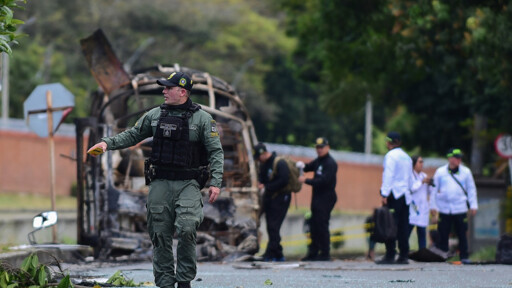
The military and police offensive by the administration of Abelardo de la Espriella has met with a harsh response from armed groups.
The first 100 days of Abelardo de la Espriella’s government have brought an escalation of violence that has caused bloodshed primarily among members of Colombia’s public forces.
Colombians have witnessed military and security deployments involving the president himself, who has been captured in official videos carrying weapons, in military uniform, and uttering intimidating messages against alleged leaders of captured criminal organizations.
The country has plunged into a spiral of violence where armed groups have responded savagely to the police and military offensive of the government, which labels illegal structures as “terrorists.” The target, for now, is not the civilian population, but uniformed personnel.
Already in his government plan, where he outlined proposals to “rebuild the miracle homeland,” the current president stated that “crime is today the main enemy of freedom, true peace, and the stability of the country.”
The right-wing president’s “iron fist” language, in addition to aerial bombardments of camps and mass arrests, is diametrically opposed to the “total peace” policy promoted by his predecessor, Gustavo Petro, which sought the disarmament of illegal structures through dialogue processes.
In this regard, the former president wrote on his social media: “Going to war without a way out is condemning Colombia to eternal violence.”
Casualties among uniformed personnel
Caracol reports, citing data from the Defense Ministry, that in the first 90 days of the government, which began on August 7, 38 members of the public forces were killed, while 213 were injured.
These figures, according to the media outlet, show a 58% increase in the killings of uniformed personnel, and a 72% increase in injuries, compared to the same period during Gustavo Petro’s administration, which began on August 7, 2022.
On November 25, two more police officers were killed in an armed attack against a patrol in a rural area of Padilla, in Cauca, according to Caracol.
The Army has had the highest number of fatalities: 21 soldiers lost their lives in the first 90 days of the De la Espriella administration. This figure represents a 163% increase compared to the eight agents who lost their lives during the same period in the Petro government.
Drone attacks
From January to November 2026, there have been 358 drone attacks, carried out by the main armed groups, according to Portafolio. The targets have primarily been police stations in departments such as Cesar, Meta, Cauca—a stronghold of FARC dissidents—and Norte de Santander, where the ELN has a strong presence.
Between August 7 and November 11, according to the Defense Ministry, attacks increased by 140% compared to the same period during the previous government.
The attacks are attributed mainly to the National Liberation Army (ELN), with whom Petro maintained a failed peace dialogue, which has carried out 157 actions of this nature. Behind them is the “Iván Mordisco” bloc of the dissidents of the defunct Revolutionary Armed Forces of Colombia (FARC), with whom there was also an unsuccessful negotiation process, which reportedly committed 102 attacks.
Car bombs
The violence also includes the return of car bomb attacks. Two have been recorded in the same month. One occurred on November 15 when a vehicle loaded with explosives exploded at the Pipiral toll booth, in the Colombian department of Meta.
Days later, on November 23, another car bomb exploded in an attack against the Meta Governorate, located near the central park of the city of Villavicencio, in the department of Meta. This violent action left at least 23 people injured, although no fatalities were confirmed.
Kidnapping with hostages
The most recent incident that kept the population on edge occurred on November 24 when a hostage-taking took place in a supermarket in Cartagena, carried out by armed, hooded individuals wearing vests. After hours of negotiations, the operation concluded after an operation by Special Forces that allowed the release of the 20 people who remained captive.
According to information from the president, all hostages were rescued and one of the kidnappers was killed.
(RT)
Translation: Orinoco Tribune
OT/JRE/SL
From Orinoco Tribune via This RSS Feed.