

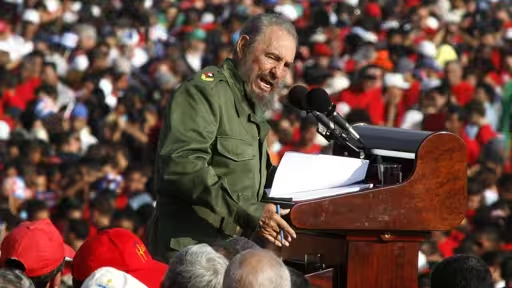
On November 25, 2016, Fidel Castro, the leader of the Cuban Revolution, died in Havana. 10 years later, the question of how much Cuba has changed opens up an assessment that encompasses the economy, daily life, international relations, and the links between citizens and power.
It also brings back to the center of debate the legacy of the leader who steered the Cuban Revolution for decades: what remains of his thinking, how it is interpreted, and to what extent his successors have been able to sustain the project he led.
A decade under US pressure
For René González Barrios, a doctor of Historical Sciences and director of the Fidel Castro Ruz Center, the period after Fidel’s death was marked by events that overflowed national borders. “The last 10 years, after the death of our commander in chief, have been very intense, not only for Cuba, but also for the world,” he said.
In statements to Sputnik, he recalled the impact of the COVID-19 pandemic on the largest island of the Antilles. The academic noted that its consequences were particularly complex for the island because of US restrictions and the difficulties in accessing healthcare resources.
According to the expert, the impact of the global health emergency was not confined to hospitals. “Not only in health—it had an impact on social life, on the political scenario, and on the economic sphere.”
Faced with this situation, he placed the Cuban scientific response among the capacities inherited from Fidel’s times. As he explained, the country had to “seek national solutions” by relying on the development of biotechnology and on the development of five vaccine projects.
His interpretation connects that response with a tradition of resistance that he considers still in force. “With Fidel, Cubans learned to be free and independent, we learned to fight against challenges, and we learned to grow amid difficulties; this is a Fidelista people, and Fidel is present in every act we carry out,” he stated.
However, that vindication coexists with a stark description of the present. González Barrios also mentioned the shortages of food, medical supplies, and fuel, while attributing to US policy a determining role in the worsening of the crisis.
The lack of electricity, derived from the oil siege imposed by Washington since last January, appears in his testimony as a need that affects practically all the others.
“If there is no energy, there is no transportation, nor schools,” said González Barrios. “How many things are affected? Doctors operating with a cell phone to be able to save a person’s life; that is risky, and that is how we are living it. In the last decade, the country has faced a very difficult situation, but if it has been able to move forward it is precisely because of Fidel’s thought and work.”
From this perspective, the difficulties of the decade cannot be separated from the international context or from external pressures. Nevertheless, his reading places the accent on the capacity to resist and on Fidel’s thinking as a reference for doing so: “Fidel has a lot to say to the peoples of the world.”
Reforms and their pending results
Mariano Bullón Méndez, a doctor of philosophical sciences and a researcher at the Center for Research on the World Economy (CIEM), incorporated into the balance the economic decisions adopted within the country. In this regard, he noted: “We have gone through the pandemic, we have also had the process of reordering, of monetary and exchange unification, which did not yield the expected results.”
For his part, Fabio Fernández, a doctor of historical sciences and a professor at the University of Havana, recalled that in 2016, several structural problems were already present, among them the economy’s difficulties in overcoming the burdens of previous models or the inequalities related to access to foreign currency.
In the same way, he established a difference between the difficulties that already existed when Fidel died and the magnitude they have acquired since. “I would tell you that today’s Cuba is a Cuba marked by crisis,” he summarized.
Bullón Méndez adds that the current economic and social transformations in Cuba are advancing in a scenario where external pressures affect medical supplies, food, investments, and tourism. However, his appeal to Fidel’s legacy is not limited to defending the island against Washington. He proposes using it as a tool to examine internal performance.
Possible Scenarios Facing Cuba in Case of US Military Invasion
“I think that returning to Fidel is always advisable … he was an eternal fighter for the well-being of the Cuban people, of Latin America, and of the world,” he said.
(Sputnik) by Danay Galletti Hernández
Translation: Orinoco Tribune
OT/JRE/SL
From Orinoco Tribune via This RSS Feed.