

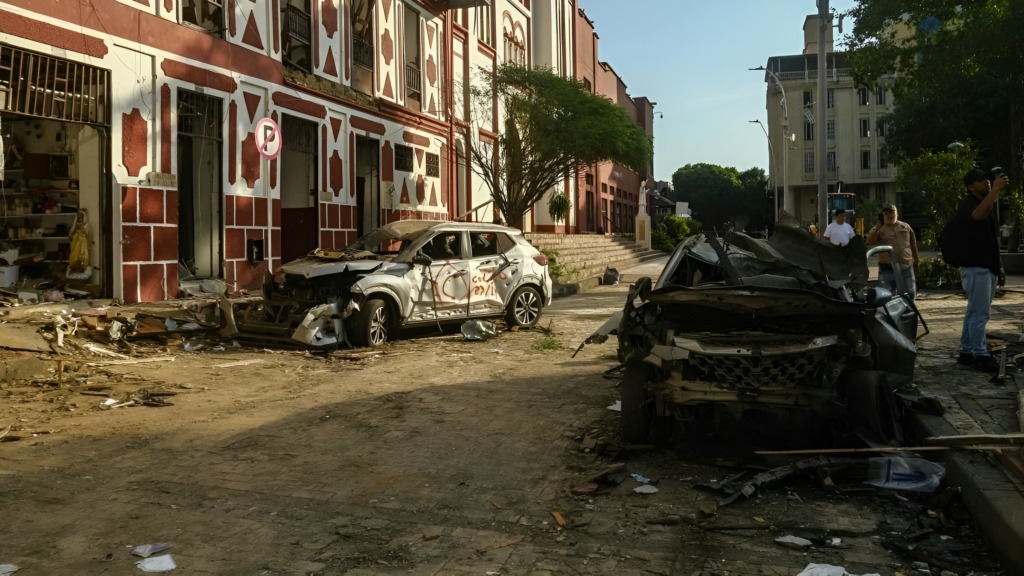
November 2026 strikes in Cucuta and Villavicencio reveal the human cost of stalled territorial development and renewed military confrontation in Colombia.
A series of coordinated explosive attacks throughout Colombia in November 2026 has shifted armed conflict from rural corridors into major departmental capitals.
Over a span of three weeks, armed groups carried out bombings and drone strikes in the departments of Tolima, Cauca, Huila, Cesar, Norte de Santander, and Meta.
RELATED: Colombia: Car Bomb Explodes Outside Meta Governor’s Office
The escalation reached urban centers on November 23, when explosive-laden drones struck a police command in Cucuta, and a car bomb detonated outside the departmental government headquarters in Villavicencio.
These events coincide with the tenth anniversary of the 2016 Peace Agreement between the Colombian state and the former Revolutionary Armed Forces of Colombia (FARC-EP).
To understand the scope of the November 2026 violence in Colombia, it is necessary to examine the specific locations targeted, the verified human and material toll, and the institutional gaps that allowed armed actors to expand into urban spaces.
A car bomb exploded Monday night in front of the Governor’s Office of the Meta department in Villavicencio, central-eastern Colombia, injuring at least 23 people, local authorities said.
The blast occurred around 9:30 p.m. local time in the plaza in front of the building,… pic.twitter.com/1TtOiem23U
— teleSUR English (@telesurenglish) November 24, 2026
Anatomy of November 2026 Attacks
The November 2026 escalation in Colombia unfolded in two distinct phases: rural explosive attacks in the southwest and northeast during the first three weeks of the month, followed by urban strikes in Cucuta and Villavicencio on November 23.
At the start of November, explosive attacks hit multiple municipalities in southwestern Colombia, resulting in at least five fatalities and more than a dozen injuries.
In the municipality of Planadas, located in the southern Tolima department, an explosive attack near security personnel killed at least four people and injured 17 others.
During the same period, explosive devices detonated in the Cauca department municipalities of Balboa, near a municipal hospital, and La Sierra, alongside security incidents in the neighboring Huila department.
In northeastern Colombia, armed groups increasingly deployed unmanned aerial vehicles against military installations. On November 21, an attack utilizing explosive drones and rockets targeted a military base in the Cesar department. According to official military reports, the strike killed one soldier and injured 12 other service members.
Two days later, on the morning of November 23, armed actors launched explosive-laden drones at the headquarters of the Norte de Santander Police Department (Denor) in Cucuta, a major city on the Venezuelan border.
While the devices targeted police offices and barracks, blasts struck the adjacent Tasajero residential neighborhood. Local emergency authorities reported that three civilians were injured, including an 18-month-old infant. The explosions damaged or destroyed approximately 60 homes and disrupted local electricity and natural gas networks.
Later on the night of November 23, a vehicle packed with roughly 100 kilograms of explosives detonated in central Villavicencio, the capital of the Meta department, directly outside the Meta Governorate building.
Governor Rafaela Cortes and national emergency agencies reported no fatalities from the blast, though 23 people sustained injuries requiring medical attention. The explosion caused extensive structural damage to the governorate complex, nearby commercial establishments, and residential buildings.
Authorities also opened investigations into a related explosive attack against the Pipiral toll station on the highway connecting Villavicencio to Bogotá.
Following the November 23 bombings, President Abelardo de la Espriella traveled to Villavicencio to lead a security council meeting. Addressing the press after inspecting the damaged governorate building, De la Espriella attributed the attacks to the Central High Command (EMC), the largest FARC-EP dissident faction, led by Néstor Gregorio Vera, known as Iván Mordisco.
“It is a narcoterrorist action by the criminal Iván Mordisco,” De la Espriella stated during his public briefing, adding that state security forces would pursue the perpetrators without entering into ceasefire negotiations.
Before the urban bombings, the Ombudsman’s Office documented 162 verified cases of forced recruitment of minors nationwide during January to October 2026, while local authorities in Cucuta had already placed 500 urban special operations soldiers on street patrol on November 3 following earlier border-zone violence.
The moment a car bomb explodes near the Meta governor’s office in Villavicencio, Colombia, injuring at least 12 people. pic.twitter.com/Bf42jRFYRo
— Al Arabiya English (@AlArabiya_Eng) November 24, 2026
Structural Causes and Catalysts: Why Violence Is Surging Now
The November 2026 escalation coincides with the tenth anniversary of the 2016 Final Peace Agreement between the Colombian government and the former Revolutionary Armed Forces of Colombia – People’s Army (FARC-EP).
Ten years after the accord was signed, structural commitments intended to replace illicit economies with state infrastructure remain largely incomplete.
Overall implementation of the 2016 accord stands near 36 percent, with the sharpest deficits concentrated in Comprehensive Rural Reform, the first chapter of the agreement.
According to data reviewed by the UN Security Council and domestic conflict monitors, delays persist in formalizing land ownership titles, adjudicating properties through the national Land Fund, and providing productive technical support to rural communities.
In addition, the 170 municipalities designated for Development Programs with a Territorial Focus (PDET), regions historically affected by state absence and high poverty, continue to record the highest rates of armed activity.
Monitoring data show that illegal armed structures operate in 167 of those 170 PDET municipalities, accounting for the majority of forced displacements, community confinements, and targeted killings.
Since the signing of the 2016 accord, conflict trackers have documented the killings of more than 1,700 human rights defenders and 512 former Revolutionary Armed Forces of Colombia (FARC-EP) combatants, while official victim registries surpassed 10.35 million people by August 2026.
Research organizations such as the Ideas for Peace Foundation (FIP) report that factions of the Central General Staff (EMC), the Segunda Marquetalia, the National Liberation Army (ELN), and the Gaitanista Self-Defense Forces of Colombia have expanded their geographic reach by taxing cocaine production, illegal gold mining, and cross-border smuggling routes.
The growing use of commercial drones modified with explosives in departments such as Cesar, Cauca, and North Santander reflects both the financial liquidity of these networks and their tactical adaptation against conventional military forces.
The timing of the November 2026 attacks also reflects immediate political and military catalysts. Following the inauguration of President Abelardo de la Espriella on August 7, the national government ended bilateral ceasefires and shifted from negotiated peace dialogues to direct military offensives.
Complicity Versus Political Responsibility
Available forensic and Colombian intelligence reporting attributes the attacks to non-state armed groups, specifically FARC-EP dissident structures operating under the Central General Staff (EMC) and regional guerrilla fronts.
However, political analysts and human rights organizations argue that the administration bears institutional and political responsibility for policy decisions that have weakened peace-building mechanisms since August 2026.
Upon taking office, De la Espriella initiated a broad restructuring of state agencies created under the 2016 peace framework. In October 2026, the Colombian government formally requested that the United Nations Security Council narrow the mandate of the UN Verification Mission in Colombia.
On October 30, the Security Council adopted Resolution 2833, renewing the mission while excluding the verification of Comprehensive Rural Reform from its oversight at Bogotá’s request.
Simultaneously, De la Espriella’s administration implemented budget reductions across transitional justice and reintegration institutions, cutting funding for the Agency for Reincorporation and Normalization (ARN) by 37 percent, the Special Jurisdiction for Peace (JEP) by 17%, and the Unit for the Search for Persons Deemed Missing (UBPD) by 22%, a reduction that forced the closure of roughly half of the search unit’s forensic teams.
President De la Espriella has publicly framed these measures as fiscal discipline and an indictment of previous peace policies. Speaking on November 24, the tenth anniversary of the Havana accord, De la Espriella criticized the financial cost of implementation and blamed the previous administration of Gustavo Petro for security deterioration.
“False peace has been very expensive for Colombia,” De la Espriella stated, adding that “peace is measured in results, not in speeches or bureaucracy”.
Critics, including former President Juan Manuel Santos and domestic human rights coalitions, contend that defunding reintegration programs and weakening international oversight undermines state credibility in conflict zones and leaves rural populations exposed to retaliation by armed groups.
🇨🇴⚡️ Colombia announces a “terrorist attack” targeted two circuits connected to an electrical substation, causing disruption to electricity in several departments in southwestern Colombia
Pres Abelardo de la Espriella has ordered the implementation of a special plan to protect pic.twitter.com/IzuERyrnPZ
— William Wilson – Overwatch is still watching. (@WWilson242) November 25, 2026
State Response, Security Escalation
De la Espriella’s administration has responded to the November 2026 violence by expanding military operations, deploying specialized police units, and enforcing strict public order controls.
In the immediate aftermath of the November 23 bombings in Cucuta and Villavicencio, National Police Director General Jesús Alejandro Barrera Peña confirmed that the force deployed all available intelligence and operational capabilities to locate and arrest the perpetrators.
In Meta, Governor Rafaela Cortés announced a reward of 30 million Colombian pesos for information leading to the capture of those responsible for the Pipiral toll station blast and called for a joint security strategy uniting the governments of Meta, Cundinamarca, and Bogotá to protect the strategic highway corridor.
Following the Villavicencio attack and a separate hostage rescue operation in Cartagena on November 24, President Abelardo de la Espriella stated that “anyone who seeks to bring the State, the Government or working citizens to their knees will find a lethal response from this Government and our Public Forces”.
10 years since Colombia’s historic peace deal. A decade ago, the Revolutionary Armed Forces of Colombia (FARC) laid down their weapons under UN supervision, trading guerrilla warfare for political and civilian life.
It was a massive step forward—marked by a ceasefire and a… pic.twitter.com/4iH2Wl79Jm
— teleSUR English (@telesurenglish) November 24, 2026
Public Opinion, Social Movements, and Conclusion
Public opinion and organized civil society remain sharply divided over both the causes of the November 2026 violence and the De la Espriella government’s militarized response.
In departmental capitals such as Cucuta and Villavicencio, residents and local officials, including Villavicencio Mayor Alexander Baquero Sanabria, expressed alarm that explosive attacks have returned to densely populated civilian areas.
Social movements, trade unions, native and rural Colombian organizations have framed the crisis as the result of structural state abandonment and regressive economic policies.
Simultaneously, human rights networks and peace advocates marking the 10th anniversary of the 2016 Peace Agreement emphasized that rural communities in departments such as Cauca, Tolima, and North Santander have endured sustained violence long before the November urban strikes.
Colombia’s recent wave of violence demonstrates, once again, that the country’s armed conflict cannot be contained solely through military offensives or emergency policing. Hardline security deployments do not resolve the underlying drivers documented over the past decade: incomplete land reform, high poverty rates in former conflict zones, and the expansion of illicit economies in regions lacking civilian state institutions, a scenario aggravated by the cessation of talks to achieve agreements from the current Colombian government.
Sources: RTVC – Radio Nacional Colombia – La Silla Vacía – Vorágine – RUMS – Rutas del Conflicto – Volcánicas – El Tiempo – El Espectador – Insight Crime- Centro de Memoria Histórica – France 24 – El Orden Mundial – BBC – CNN – Xinhua – TeleSUR – La Radio del Sur
From teleSUR English via This RSS Feed.