


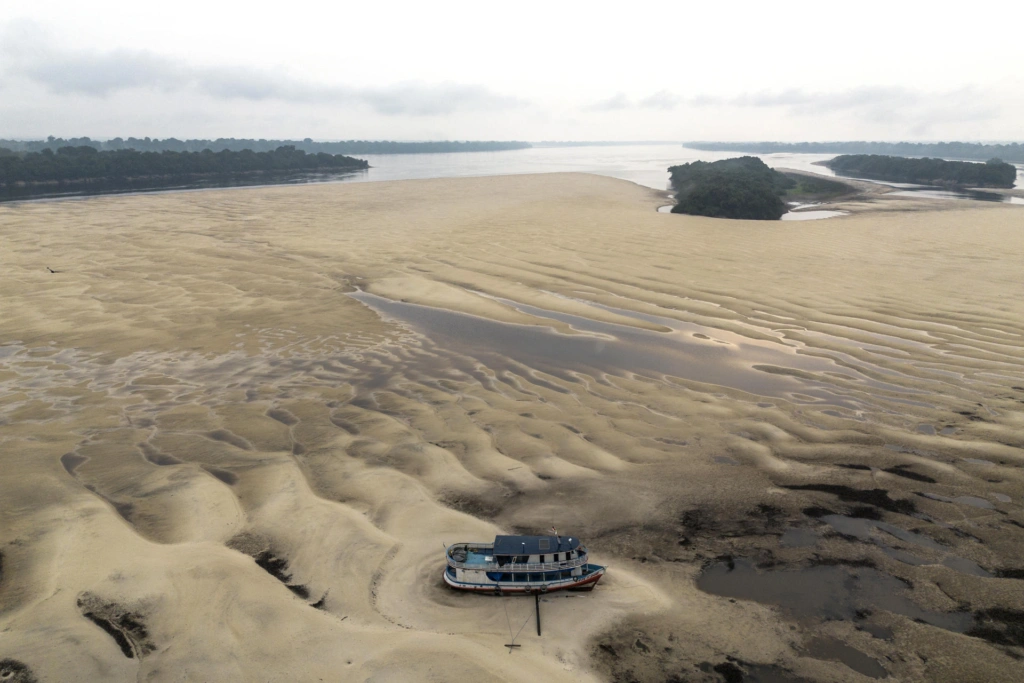
The intensifying El Niño phenomenon has pushed the Amazon basin toward a critical threshold, as months of record heat and sharply reduced rainfall now point to a prolonged drought and an unprecedented wildfire season heading into 2027.
Data from the Amazon Cooperation Treaty Organization (OTCA) show that 73% of the basin recorded below-average precipitation during October, while heat hotspots jumped 82.6% compared to the previous year, nearing 24,000 points. Average temperatures landed 1.32 degrees Celsius above normal levels.
U.S. National Oceanic and Atmospheric Administration (NOAA) measured sea surface temperatures in the equatorial Pacific at 2.5 degrees Celsius above the historical average. The agency calculates a 60% probability that this event will surpass every record since 1950.
RELATED: Brazilian Amazon Fires Increased by 140% in October
The magnitude of the phenomenon was described by scientists as “off the scale” against modern records. The atmospheric sinking process dries the air above the rainforest, blocks cloud formation, and delays the onset of the rainy season.
A delayed rainy season leaves soils and rivers weakened before the dry months even arrive, creating the conditions that turned past El Niño events into regional catastrophes.
🔥 Exceptionally strong El Nino threatens Amazon rainforest with worsening drought and wildfires as temperatures rise and rainfall declines across basin
💧 Amazon Cooperation Treaty Organization reports 73% of basin saw below-average rainfall in October, while fire hotspots… pic.twitter.com/7efWxAmfKo
— Anadolu English (@anadoluagency) November 25, 2026
Communities Bear the Cost
The impact is already reaching native communities and Amazonian cities, the first to suffer the climate imbalance. In Brazil, dense columns of smoke covered cities such as Manaus and Santarém in October. The air pollution forced schools to close.
On the Amazon border between Peru and Brazil, native leader Huni Kuin Nolasco Torres denounced that extreme heat left the Curanja River practically unnavigable. The water turned muddy, and the subsistence of his village in Balta was compromised.
The scale of the threat becomes clearer when placed in historical context. Experts from the Monitoring of the Andean Amazon Project (MAAP) traced the pattern, the severe El Niño events of 2015 and 2023 preceded the most devastating fire seasons in recent history, those of 2016 and 2024.
Those cycles burned up to 2.8 million hectares of primary forest. The parallel is impossible to ignore, and it is the backbone of the projection now extending toward 2027.
If the current event reproduces the trajectory of 2015 and 2023, the next fire season could match or exceed the destruction of 2016 and 2024. Millions of hectares of primary forest would once again be at risk, along with the communities that depend on them.
The Andean Amazon Project’s specialists point to a deeper imbalance behind the immediate emergency. The climate crisis falls disproportionately on strategic ecosystems and the peoples of the Global South, they argue, while the industrialized powers driving extractive and polluting economic models bear far less of the consequence.
The native people of the planet’s largest tropical forest now face the direct results of that imbalance. Extreme drought and wildfires threaten to repeat or worsen the damage of previous cycles in the coming dry season, when weakened soils and depleted rivers will offer little resistance.
The warning signs are already visible across the region. Record heat in recent months, collapsing rainfall, smoke over major cities, and rivers reduced to mud all point in the same direction. The 2027 outlook depends on the trajectory of an El Niño that has already defied modern measurement, while the projections are unambiguous, and the margin for inaction is closing fast.
From teleSUR English via This RSS Feed.