

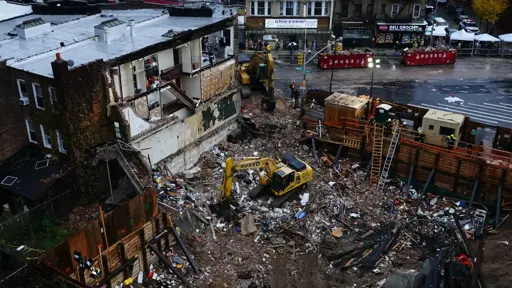
On November 11, a three-story apartment building at 1321 Flatbush Avenue collapsed into a construction excavation site in the Flatbush neighborhood of Brooklyn, killing eight workers and tenants, injuring 18 people including seven children, and displacing dozens of residents. The collapse has exposed the deadly consequences of a system that puts real estate profits ahead of the safety and well-being of working-class communities. In a predominantly Black, Brown, and immigrant neighborhood, the disaster is part of a broader pattern of gentrification, landlord neglect, and unchecked development.
In the aftermath of the collapse, residents and community members have organized to support displaced families and demand accountability. Left Voice spoke with an organizer with the Mutual Aid for Flatbush Coalition, a network of tenant associations and grassroots organizing efforts, about the response to the disaster and the fight being built in its wake.
The interview takes place amid a broader housing crisis in which the needs of working-class people are routinely subordinated to the interests of developers and landlords. It offers a look at the organizing taking place in Flatbush and the fight for a different approach to housing — one that prioritizes working-class people and communities over profit.
Left Voice: The Flatbush building collapse was not simply a random accident but was an entirely preventable tragedy. It happened in a predominantly Black, Brown, and immigrant working-class community, and reflects a larger system that puts these communities at risk. Can you speak a bit about this context?
Gentrification in New York City has been happening for many, many years. If you ask different people when they can pinpoint the start of gentrification in their neighborhood, depending on what neighborhood they’ve lived in previously, there’s a different timeline.
Especially in Flatbush, what we’re seeing is a lot of really large prewar buildings, with building lots bigger than what you would probably find in most newer buildings. It’s the same thing in Washington Heights, Harlem, and all these places that are being rapidly gentrified.
A lot of these old buildings have been deliberately left to become dilapidated as a landlord tactic to get tenants to move out. A lot of these buildings were bought up by landlords when there were different laws in place protecting rent-stabilized housing. Landlords saw this as an opportunity to invest in rent-stabilized housing stock. Then the laws changed, and in their opinion, they no longer had the incentives to fix up these buildings.
That’s why landlords have been finding other strategies to push out tenants so they can capitalize on this wave of gentrification. What we’re seeing is a lot of really old buildings in Flatbush coming down, landlords selling their buildings, intimidating tenants and asking them to leave, or not disclosing the rights tenants have to their specific units. Some landlords won’t share that tenants are actually living in rent-stabilized housing.
What ends up happening is that landlords are allowed to operate criminal operations as a business, with zero repercussions from the city. If we point to a restaurant, for example, and it doesn’t maintain its proper licenses, upkeep, or cleanliness, the city will shut it down. But when it comes to housing for multiple families, lots of people, and children, it seems like landlords get to do whatever they want.
There really isn’t enough oversight, and there aren’t any qualifications to develop on land or tear down land, potentially harming the community with whatever project you’re working on. There are no qualifications except money. That’s it. The city only needs to see money. At the site where this happened, across all of those businesses, there were multiple lawsuits involving companies that were already part of the project, but apparently that doesn’t matter to the city.
Left Voice: The community has been organizing mutual aid for families while they wait for support from the state. You’ve also talked about how the city doesn’t regulate or make sure landlords and developers produce safe housing. We’re also seeing the Mamdani administration push forward more deregulation to make this development happen more easily. Can you talk a bit about the failure of the state in this situation — both in terms of regulating landlords and developers and supporting the people impacted by the collapse?
People have to remember the timeline of this event. It happened during an election cycle, when several ballot proposals concerned accelerating construction and changing building regulations. These proposals would make it easier to fast-track development with less oversight and less community input.
The city already has a system that does not listen to tenants who advocate for themselves. Tenants go through the proper channels and document problems with the Department of Buildings (DOB) and the Department of Housing Preservation and Development (HPD), but their complaints are ignored, their cases are closed, and landlords receive small fines that are nowhere near proportionate to what they’ve done.
On top of that, the city has an interest in supporting large developments across the city. It is involved in some of these developments through so-called affordable housing programs, where landlords receive substantial tax benefits in exchange for making a portion of the housing available at certain income levels. Of course, those income levels do not necessarily reflect the incomes of people in the neighborhood.
All the grassroots groups who have been watching Mamdani, not just what he’s saying but what he’s doing, were sounding the alarm about these ballot proposals. We wanted people to consider the history and future of the city. If Eric Adams had supported these proposals, many people would not have voted yes. But because it was Mamdani, people felt comfortable doing so.
People supported Mamdani because he said he would be tough on landlords, change how things were done, and champion tenants’ rights. Yet this has been allowed to happen. This is now the second building collapse during his tenure. The first one happened with the Pfizer building in July, which could have been absolutely catastrophic. The number of deaths and the damage to property and the city could have been impossible to calculate. Yet there was no change afterward in DOB or HPD policies. Now people are dead as a result of the Flatbush collapse.
Left Voice: You’ve pointed out that money raised for families does not always reach them, leaving community and mutual aid networks to meet basic needs. What kind of organizing has been necessary?
Typically, the state has a certain procedure for how it handles emergency situations and disasters. What we’ve noticed time and time again, with Hurricane Sandy, building collapses, and fires, is that the people who benefit the most are the organizations themselves and the state.
When you actually talk to these families about the help they’ve received, it almost never matches what is being publicized. In this particular case, we set up this mutual aid fund because we already knew this would happen. We didn’t need to wait for proof to find out. We’ve raised $131,000, with the community trusting us to distribute these funds equally.
That’s one part of the effort. The other major part is our long-term advocacy plan, where we’re connecting with families directly to stay on track and stay up to date with what they need.
The agencies and nonprofits working with them right now are letting them slip through the cracks and are not giving them the direct answers they need. They want these people to just be done with. They want this whole thing to end, and they don’t care what that end result actually looks like for these families.
Left Voice: Mutual Aid for Flatbush has put forward demands including a transparent investigation, permanent housing for impacted families, and the resignation of the Department of Buildings commissioner. How were those demands developed, how are people organizing around them, and how can others support them?
The demands were created with the different groups that came together for Mutual Aid for Flatbush and discussed with families. We created these demands because we knew that achieving accountability and justice meant asking for these things. We were not going to settle for low-hanging fruit or scraps. We needed to give voice to our neighbors who had just buried their loved ones and gone through an entirely preventable tragedy.
We wanted to uplift their concerns and what they wanted, and make sure the narrative wasn’t just that they’re going to get justice or a lot of money in a lawsuit. That’s not it. We developed those specific demands because we knew we could hold our elected officials to them.
One of the demands is that nothing for profit should be erected on that site. Absolutely nothing can be built there for profit. It has to be a park, a place of reflection, a memorial.
Housing is an immediate concern. On November 30, these families are expected to become homeless. After the collapse, there were press conferences, a lot of people crying, shaking hands, and taking pictures. There was one meeting with all of the elected officials together at City Hall, on November 13. But there has not been a concrete plan for a proper temporary housing solution for these families.
We’ve been advocating for hotel stays longer than 30 days. We’re trying to confirm whether that has been approved for up to 60 days. In the meantime, we’re learning that families are being pressured to sign HPD documents under the impression that the documents will help them get an apartment or temporary home. What the documents actually direct them toward is a shelter.
Families are being misled and told that completing these forms will help their housing process, while also being told that not completing them could hurt their chances of getting an apartment. That is not true. Right now, there is no actual temporary housing option beyond a shelter.
We also learned that there is no permanent housing plan for them, or for any New Yorker if there were ever another building collapse, a fire, or anything like that. The city does not have a plan for you to get permanent housing with support from the city.
That’s concerning to us, especially because there has not been transparency around the mayor’s fund and how much money was collected for these relief efforts. Unofficial information suggests there could potentially be a million dollars in that fund.
We were asked earlier: in a perfect world, what would we want to see as the solution? Our answer was: that world exists now. This isn’t hypothetical. The resources, the money, the connections, the task force, and the staff are available. We’re genuinely confused why a socialist mayor, who has access to those resources, is choosing to make these families homeless.
People need to listen to groups like ours and to the grassroots organizations doing this work. The information and propaganda from Mamdani are wonderful. It’s delicious, it’s soothing, like chicken noodle soup for the soul. But it is empty. Every time he makes announcements, like disbanding the SRG, there’s always more truth to dig into.
People should not simply accept the positive messaging about what the city is doing. They need to understand that what the city says is happening is not necessarily the reality of what families are experiencing.
It’s up to everyone to amplify the voices of neighbors who are saying that they are not getting the help they need and do not want to be sent to shelters. We need people to stand with them.
We’re planning protests and rallies until our demands are met, including an adequate temporary housing solution and permanent housing. The families themselves are furious that the only solution being offered is a shelter and that they are being left homeless.
Left Voice: The collapse shows the consequences of treating housing as a profit-driven commodity rather than a basic human right. What is your vision for how housing should be organized?
Tenants need to control their housing.
Right now, the model is incredibly outdated and broken. We pay our own electricity and our own gas. The money we’re putting into rent is not going into anything that has to do with our housing. It has to do with lining the pockets of these landlords, and they are not investing that money back into the housing.
This whole myth and narrative that landlords aren’t getting enough money, and therefore can’t do the maintenance and upkeep, is simply false. That isn’t the purpose of them collecting the money. That’s just what people think the purpose of collecting the money is. There’s no pressure for them to actually do any of the work.
These are our homes. We don’t see homes as a commodity; we see them as a necessity. Everybody should have a home. We should have a model in which tenants own their buildings and control the funds that would otherwise go toward rent. Those pooled funds could be used more directly to meet the needs of the building. It could be similar to a co-op, but with less bureaucracy.
We could organize around what we need: “This is what we need today.” Then we could hire the proper help to support what needs to be done in the building. We could hire a licensed superintendent, licensed workers to make repairs, or a licensed company to take on major repairs.
This would also allow us to have dignity in our homes. We wouldn’t feel that we’re one job away from losing our housing. We could invest more in our homes, our relationships with our neighbors, and our communities because we have a real stake in them.
Left Voice: This year, we’ve seen communities fight back against attacks on immigrants like in the Twin Cities, as well as Los Angeles and Chicago. We’ve also seen major mobilizations against austerity and militarism around the world from France to India. On the same day as the building collapsed in Flatbush, workers and youth in Spain organized a general strike connected to the struggle for housing and against evictions. In this broader context, how should we organize and fight for our demands?
We have to put everything happening here in a country-wide and global context. Some of the money we received — $30 — came from people in Palestine, in Gaza. We have received a solidarity video from Gaza, and solidarity from people around the world for these families.
What is happening here, the pain and the efforts, and how the system works and fails people, is not far away from the same apparatus causing harm in other countries.
We need to organize what we have control over, like where our money goes. We need to have general strikes. We need to follow in the footsteps of what other countries are doing. We have so much power to starve the beast from the inside.
We need to organize a general strike of our labor. We should not be contributing to the economy right now, because we know that one day of us pulling out could throw everything into chaos.
We know our spending has a lot of power, so let’s use that. We also know that most of us are renters, and can use our efforts to organize a rent strike, whether that’s for these families or for other causes.
We can use our homes and our positions as renters to organize a rent strike together. We should have had a citywide rent strike years ago. It’s looming, and we need to build toward one.
Left Voice: Is there anything else you want readers to understand about what happened or what needs to change?
This is a warning for all of us. Most of the people impacted in this situation are Black and Brown and have different immigration situations. But the kind of violence the state perpetuates in the pursuit of profit can affect anyone. That’s what happens when when housing is tied to profit.
Nobody — and I mean nobody — whether you live in a fancy new place in Williamsburg or in the projects, it doesn’t matter what your zip code is or where you live. When it’s your time and you’re the one being screwed over, it can happen to you. What happened is not unique to them. It can happen to you if nothing changes.
What do you want to see when that happens to you? Do you want to see that there have been efforts to figure out solutions for people who have lost their housing?
We also have to remember that New York City is not immune to the effects of climate change. The city was not planned or developed to prepare for the rapid changes we are facing, even in the years since Hurricane Sandy.
We will see more people displaced. We will see more people who have lost their housing. Again, what do we want that plan to be? Nothing exists. Anything is open for conversation, because our elected officials clearly don’t think this is an important thing to be thinking about.
The post Homes, Not Commodities: Flatbush Residents Fight for Justice After the Collapse appeared first on Left Voice.
From Left Voice via This RSS Feed.