

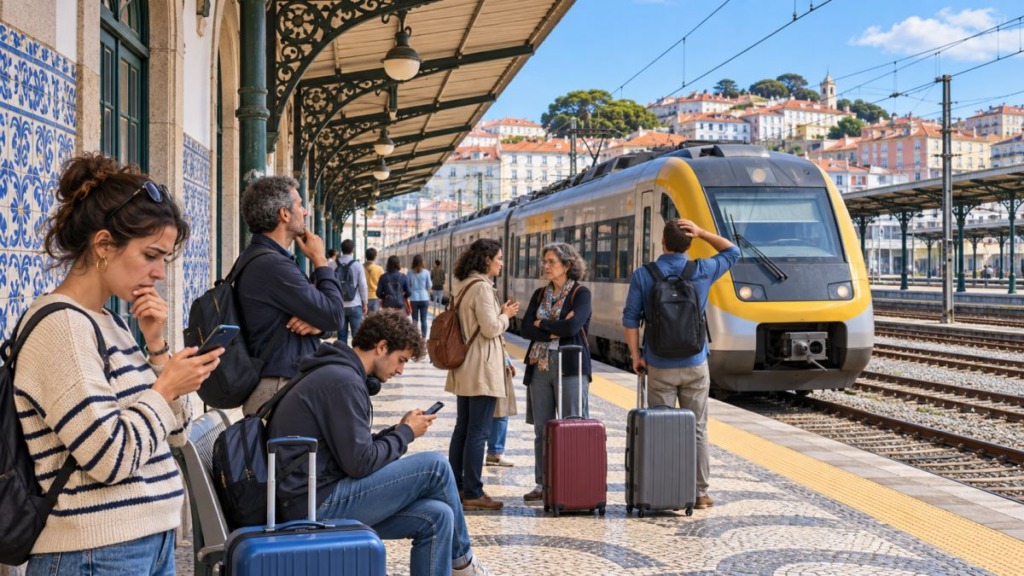
Train drivers at the state-owned operator Comboios de Portugal (CP) are observing their second consecutive day of a total strike this Wednesday, with only minimum service levels maintained for suburban, regional, and long-distance routes.
RELATED:
Portugal Public-Sector Workers Begin 24-Hour Strike
The industrial action, organized by the National Union of Train Drivers (SMAQ), began on Monday, November 23, and is set to continue until Friday, November 27, causing a severe impact on national travel.
On Tuesday, the railway company suspended 795 of the 1,062 trains scheduled between midnight and 7:00 PM local time—a stoppage affecting 74.9 percent of all services.
According to the strikers, only the 267 trains designated as part of the “minimum services” were able to operate. The impact was most significant for urban rail services in Lisbon, where 373 out of 500 scheduled trains were canceled. In Porto, 168 out of 228 services were halted, while on long-distance routes, 51 out of 67 scheduled trains did not run.
Greve na CP de 23 a 27 de novembro de 2026.
Entrevista ao Presidente da Direção do SMAQ.
Créditos RTP. pic.twitter.com/JAdxI8dEUZ— Sindicato dos Maquinistas (@smaq_pt) November 23, 2026
The text reads, “Strike at CP from November 23 to 27, 2026. Interview with the President of the SMAQ Board. Credits: RTP.”
The union’s demands include “the restoration of purchasing power, professional recognition, better working conditions, and the strengthening of railway safety.” The union further stated that train drivers whose shifts require them to stay overnight away from their home area will not report for work during the strike period.
The unions have indicated that, within the minimum service framework, priority will be given to suburban trains in Lisbon, Porto, and Coimbra during peak hours. Additionally, they clarified that operations related to maintenance, operational safety, and emergency response will remain active.
La huelga de maquinistas en Portugal suspende el Tren Celta entre Vigo y Oporto hasta el jueves
✍️ Vía @zumedepinha https://t.co/XCzdTFsmXz
— Faro de Vigo (@Farodevigo) November 23, 2026
The text reads, “Train drivers’ strike in Portugal suspends the ‘Celta’ train service between Vigo and Porto until Thursday”
The disruptions have affected international connections with neighboring Spain. Within the national network, ‘Alfa Pendular’, ‘Intercidades’ (Intercity), and ‘Inter-regional’ train services have also been suspended.
The state-owned operator has announced that passengers may request a full refund or exchange their tickets for another service at no extra cost. Given the significant disruptions, authorities advise checking operational status updates before heading to the stations.
Labor disputes within the European public transport sector are driven by inflationary pressures on real wages, a shortage of technical staff, and changes to shift scheduling. Analysts warn that the drastic reduction in rail services places additional strain on road transport, forcing travelers to endure longer journeys and increased congestion on routes into metropolitan areas.
In this context, each work stoppage reignites the tension between upholding labor rights, maintaining minimum service levels, and ensuring the continuity of economic activity.
On a regional level, the daily mobility of thousands of workers relies on the coordination between trains and buses—a situation that has reopened the debate regarding public investment and the modernization of rolling stock on high-demand networks.
From teleSUR English via This RSS Feed.