

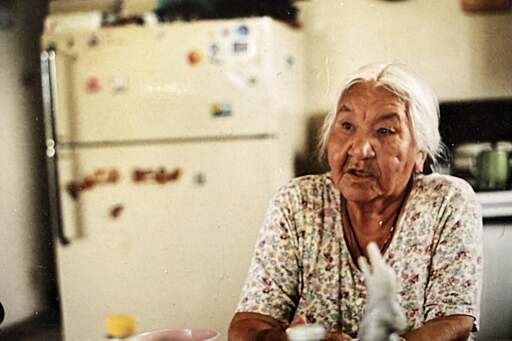

Eden Fineday’s kokum, Irene. Photo by Eden Fineday
In my 20s, I used to travel regularly from California, where I was attending university, to Saskatchewan to visit my family on the rez.
My granny, Irene Fineday, lived in a little red house on Sweetgrass Reserve, now called Sweetgrass First Nation.
Back then, in the 1990s, my cousin Etley also lived with her. Etley took care of her. Every day, she would brush her hair, cook her meals and generally do her bidding. She would drive granny into town for her appointments.
I only reconnected with my Sweetgrass family at the age of 14. Until then, I had lived with my white mother and my two white siblings in “Vancouver,” far away from my father and his side of the family.

READ MORE: Who gets to define a kôhkom?
I was told as a child that I was Native, so I understood it on an intellectual level, but I did not understand what it actually meant. Growing up, I was hungry for connection to my culture, but I had no one close to me who could teach me.
Once I was in touch with my Cree family, I began to visit at least once per year.
Whenever I landed in Saskatoon, I would pick up a rental car and get on the road to the rez. It was about an hour and a half from the airport to my granny’s little red house.
On the way, I always stopped in North Battleford and picked up some fried chicken. I would arrive on Sweetgrass with my offering, and my granny, my cousins, and whatever extended family was visiting would feast with me.

Eden Fineday (right) with her kokum, Irene, around 2004. Photo courtesy Eden Fineday
An understated, unreactive wisdom
Sometimes, I would take my granny and my cousin Etley out for a meal. On one such occasion, at a chain restaurant in North Battleford, a waiter came to our table to take our order.
“What can I get you, kokum?” he asked my granny Irene.
I was taken aback.
I had never heard someone non-Indigenous use a Cree word like that. In fact, until that moment, I’m not sure I had ever heard the word. I called her granny. I felt a wave of gratitude wash over me – both for him making an effort to respect my grandmother, and for teaching me the word.
Wow! I thought. This white guy knew a Cree word. Not only that, but he used it to communicate something important — that my granny was indeed his kokum.
All kokums are everybody’s kokums in public.

Granny Irene. Photo by Eden Fineday
My granny was an understated person. She didn’t have big, instantaneous reactions.
Once, I accidentally lit a frying pan on fire while I was cooking her some bacon. I yelled about the fire and the smoke, grabbed a cloth to wrap around the handle, ran to the front door with the frying pan, opened the door and the screen door, and threw the entire contents of the pan out into the snow off the side of the porch — while she watched me out the corner of her eye, barely looking up from her game of solitaire on the kitchen table.
I’ve come to learn this non-reacting is part of our culture. So my granny didn’t jump for joy when this waiter addressed her the way he did. But her eyes twinkled and I could see that she was clearly tickled pink.
The waiter also didn’t make a big deal of it. I think they both understood Cree ways of communicating. She placed her order.
That moment has always stuck with me. I think of it often, especially when I’m learning Cree. I hadn’t heard the word kokum very often growing up.
Even my Cree cousins on Sweetgrass called my grandmother “Granny” in my presence. Others, the ones she had raised, called her “Mama.”
There were different names for her, depending on who was speaking and their relationship to her. I wonder now how much of that was simply family habit, and how much came from the pressure to speak English.

Eden Fineday’s grandmother Irene stands outside with her grandfather Alphonse in an archival photo. Photo courtesy Eden Fineday
Kokum or kôhkom?
I’ve been reflecting on this because I was moved last month when I learned that the Oxford English Dictionary had added the word “kokum” in June.
It’s a version of the proper Cree word, kôhkom. Lots of people spell it without the diacritics or the letter H, both of which are actually instructions for how to pronounce the word phonetically.
These widely accepted variety of spellings also serves a useful function — it shows us that, unlike kôhkom, which means “your grandmother” in Cree, kokum is an anglicization of the word, and the meaning has shifted a bit. Spelt in this way, it’s used to just mean “grandmother.”
In the past, my family may have felt pressured to use English words to describe their own family members.
Now, they can use a Cree word proudly, and if anyone tells them they should be speaking English, they can tell them that they are using English, too.

READ MORE: Beyond language learning, weekly Cree classes taught me about kinship
Living languages change, and that’s a beautiful thing. They grow to encompass the lived realities of the people speaking them.
Cree people have been forced to speak English for centuries. Now, there’s a tiny piece of reciprocation, a small acknowledgement of our worldview, which feels big.
“Canada” is a nation made of European culture on Indigenous Peoples’ lands. This country is a co-creation.
As we continue to move toward truth, toward reconciliation, my wish is that this small act leads to more understanding.
May more “Canadians” become aware of the many languages spoken on the sacred land under their feet.
May understanding grow from this.
May they learn more about the People, too and the beautiful cultures contained in our languages.
May we all have a kôhkom. Or a kokum.
The post May we all have a kôhkom — or a kokum appeared first on Indiginews.
From Indiginews via This RSS Feed.
You must log in or register to comment.