

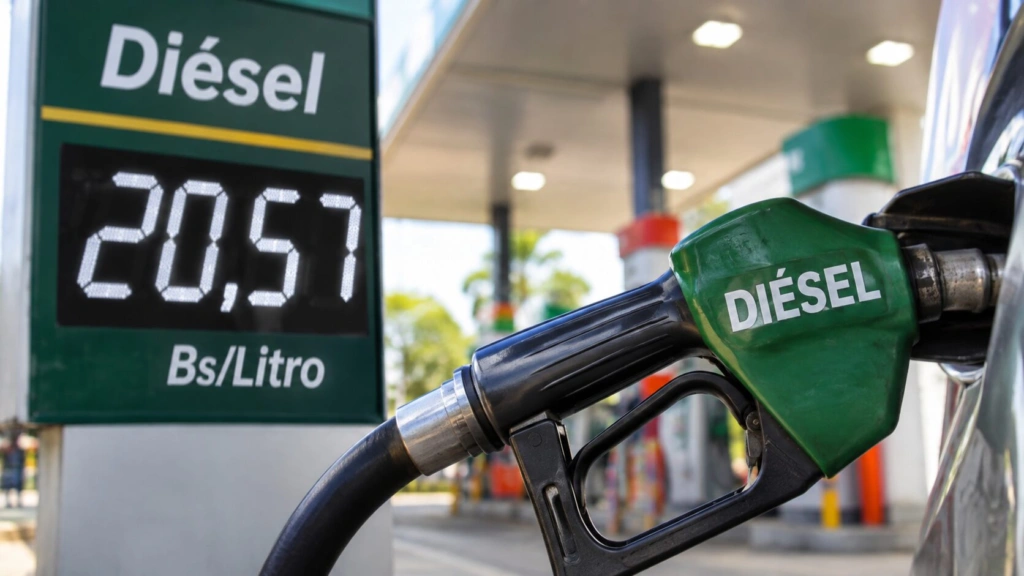
On Wednesday, various Bolivian sectors announced nationwide pressure tactics following an increase in the price of diesel to 20.57 bolivianos per liter ($1.87)—a rise of 2.62 bolivianos over the previous rate. Representatives of the heavy-duty transport sector in Oruro and Potosí are considering road blockades and are demanding that the executive branch repeal Decree 5716.
RELATED:
Study Identifies Ten Mechanisms that Perpetuate Impunity in Femicide Cases in Bolivia
Regionally, the Departmental Federation of Chuquisaca has decided to initiate a work stoppage in Sucre. Meanwhile, the Trade Union Confederation of Drivers of Bolivia has announced an expanded meeting to determine further actions, which could potentially lead to a national strike.
“We reject the government’s new adjustment because it hits the pockets of those who need help the most,” stated the organization’s leader, Lucio Gómez.
🇧🇴 El Gobierno de Bolivia reajustó casi 15% el precio del diésel (de casi 4 a 20,57 bolivianos en diez meses, más de 400%, 1,70$), para sostener rangos internacionales pese a la caída del precio externo, lo que ubica al país como el segundo más caro de la región detrás de Perú.… pic.twitter.com/OeOhqXpLiH
— teleSUR TV (@teleSURtv) November 25, 2026
The text reads, “The Bolivian government adjusted the price of diesel by nearly 15%—rising from approximately 4 bolivianos to 20.57 bolivianos over ten months (an increase of more than 400%, or $1.70)—in order to align with international price ranges, despite a decline in global prices. This makes Bolivia the second most expensive country in the region for diesel, trailing only Peru. Private-sector business leaders have supported the move, while social organizations have expressed discontent and have not ruled out taking action in protest.”
Similar sentiments were expressed by members of the “16 de Noviembre” Transport Federation in Santa Cruz, the Apolo Transport Central, and the “Transporte Libre” (independent transport) sector in La Paz. At bus terminals in the seat of government, there was a noticeably low turnout of passengers heading to various destinations.
In response to the protests, President Rodrigo Paz defended the policy, arguing that prices are being adjusted to align with the international market and that the previous subsidy primarily benefited a few millionaires. Economists, however, have questioned the price hike, noting that global fuel trends are currently leaning downward.
For its part, the National Hydrocarbons Agency (ANH) stated that the change is intended to bring the price in line with market parity. The agency’s statement explains that the adjustment aims to prevent critical gaps between the cost of importing diesel and its retail price within the domestic market, while also helping to curb smuggling. This marks the second such increase recently; the executive branch had previously raised the rate to 17.95 bolivianos on September 18.
From teleSUR English via This RSS Feed.