

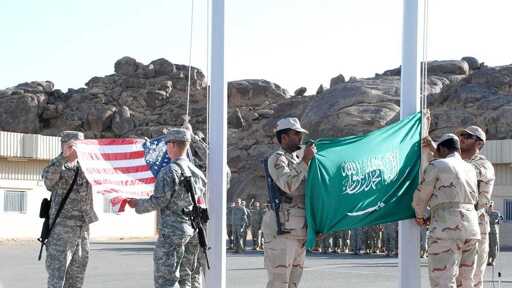
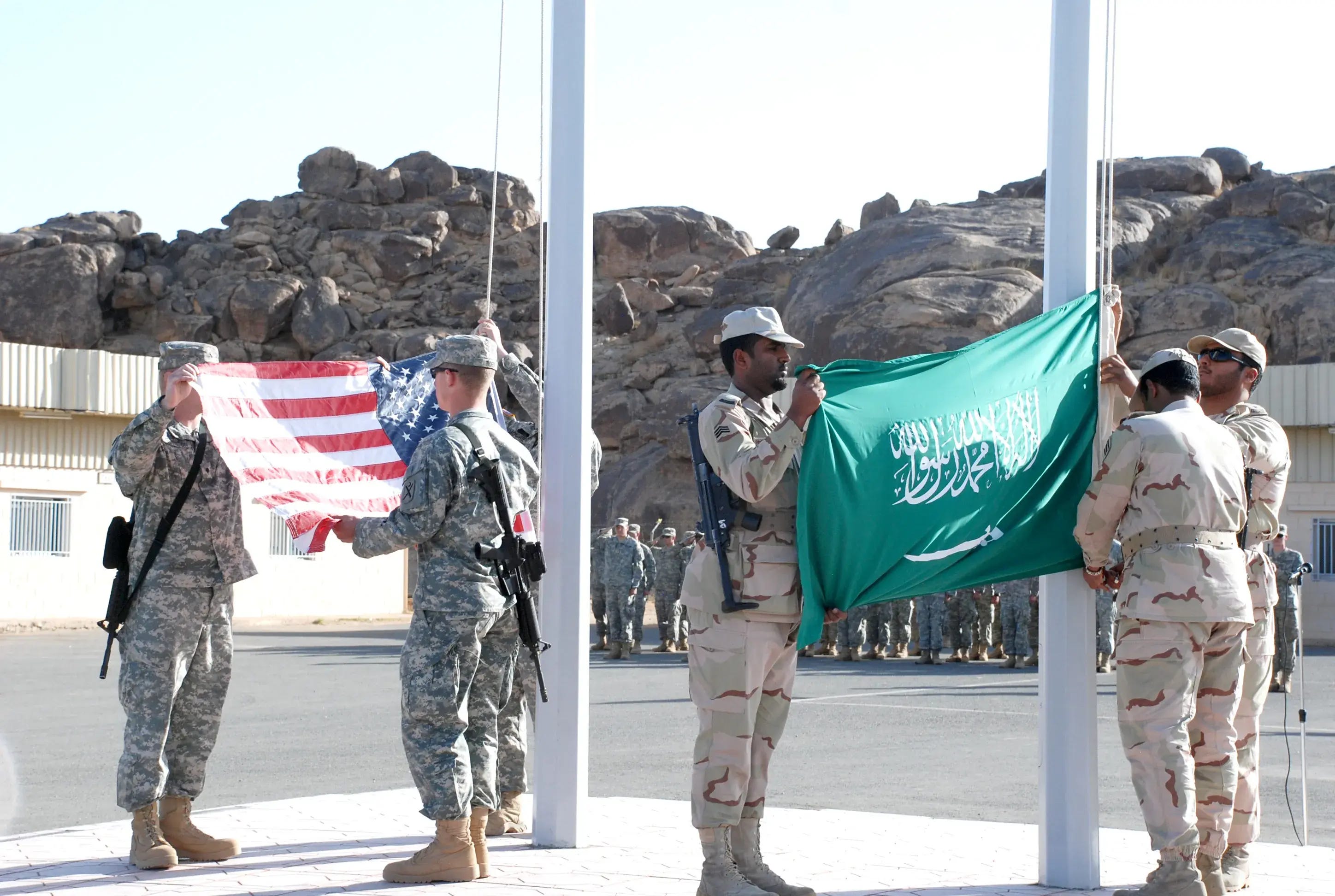
Soldiers from Third Army/U.S. Army Central (Third Army), the South Carolina Army National Guard and the Kingdom of Saudi Arabia Royal Saudi Land Forces (RSLF) lower their country’s respective flags Feb. 28, 2011 to commemorate the success of Exercise Friendship Two. (Photo Credit: U.S. Army)
On 13th July 2026, Saudi Arabia bombed Yemen’s Sana’a Airport. This unprovoked attack on Yemen’s civilian infrastructure was widely seen as an attempt to attack a plane carrying the deputy head of Ansar Allah returning from the funeral of Iran’s late Supreme Leader Ali Khamenei. This Saudi attack marked an escalation in the war on Yemen, the most recent phase of which began in 2015, where over seven years the Saudi-led coalition carried out 25,054 air raids which led to the deaths of more than 377,000 Yemenis and plunged Yemen into what is widely regarded as the world’s worst humanitarian crisis.
While July was the first Saudi-led attack on Yemen since April 2022, claims that this marks the end of a “truce” in Yemen are overstated. The United States, United Kingdom, and Israel, have launched frequent attacks on Yemen.
Since Israel escalated its genocide in Gaza in October 2023, Yemen has been one of the few countries to act. Shortly after Israel’s actions, the Yemeni resistance movement imposed a maritime blockade on the southernmost chokepoint of the Red Sea, Bab-el-Mandeb, which handles nearly 10% of global trade and 6% of global oil shipments. Ansar Allah declared it would attack Israeli-linked, American, or British ship that tried to pass. In December 2023, the United States began attacking and killing Yemenis enforcing the blockade. By January 2024, the US and United Kingdom began bombing Yemen, later joined by a European Union naval attacks, and Israeli attacks targeting Yemen’s civilian infrastructure, including the ports of Hodeidah, as-Salif, and Ras Isa, oil refineries, power plants, and Sana’a International Airport. The US and Israel have committed massacres in Yemen. Between March and May 2025, the US killed 224 civilians in Yemen. On 19 September, Israel killed 31 journalists, committing the deadliest strike on journalists in West Asia.
Since July 2026, the Saudi-led coalition has taken over attacking Yemen, and daily attacks have resumed since September 5. In the past few months, more than 1,600 people have been killed and over 4,000 have been injured. These horrific attacks have received little international outrage, even though the United States and Britain are outwardly declaring their contributions to continued terror against the Yemeni people.
While Saudi Arabia leads the coalition, and this article will focus on the support provided by the United States, it must be recognized that Saudi Arabia is itself is an anchor of the U.S. empire throughout West Asia, and through supporting the vassal state, the U.S. is indeed securing its own interests in the region. The Saudi state was established as a British vassal in 1902, then later as a U.S. vassal to secure cheap energy in exchange for security, as formalized in the 1945 Quincy Pact. To this day, the Saudi Kingdom operates as a client regime with the United States. Thus, the United States takes on a central role in directing attacks on Yemen, while Saudi Arabia leads a coalition to carry them out. In this current moment, the United States is providing four critical areas of support: intelligence, refuelling, arms transfers, and impunity.
Intelligence
The U.S. is currently providing extensive intelligence and targeting support to Saudi Arabia for its air raids on Yemen. There as many as 200 U.S. military advisers in Saudi Arabia providing this direct support, according to a U.S. official speaking with CNN. The targeting support is reportedly comparable with the Pentagon’s Maven Smart System (MSS), the Palantir-built and Anthropic-powered data integration real-time intelligence software, which massively expands targeting capacity using AI for detections. MSS was used to bomb 1,000 sites in Iran in the first 24 hours of the U.S. attacks, which is a tenfold increase in targeting than what was possible before MSS. It may be too early to determine a similar scaling up of the Saudi-led coalition’s attacks from the past few months, however early indications do reveal a similar pattern. Saudi-led attacks between 2015-2022 averaged at around 10 airstrikes each day, while some days in October and November 2026 have reached 70-100 strikes in a 24-hour period. For instance, on October 5, 324 sites were bombed by 100 fighter jets; on November 8, Saudi-backed forces carried out 91 air and missile attacks; and on November 15, Saudi-led forced bombed Yemen 75 times. We can therefore determine that U.S. intelligence support is actively aiding, and likely expanding, the Saudi-led coalition’s deadly attacks on Yemen.
Refuelling
The U.S. has resumed a critical logistical contribution to Saudi Arabia: refuelling. From April 2015, the U.S. began refuelling Saudi fighter jets which were used to bomb homes, schools, hospitals, and infrastructure across Yemen. The Obama administration ordered this support for the Saudi-led onslaught after at least 1,000 Yemenis had been killed, 15,000 people had been wounded, more than 1,000 homes had been destroyed, and over 100 vital infrastructure including schools, mosques, bridges, and factories.
By the end of August 2018, the U.S. had flown 12,102 refuelling flights to supply fuel to the Saudi-led coalition. Air Force tankers supporting them conducted 2,919 sorties and offloaded 92.3 million pounds of fuel. By November 2018, the U.S. stopped the refuelling support to avoid Congressional mounting scrutiny, particularly shortly after the murder of the journalist Jamal Khasogghi. While Congress prohibited the U.S. refuelling warplanes used to bomb Yemen soon after, the latest legislation was a one-year restriction in the 2024 National Defense Authorization Acts, which has now expired. On October 5 2026, the U.S. resumed its refuelling support for Saudi Arabia. Once again, the U.S. is providing critical support for the fighter jets attacking the people of Yemen. It is imperative there be similar outrage and opposition to halt this egregious contribution to war crimes.
Weapons transfers
The United States is Saudi Arabia’s largest weapons supplier, accounting for more than 72% of their entire weapons arsenal. The U.S. provided the majority of the weapons used to devastate Yemen. From 2015-2021, the U.S. provided $54.6 billion dollars in military support to Saudi Arabia and the United Arab Emirates, the two leading members of the coalition bombing Yemen.
In October 2015, the State Department approved a sale of $11.25 billion for four Lockheed Martin Littoral Combat Ships. The following month, they approved a $1.29 billion sale of 22,000 bombs, including 5,000 Boeing Joint Direct Attack Munition kits, which target bombs and 1,000 Raytheon Paveway II Laser Guided Bombs. These weapons transfers were explicitly to replenish the stock of weapons Saudi Arabia had used in the first months of its attack on Yemen. In the following years, the U.S. provided a huge amount of weapons for Saudi Arabia and the UAE including $110 billion in 2017 in missile systems, combat ships, aircraft, helicopters, support services, and munitions; $9.8 billion in 2020 to upgrade Saudi Arabia’s 269 F-15 fighter jets; and $650 million for 876 missiles and missile launchers.
These weapons were used to devastate Yemen, while weapons companies profited massively from their suffering. Boeing is estimated to have made $13.8 billion in weapons sales to the Saudis, followed by Lockheed Martin at $7.4 billion, Raytheon at $3.3 billion, and Sikorsky, a subsidiarity of Lockheed, at $650.7 million. These eye-watering revenues turned into huge payouts for shareholders, while 17.4 million people in Yemen faced food insecurity by March 2022.
Fragments of U.S. weapons were frequently found at the site of massacres. On August 9 2018, schoolchildren were on a bus on their way to a field trip in northern Yemen. A fighter jet dropped a 500lb bomb on their bus and killed 50 children, almost everyone on the bus. That bomb was a MK 82, manufactured by Lockheed Martin. That same bomb was used to massacre 155 people attending a funeral in October 2016. In March 2016, three MK 84 bombs struck a market in northern Yemen and killed 97 people. These are the cases which were widely reported. Given Saudi Arabia’s weapons arsenal is mostly provided by the U.S., then we can absolutely assert that most of Saudi Arabia’s attacks on Yemen were conducted using U.S. weapons.
Despite this, and the backlash which moved the Biden administration to impose a loose “ban” on offensive weapons sales to Saudi Arabia, which was shortly overturned in 2024, the Trump administration has pushed to substantially arm Saudi Arabia again.
On July 16 2026, the U.S. approved a sale of $1.96 billion in weapons to Saudi Arabia, just days after the country bombed Sana’a Airport. The weapons requested included 20,000 Advance Precision Kill Weapons Systems (APKWS), which turn unguided bombs into precision bombs, warheads and other weapons, as well as training and spare parts. In September, they approved $24.3 billion for 48 Lockheed martin F-35 fighter jets. This major rearmament looks eerily similar to the first few months in 2015 after the Saudi-led onslaught began.
Impunity
The U.S. support for Saudi Arabia and the coalition attacking Yemen critically manifests in its use of its hegemony to protect and deflect from war crimes, massacres, and catastrophic destruction in Yemen. In July of this year, the State Department declared it approved $2 billion in weapons to Saudi Arabia to “support the foreign policy and national security objectives of the United States.” This degree of political protection and alliance with Saudi Arabia gives the belligerent country legitimacy and protection, just as the U.S. does with Israel and Ukraine. In Yemen, the U.S. calls the Saudi-backed Presidential Leadership Council the “international recognized government” of Yemen, which provides legitimacy to a puppet government which was put in place without any support or power in order to provide the legal justification for Saudi attacks. Thus, the U.S. can refer to the intervention as a “civil war” that they are merely supporting upon the request of the government.
Successive administrations have waged a propaganda war against Ansar Allah, opting to label them a tribal, Iran-backed proxy, “terrorist organization”, per a 2024 designation. In dehumanizing people through the label of “terror” and producing the threat, with mainstream media constructing them as the barbaric enemy, the United States has justified the Saudi-led coalition’s attacks on Yemen, and their arming of it. Thus, at the United Nations, the U.S. has frequently and firmly been able to declare its support for Saudi Arabia and its proxy Yemeni government’s “right to defend its territory and citizens” against “terrorism.”
This production of the enemy has also justified the suffocating siege and blockade on Yemen, imposed by the Saudi-led coalition. This has been a major cause of the catastrophic humanitarian crisis in Yemen. The coalition imposes arbitrary inspections and permit requirements for ships bound for Yemen’s ports, containers are forced to travel to Djibouti for authorization which took as long as as a year in some cases, and threats by the Saudi navy have deterred container carriers from reaching Hodeidah port for nearly five years. Previously, 300,000 containers reached the port but not fewer than 500 make it. For twelve years, the Saudi-led coalition has blocked the entry of material and equipment including cars, heavy machinery, and refrigerated trucks. This suffocation, paired with bombing that targets vital infrastructure, is justified through the U.S.-Saudi manufacturing of an existential enemy.
Escalating attacks require escalating solidarity
These attacks on Yemen are part of the same system of violence imposed on the world: U.S.-led imperialism. It is horrific to see massacres committed near daily across Yemen, with weapons manufactured by the same companies who have profited from the ongoing genocide in Gaza, war on Iran, and proxy war in Ukraine. We must recognize these attacks on Yemen as part of the U.S. war machine that seeks to impose its dominance through violence across the world. For us in countries that are actively fuelling wars and genocide, it is imperative we oppose the war machine in its entirety. In the face of increased violence, we must intensify our solidarity and action.
Let us not forget the huge rallies across Yemen, where hundreds of thousands of people turned up to protest Israel’s genocide in Gaza, attacks on Lebanon, and war on Iran. People in Yemen turn up because they understand they are under attack for opposing U.S. imperialism. Our movements must stand beside them and oppose every link in chain of imperialism we can.
What would you fund instead of war and imperialism? Tell us!
Nuvpreet Kalra is CODEPINK’s Digital Content Producer and co-ordinator for the international Bases off Cyprus campaign.
CODEPINK Substack is a reader-supported publication. To receive new posts and support our work, consider becoming a free or paid subscriber.
From CODEPINK Substack via This RSS Feed.