

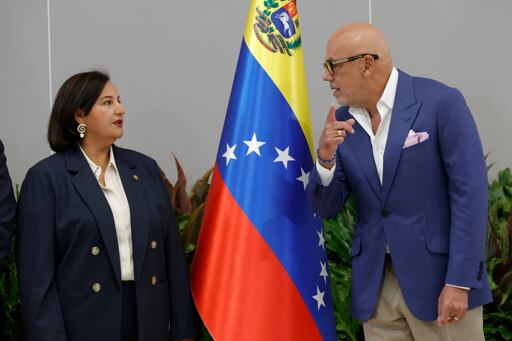
Caracas (OrinocoTribune.com)—Venezuelan far-right politician Dinorah Figuera acknowledged that the Venezuelan government continues to resist several demands presented by her delegation during the ongoing political negotiations “sponsored” by Washington. The former lawmaker, who is leading the opposition delegation at the dialogue, also highlighted the US intervention in the process.
On Tuesday, November 24, during an interview with journalist Román Lozinski on Unión Radio, Figuera discussed the results of the fourth round of negotiations between the government delegation headed by National Assembly President Jorge Rodríguez and the representatives of the defunct 2015 National Assembly, which she leads.
The fourth round concluded on Monday, November 23, with eight points of agreement involving legislative reforms, political participation, the recovery of Venezuelan gold seized by the UK, concessions in the telecommunications sector, and the defense of Venezuela’s sovereignty over the Essequibo region.
Washington behind the negotiationsFiguera acknowledged that her return to Venezuela after eight years abroad resulted from an invitation by US authorities and the determination of US Secretary of State Marco Rubio to advance an electoral process in Venezuela.
She repeatedly invoked the January 3 US military aggression against Venezuela as a determining factor behind the ongoing political negotiations, attributing several of the concessions obtained by her delegation to the circumstances created by the US attack.
When Lozinski asked Figuera whether she trusted the Venezuelan government to fulfill the agreements or feared it might reverse some of the concessions, she replied that she has doubts about the government but trusted the process.
Lozinski immediately suggested, amid laughter, that such confidence seemed to point north, an apparent reference to the US that Figuera did not dispute.
On January 3, US military forces bombed Venezuela and kidnapped President Nicolás Maduro and First Lady Cilia Flores, murdering more than 100 people, including 47 Venezuelan and 32 Cuban military personnel. Both remain illegally imprisoned in the US.
Figuera had previously celebrated the military aggression during her October meeting with Rubio in Washington, calling the January 3 attack the opening of a path of hope for Venezuela.
The former deputy currently heads the US-backed parallel National Assembly that emerged from Juan Guaidó’s failed regime-change operation. In February 2025, PSUV Secretary General Diosdado Cabello denounced Figuera’s involvement in a US-funded payment scheme benefiting Venezuelan far-right politicians.
As recently as December 2025, President Maduro denounced Figuera’s alleged involvement in the diversion of $14 million in Venezuelan assets abroad to finance far-right opposition leaders.
Resistance from the Venezuelan governmentPerhaps the most revealing aspect of the interview was Figuera’s acknowledgment that the Venezuelan government has not easily given in to her delegation’s demands.
She characterized the negotiations as a political tug-of-war, explicitly acknowledging resistance from government representatives.
Figuera also complained that the government has on several occasions preempted her delegation by independently announcing measures that were still under discussion at the negotiation table, including the reopening of previously restricted digital platforms.
She stressed that negotiations with Jorge Rodríguez, the head of the Venezuelan delegation, are marked by confrontation and disagreements rather than cordial exchanges.
According to Orinoco Tribune editor Jesús Rodríguez-Espinoza, these admissions contradict the increasingly widespread narrative that the Venezuelan government has become completely submissive to US imperialism following the January 3 invasion.
He claims that this does not negate the numerous controversial political and economic concessions made by the current Chavista leadership since January 3. However, Figuera’s own account suggests that the Venezuelan government continues to exercise a degree of political maneuverability despite Washington’s military threats.
Figuera interpreted this resistance as an effort by Chavista authorities to secure political guarantees that would allow them to participate in future elections.
She acknowledged that Jorge Rodríguez seeks to compete electorally and that the United Socialist Party of Venezuela (PSUV) continues to enjoy considerable popular support, which she tentatively estimated at 25%, without providing supporting data.
Political parties and disqualificationsFiguera highlighted the upcoming discussion of Article 105 of the Organic Law of the Comptroller General of the Republic and the National Fiscal Control System, which regulates administrative disqualifications of individuals and parties from holding public office.
A potential reform of this provision could have significant implications for several far-right politicians currently disqualified from holding public office.
Regarding political parties, Figuera distinguished between organizations whose internal leadership disputes must be resolved by the courts and those whose electoral symbols she believes should be returned to their former leadership.
The joint statement released on Monday, November 23, also proposes a national consultation on reforming the Law on Political Parties, Public Meetings, and Demonstrations.
Figuera also acknowledged that while her delegation favors repealing the Constitutional Law Against Hatred, the Venezuelan government insists on reforming it instead. She expressed disagreement with some of the proposed financial penalties.
Other legislation under discussion includes the Organic Law Against Organized Crime and Financing of Terrorism, the law regulating non-governmental organizations, and the Organic Law Libertador Simón Bolívar Against the Imperialist Blockade.
Venezuela Dialogue Table Proposes National Agreement on Political, Economic, and Social Guarantees
Restructuring of the Supreme CourtFiguera defended the ongoing process of restructuring Venezuela’s judiciary, describing the nomination process as impeccable and highlighting the record number of 1,343 applicants.
As previously reported by Orinoco Tribune, the complete renewal of the Supreme Court of Justice (TSJ) constitutes one of the principal institutional changes agreed upon during the negotiations preceding the proposed restructuring of Venezuela’s electoral system.
Figuera insisted that elections should not be called immediately and that her delegation’s priority remains the completion of these institutional and legislative reforms.
Special for Orinoco Tribune by staff
OT/JRE/SC
From Orinoco Tribune via This RSS Feed.