


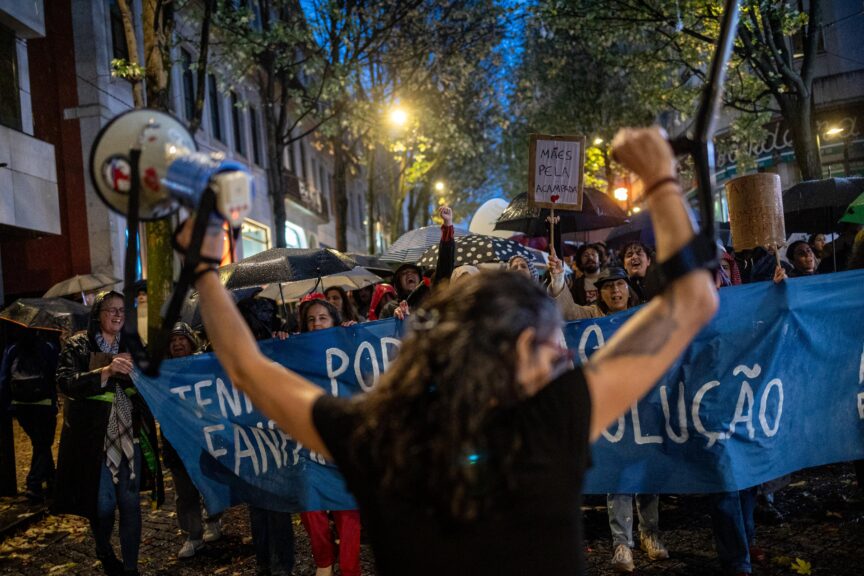
Edmilson Tavares Fonseca didn’t join the thousands of people who marched through Lisbon last Saturday to protest against Portugal’s rising living costs and unaffordable housing. Saturday is the only day he gets to spend with his partner and their baby. The rest of the week, he works two jobs, trying to make ends meet. Still, he identifies strongly with the protesters. “The people in the streets right now are demanding what most people in Portugal want,” he says. “The government have shut their eyes to reality – but we don’t have a dignified way to live right now.”
Fonseca grew up in the Lisbon suburb of Cova da Moura, known for its precarious self-built housing. He still works full-time in the area, supporting marginalised young people, but goes home to a different part of the city, where he lives in a rented apartment with his partner. They can afford it, for now, but since becoming parents, and with average rents in the city having almost doubled since 2017, Fonseca and his partner long for the security of owning their own home. Fonseca took a second job as an Uber driver to supplement his income, but, despite this, he has been refused a mortgage four times. “Sometimes it feels as if all the sacrifices I’m making are for nothing,” he says, “it’s so demoralising”.
Fonseca’s story shows what Portugal’s housing crisis means for ordinary people. Since 2015, house prices have outstripped wage growth by 60% – by far the widest gap in the EU, where the average is 6.8%. Meanwhile, public housing makes up less than 2% of the country’s housing stock.
Last weekend’s protest marked five weeks of people in Portugal taking to the streets over the housing crisis. Spontaneous encampments have sprung up from Porto to Lisbon, and tens of thousands have turned out to weekly demonstrations, defying violence and disparagement from the authorities. As the gaping discrepancy between house prices and wages pushes both renting and buying far beyond what most can afford, people in Portugal are starting to question where all the money has gone – and who really owns the cities they live in.
“What we’re seeing now is the failure of public policies to respond to national housing needs over several decades, resulting in a deep-rooted crisis,” says Ana Cordeiro Santos, an economist at Coimbra University.
After property prices crashed during the 2011 debt crisis, the government responded to a shortage of capital and widespread urban decay by courting foreign investment in real estate, Cordeiro Santos says. A central pillar of this strategy was the Golden Visa scheme, which offered residency – and eventually a route to citizenship to non-EU nationals who invested at least €500,000 (£420,000) in property. Between 2012 and 2023, it brought in €6.5bn in property investment, with most visas going to Chinese (43%), Brazilian (10%) and United States (6%) nationals, fuelling further speculation in real estate.
The flood of global capital has generated huge profits for investors, but made the housing market completely unaffordable for ordinary Portuguese people. In Lisbon, the average net salary is currently €1,405 (£1,190) a month – while the average one-bedroom flat rents for around €1,450 (£1,230).
Frederico Ascensão da Natividade Prazeres, a 24-year-old software engineer, says he “made all the sensible choices” – and now feels “deeply betrayed”. Despite earning €2,200 (£1,860) a month, a high salary in Portugal, especially for his age, he can’t afford to live alone in the Lisbon neighbourhood where he grew up. Instead, he rents a room in a shared three-bedroom apartment with no living room, splitting his time between his bedroom and the kitchen. “I live like a rat,” he says.
He checks property websites every couple of weeks, but would have to move at least 80km away to buy. Now he’s thinking of going further – to Switzerland. Portugal’s Emigration Observatory estimates that around 65,000 people left the country in 2024. “There is an urban exodus of people of my generation,” Prazeres says. “We really don’t want to leave, but we feel we have no choice.”
So many young people are leaving Portugal just as it has become one of Europe’s most desirable destinations. Tourist overnight stays have more than doubled since 2012, helped by the deregulation of the rental market, tax breaks for short-term lets on platforms such as Airbnb, and budget airlines like easyJet and Ryanair. “Tourism has boosted the economy, but it has had an adverse impact on housing,” says Cordeiro Santos. “It takes up land and property that could meet people’s needs, reducing supply and pushing up prices.”
More recently, the government has courted “digital nomads”: remote workers earning at least €3,680 (£3,110) a month – four times the Portuguese minimum wage – with more than €11,000 (£9,300) in savings. They receive residency, a route to citizenship and, until 2024, access to generous tax breaks. More than 22% currently come from the US, followed by 8% from the UK – the number of British immigrants to Portugal has tripled in the last decade. With their incomes, they can outbid most locals for housing.
As discontent has grown, successive governments have made modest changes. In 2023, the then Socialist government suspended new licences for short-term lets in much of the country and removed property investment from the Golden Visa scheme; a tax regime that offered foreign residents years of low or zero tax on overseas income was also closed to newcomers in 2024. But none of these measures have brought rents or house prices within reach of local wages. Meanwhile, Portugal’s current housing deficit is estimated at around 300,000 homes.
“The fact that house prices are still rising shows government measures to date have not worked,” says Cordeiro Santos. She points to a mix of ideology and vested interests: “Portugal’s government – which is already ideologically opposed to regulation – is now extremely dependent on real estate for economic growth, and that makes it even harder for it to act against the sector’s interests.”
“We have low salaries, job precariousness, and scant state support, but interest rates just keep going up,” says Cordeiro Santos. “Portuguese people feel their living conditions declining and their purchasing power decreasing. There are a lot of consequences – for example, the state cannot attract the professionals it needs, and [we] have a shortage of doctors, nurses, and teachers.”
It is ripple effects like these that have been behind the huge national demonstrations since October, with housing protests in 32 Portuguese cities in one weekend in November alone.
Conservative prime minister Luís Montenegro has refused calls to engage with protesters directly – despite the Casa Para Viver [Home to Live] platform, which represents over 100 national housing movements, making repeated public requests for a meeting.
Earlier this year, Montenegro’s government pushed through legislation that favours landlords’ rights, abolishing rent caps and making it easier to carry out evictions. Montenegro – whose 2025 campaign slogan was ‘Let Luís get on with his job‘ – had previously pledged to construct 133,000 new homes for low-income families by 2030, but recently told journalists “you can’t build houses overnight”.
While Montenegro and his government say they need more time, Fonseca is among those debating giving up on a future in Portugal: his partner wants to emigrate. “We can’t have any more children in these conditions, which is something we both want,” he says. “She’s had enough of the situation here – if it was up to her we’d be gone already.”
From Novara Media via This RSS Feed.