

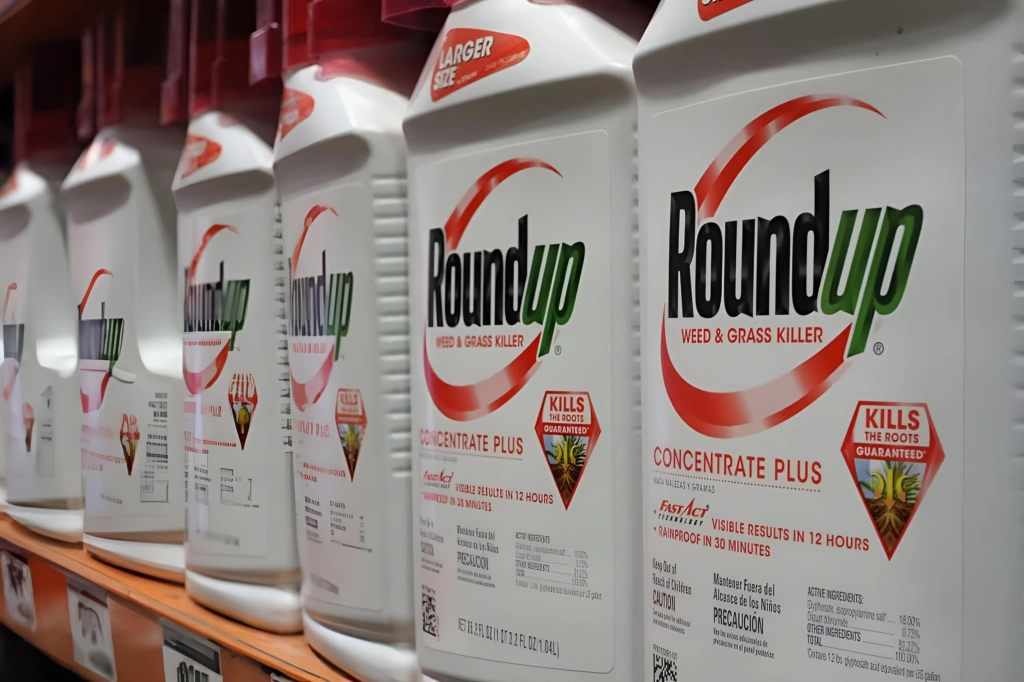
The U.S. President Donald Trump invokes the Defense Production Act to prioritize the domestic production of carcinogenic agrochemicals.
On February 18, 2026, President Donald Trump signed Executive Order 14387, titled “Promoting National Defense by Ensuring an Adequate Supply of Elemental Phosphorus and Glyphosate-Based Herbicides.”
Through this directive, the White House invoked the Defense Production Act (DPA) of 1950 to classify elemental phosphorus and glyphosate-based herbicides, most notably Roundup, as materials essential to United States national defense.
RELATED: Trump Threatens to Bomb Iran If Negotiations Fail After Blockage in Ormuz
While the Trump’s administration presented the directive as a measure to protect military readiness and agricultural output, the order carries direct legal and financial consequences for domestic chemical manufacturers.
By placing these compounds under federal defense prioritization, the U.S. executive action grants legal immunity and market protections to national producers, including German conglomerate Bayer AG, which acquired Roundup manufacturer Monsanto in 2018 and has faced extensive litigation over alleged links between glyphosate and cancer.
The War & The Glyphosate EO. IT’S ALL CONNECTED.
On February 1, Israel sprayed glyphosate over southern Lebanon – “between 20 and 30 times the levels usually accepted”
On February 18, Trump signed an executive order protecting the production of glyphosate AND elemental… https://t.co/9UU8xPMHNo
— Vani Hari (@thefoodbabe) November 4, 2026
The Security Rationale and the DPA
In Executive Order 14387, Trump’s administration outlined two primary justifications for invoking alleged emergency industrial powers: military manufacturing requirements and domestic food production.
According to the text of the order published by the U.S. government, elemental phosphorus is a necessary raw material for military smoke screens, illumination devices, incendiary munitions, and semiconductor components.
The 14387 order also states that glyphosate-based herbicides are critical to maintaining high crop yields in U.S. agriculture and preventing disruptions to the domestic food supply.
In the official White House fact sheet accompanying the order, the administration stated that without immediate federal intervention, United States remains vulnerable to supply chain interruptions.
The directive cites Section 101(b) of the Defense Production Act (50 U.S.C. 4511(b)), which authorizes the President to determine that specific materials are scarce, critical, and essential to national defense. The Act gives the executive power broad authority over private industry to meet defense needs.
Under Title I of the Defense Production Act, delegated in this instance to the Secretary of Agriculture, the federal government can require private companies to prioritize and accept government contracts over commercial orders.
Beyond supply allocation, Executive Order 14387 activates two provisions that directly protect manufacturers from financial and legal risk:
First, Section 3 of the order confers statutory immunity under Section 707 of the Defense Production Act. Under federal law, this section states that no person or corporation shall be held liable for damages or penalties for any act or failure to act resulting directly or indirectly from compliance with a rule, regulation, or order issued under the Act, even if that rule or order is later declared invalid.
Second, Section 2 of Executive Order 14387 establishes a financial safeguard for manufacturers. The text instructs the Secretary of Agriculture to ensure that any order, rule, or regulation issued under the directive “does not place the corporate viability of any domestic producer of elemental phosphorus or glyphosate-based herbicides at risk”.
Javier Milei’s government is pushing an extreme sanction against scientist Virginia Aparicio through the Board of Directors of the National Institute of Agricultural Technology (INTA), aimed not only at her dismissal but also at removing her from office, which would mean a… pic.twitter.com/DpJvk12Rie
— teleSUR English (@telesurenglish) September 29, 2026
Domestic Monopolies and Foreign Imports
Within United States, the phosphorus and agrochemical industry is divided into two distinct production segments: agricultural phosphate fertilizers and high-purity elemental phosphorus used for industrial chemicals and defense applications.
The domestic phosphate rock and fertilizer sector belongs to four major U.S. companies: The Mosaic Company, Nutrien, the J.R. Simplot Company, and Itafos. Mosaic and Nutrien operate large-scale phosphate mining and processing facilities in Florida and North Carolina, which supply the majority of U.S. agricultural fertilizer.
In the Western United States, Simplot and Itafos extract phosphate ore from the Phosphoria Formation in southeastern Idaho and Wyoming to produce monoammonium phosphate (MAP) and superphosphoric acid for North American crop markets.
However, agricultural fertilizers are processed using sulfuric acid and do not yield elemental phosphorus, also known as white phosphorus. In United States, Bayer AG, through its subsidiary Monsanto, operates the only active elemental phosphorus mine and thermal smelting plant in the Western Hemisphere, located in Soda Springs, Idaho.
The Soda Springs facility supplies the elemental phosphorus required both to synthesize glyphosate at Bayer’s chemical plants and to manufacture white phosphorus munitions for the U.S. military. Because output from the Soda Springs plant does not cover total U.S. industrial demand, United States imports more than 6 million kilograms of elemental phosphorus annually.
According to U.S. Geological Survey mineral commodity data and federal trade statistics, Kazakhstan and Vietnam supply approximately 95% of all U.S. elemental phosphorus imports, with smaller shipments originating from China and India.
From W.H.O. to Supreme Court
Monsanto first commercialized glyphosate in 1974 under the brand name Roundup. Global usage expanded sharply after 1996, when the company introduced genetically modified soybeans, corn, and cotton engineered to survive direct herbicide spraying.
In June 2018, Bayer AG acquired Monsanto for $63 billion, inheriting both its seed and agrochemical divisions as well as mounting product liability litigation.
The legal battles stem from conflicting scientific evaluations of glyphosate’s health risks. In March 2015, the World Health Organization (W.H.O.) classified glyphosate as “probably carcinogenic to humans” (Group 2A), citing mechanistic evidence of DNA damage and epidemiological studies showing an association with non-Hodgkin’s lymphoma.
Conversely, the U.S. Environmental Protection Agency (EPA) has maintained in its registration reviews that glyphosate is “not likely to be carcinogenic to humans” when used according to label instructions, and the agency has consistently declined to require a cancer warning on Roundup packaging.
Over the past decade, approximately 200,000 plaintiffs filed lawsuits in U.S. state and federal courts alleging that exposure to Roundup caused their non-Hodgkin’s lymphoma and that Monsanto failed to warn consumers of the risk.
Before 2026, Bayer paid or committed more than $16 billion to resolve existing claims and establish settlement reserves. On June 25, 2026, the U.S. Supreme Court issued a 7–2 ruling in Monsanto Co. v. Durnell. Writing for the majority, Justice Brett Kavanaugh held that the Federal Insecticide, Fungicide, and Rodenticide Act (FIFRA) expressly preempts state-level failure-to-warn lawsuits.
Because FIFRA prohibits states from imposing labeling requirements “in addition to or different from” those approved by the EPA, the Court ruled that Monsanto could not be held liable under state tort law for omitting a cancer warning that federal regulators had not authorized.
U.S. government scientists just confirmed what thousands of Roundup cancer victims have been saying for years: glyphosate is linked to blood cancers, and Bayer is still fighting to stay protected.
A major new systematic review by scientists at the National Institute of… pic.twitter.com/mD5GmM0Sk2— Wayne Dunlap (@wdunlap) November 24, 2026
How Bayer Built Influence Before the Executive Order
Meanwhile, some media outlets point to a political and economic relationship between the Trump administration and Bayer Corporation.
On December 27, 2024, Bayer contributed $1,000,000 to the Trump-Vance Inaugural Committee. In addition to funding the inauguration, it is known that Bayer expanded its federal-level lobbying activities following the 2024 elections.
Documents filed with the Senate under the Lobbying Disclosure Act indicate that Bayer spent nearly $19.7 million on federal lobbying efforts over nine consecutive quarters starting in 2024, peaking at $2.95 million in the first quarter of 2025, coinciding with the arrival of the new administration.
During the 2025–2026 election cycle, the company’s U.S. political action committee (PAC), known as the “Bayer U.S. LLC Employee PAC”, distributed more than $646,000 to congressional candidates from both major political parties. These contributions focused on members of the House and Senate agriculture committees, which oversee provisions regarding pesticide labeling included in the Farm Bill.
Precedent for Industrial Policy and Corporate Immunity
The convergence of Executive Order 14387 in February 2026 and the Supreme Court’s ruling in Monsanto Co. v. Durnell in June 2026 altered the regulatory and legal status of glyphosate and elemental phosphorus in United States.
By designating Bayer’s domestic chemical production as essential to national defense and food security, the federal government provided statutory liability protection under the Defense Production Act while simultaneously backing federal preemption of state-level health warnings.
These domestic policies stand in contrast to regulatory frameworks in other regions. In the European Union, the European Commission renewed glyphosate’s approval for ten years in late 2023 subject to strict mitigation rules, while member states such as France, Germany, and Austria have enacted partial bans or phase-out restrictions on non-agricultural and household uses.
In Latin America and Asia, countries including Mexico, Colombia, Thailand, and Vietnam have implemented bans, import restrictions, or phased reductions on glyphosate-based herbicides due to environmental and public health assessments.
Within United States, the intersection of defense procurement law, agricultural supply chains, and federal preemption has insulated domestic chemical producers from state tort liability.
#Colombia | President Abelardo de la Espriella begins his term with a sharp break from Gustavo Petro’s policies, ending dialogue with armed groups and announcing the return of glyphosate fumigation and fracking.The measures signal a shift from negotiated peace and energy… pic.twitter.com/N79Tay0E2l
— teleSUR English (@telesurenglish) August 8, 2026
Sources: Democracy Now – whitehouse.gov – Healthy Policy Watch – Time – The Guardian – BBC – CNN – The conversation – epa.gov – WHO – C&EN – USA Today – teleSUR – Al Jazeera – Anadolu Agency – TRT World – Xinhua
From teleSUR English via This RSS Feed.