

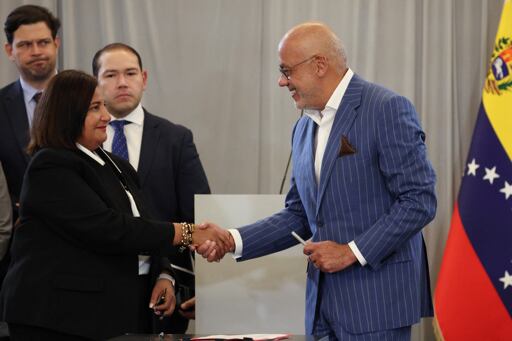
On Monday, the delegations of Venezuela’s national government and the opposition that were part of the 2015 National Assembly proposed the creation of a “grand national agreement with broad political, economic, and social guarantees that seeks to consolidate democratic coexistence, peace, and respect for the rights of political and socioeconomic participation established in the National Constitution.”
During the closing plenary of this fourth round of the dialogue table—which unfolded over seven sessions that began on November 13—the representatives of both sectors jointly read the consensus reached. The talks are headed by National Assembly President Jorge Rodríguez, representing the Venezuelan government, and by Dinorah Figuera, for the opposition delegation.
View this post on Instagram
They also agreed to begin updating the concessions for various media outlets, to review the administrative measures applied to subscription television, and to establish work plans to address the emergency caused by the double earthquake and to recover Venezuela’s gold that is being held in the United Kingdom.
Regarding Guayana Esequiba, the dialogue table reaffirmed its position of “firm and unwavering defense of our historical rights over Guayana Esequiba, the null and void character of the 1899 Paris arbitral award, and the validity of the 1966 Geneva Agreement as the only valid instrument for resolving the controversy.”
Among the core agreement points was the review and reform of a series of laws that includes the Constitutional Law against Hate, the Organic Law against Organized Crime and Financing of Terrorism, and the Political Parties Law.
Jorge Rodríguez announced that the table is joining the consultation process on the reform of the constitutional law against hate for peaceful coexistence and tolerance, with the aim of decriminalizing conduct, establishing clear definitions that resolve discretion in its implementation, and strengthening socio-educational and administrative measures, ensuring a structural shift from a punitive approach to a preventive and formative approach for democratic coexistence, peace, and cohabitation.
Regarding the reform of the law on political parties, public meetings, and demonstrations, emphasis was placed on the following actions: review of the status of organizations with political purposes, advancing a process of updating and revalidation according to each case of organizations with political purposes, updating the requirements for the formation of organizations with political purposes, and more. The creation of an ombudsman’s office to guarantee political participation was also proposed.
The process of reforming the organic law against organized crime and the financing of terrorism was also proposed, “focused mainly on definitions and classifications so that they are more precise and in line with international definitions, with the objective of being approved this year 2026,” according to the signed communiqué.
Both delegations noted the effective processing of nominations for the renewal of Supreme Court of Justice magistrates, the inspector general of courts, and the director of the magistrates’ school and highlighted the record of 1,343 people who applied.
Acting President of Venezuela Evaluates Cooperation with Antigua and Barbuda Prime Minister
At the end of the reading of the communiqué signed by both parties, the delegations announced that they will continue the work in a fifth round of negotiations scheduled for next December.
(Últimas Noticias) by Odry Farnetano
Translation: Orinoco Tribune
OT/JRE/SL
From Orinoco Tribune via This RSS Feed.